. 2022 Nov;119(44):e2210434119.
doi: 10.1073/pnas.2210434119. Epub 2022 Oct 25.

Phosphorylation of RXRα mediates the effect of JNK to suppress hepatic FGF21 expression and promote metabolic syndrome

Affiliations

Phosphorylation of RXRα mediates the effect of JNK to suppress hepatic FGF21 expression and promote metabolic syndrome

Santiago Vernia et al. Proc Natl Acad Sci U S A. 2022 Nov.

Abstract

The cJun NH2-terminal kinase (JNK) signaling pathway in the liver promotes systemic changes in metabolism by regulating peroxisome proliferator-activated receptor α (PPARα)-dependent expression of the hepatokine fibroblast growth factor 21 (FGF21). Hepatocyte-specific gene ablation studies demonstrated that the Mapk9 gene (encoding JNK2) plays a key mechanistic role. Mutually exclusive inclusion of exons 7a and 7b yields expression of the isoforms JNK2α and JNK2β. Here we demonstrate that Fgf21 gene expression and metabolic regulation are primarily regulated by the JNK2α isoform. To identify relevant substrates of JNK2α, we performed a quantitative phosphoproteomic study of livers isolated from control mice, mice with JNK deficiency in hepatocytes, and mice that express only JNK2α or JNK2β in hepatocytes. We identified the JNK substrate retinoid X receptor α (RXRα) as a protein that exhibited JNK2α-promoted phosphorylation in vivo. RXRα functions as a heterodimeric partner of PPARα and may therefore mediate the effects of JNK2α signaling on Fgf21 expression. To test this hypothesis, we established mice with hepatocyte-specific expression of wild-type or mutated RXRα proteins. We found that the RXRα phosphorylation site Ser260 was required for suppression of Fgf21 gene expression. Collectively, these data establish a JNK-mediated signaling pathway that regulates hepatic Fgf21 expression.

Keywords: FGF21; JNK; RXRα; high-fat diet; insulin resistance.


Conflict of interest statement

The authors declare no competing interest.

Figures
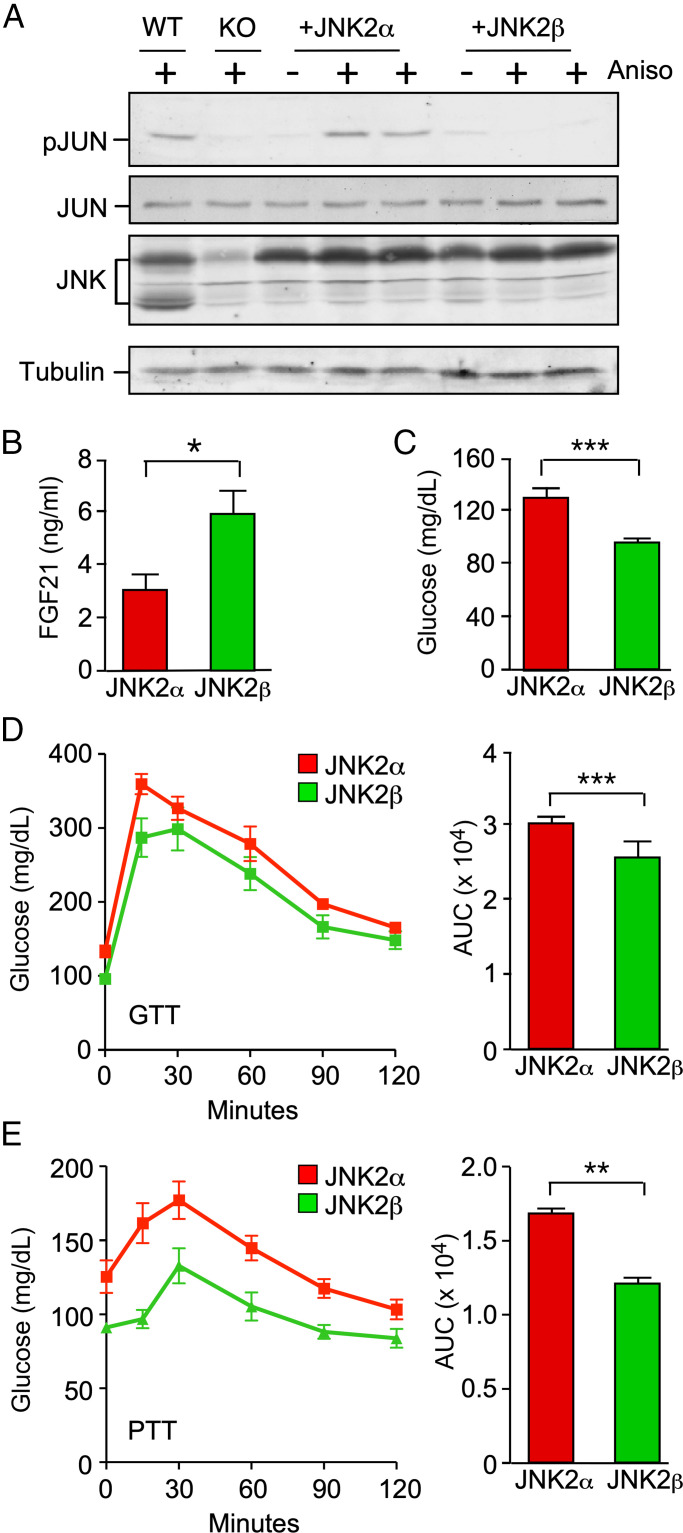
Fig. 1.
Fig. 1.
Complementation analysis demonstrates a selective role for hepatic JNK2α in the regulation of glycemia. (A) Primary hepatocytes prepared from wild-type (WT) mice (Alb-Cre−/+ Mapk8+/+ Mapk9+/+), knockout (KO) mice with hepatocyte-specific JNK1 plus JNK2 KO (Alb-Cre−/+ Mapk8loxP/loxP Mapk9loxP/loxP), and KO mice complemented with AAV-mediated expression of JNK2α or JNK2β were treated with 1 µg/mL anisomycin (Aniso) (15 min). Lysates were examined by immunoblot analysis by probing with antibodies to pSer63 JUN (pJUN), JUN, JNK, and α-tubulin. (B and C) Blood FGF21 and glucose concentration in HFD-fed mice (16 wk) expressing JNK2α or JNK2β in hepatocytes was measured (mean ± SEM; *P < 0.05, ***P < 0.001; n = 6∼8). (D and E) GTTs and PTTs on HFD-fed mice (16 wk) expressing JNK2α or JNK2β in hepatocytes were performed and the area under the curve (AUC) was measured (mean ± SEM; **P < 0.01, ***P < 0.001; n = 6∼8).
Fig. 2.
Fig. 2.
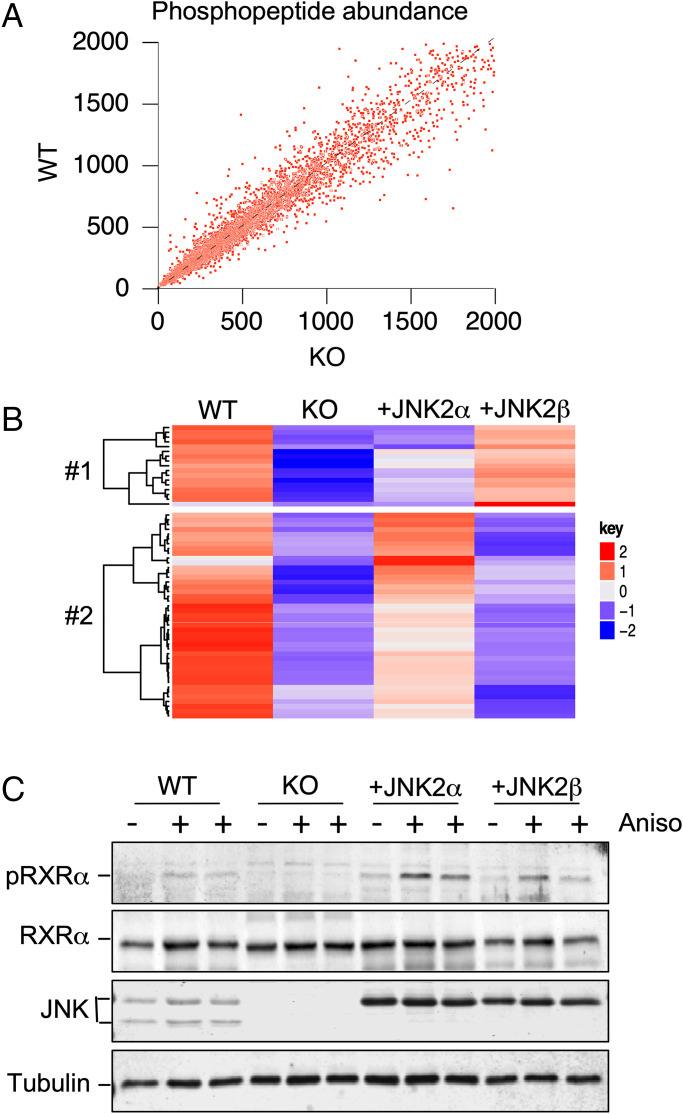
Phosphoproteomics analysis identifies JNK-dependent phosphorylation of RXRα. (A) Quantitative mass spectroscopy of multiplexed samples labeled with iTRAQ tags identified 8,955 phosphopeptides. The abundance of detected phosphopeptides in the liver of HFD-fed (16 wk) mice was examined. Data obtained from WT and hepatocyte-specific JNK1 plus JNK2 KO mice are presented. (B) Phosphorylation sites that conform to the MAPK consensus sequence (Ser-Pro and Thr-Pro) that are phosphorylated in WT liver and exhibit decreased phosphorylation in hepatocyte-specific JNK1 plus JNK2 KO liver that is partially complemented by AAV8-mediated expression of JNK2α or JNK2β are presented as a heatmap. (C) Primary hepatocytes were treated with 1 µg/mL anisomycin (Aniso, 15 min). Lysates were probed using antibodies to pSer22 RXRα (pRXRα), RXRα, JNK, and α-tubulin.
Fig. 3.
Fig. 3.
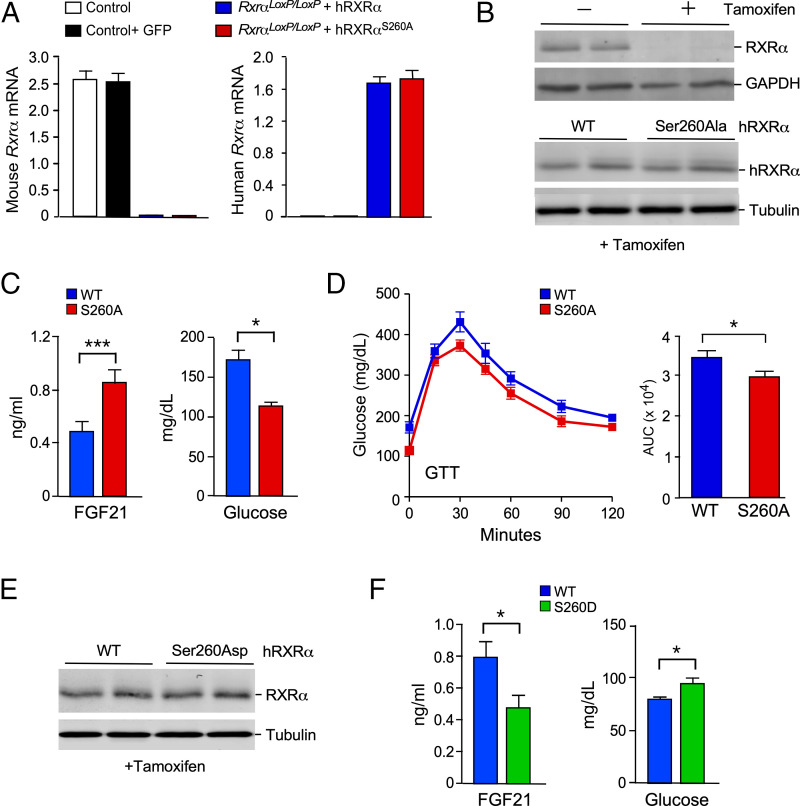
Hepatic hRXRα phosphorylation on Ser260 increases FGF21 signaling. (A) Control SA-CreERT2 mice and SA-CreERT2 RxraloxP/loxP mice (age 7 wk) were transduced with AAV8 viruses expressing green fluorescent protein (GFP), hRXRα, or Ser260Ala-hRXRα. The mice were treated without or with tamoxifen at age 8 wk, fed a HFD starting at age 10 wk, and euthanized at age 18 wk. Reverse transcriptase quantitative PCR (RT-qPCR) assays of murine liver to detected mouse and human Rxra mRNA are presented (mean ± SEM; n = 8∼10). (B) Lysates of murine liver were examined by immunoblot analysis by probing with antibodies to RXRα, glyceraldehyde-3-phosphate dehydrogenase (GAPDH), and α-tubulin. (C) Fasting blood FGF21 and glucose concentration in HFD-fed mice expressing hRXRα or Ser260Ala hRXRα in hepatocytes was measured (mean ± SEM; *P < 0.05, ***P < 0.001; n = 9∼10). (D) GTTs on HFD-fed mice expressing hRXRα or Ser260Ala hRXRα in hepatocytes were performed and the area under the curve (AUC) was measured (mean ± SEM; *P < 0.05; n = 7∼10). (E) CD-fed mice expressing WT hRXRα or Ser260Asp hRXRα were euthanized at age 18 wk. Immunoblot analysis of liver extracts was performed by probing with antibodies to RXRα and α-tubulin. (F) Fasting blood FGF21 and glucose concentration in CD-fed mice expressing hRXRα or Ser260Asp hRXRα in hepatocytes was measured (mean ± SEM; *P < 0.05; n = 9).
Fig. 4.
Fig. 4.
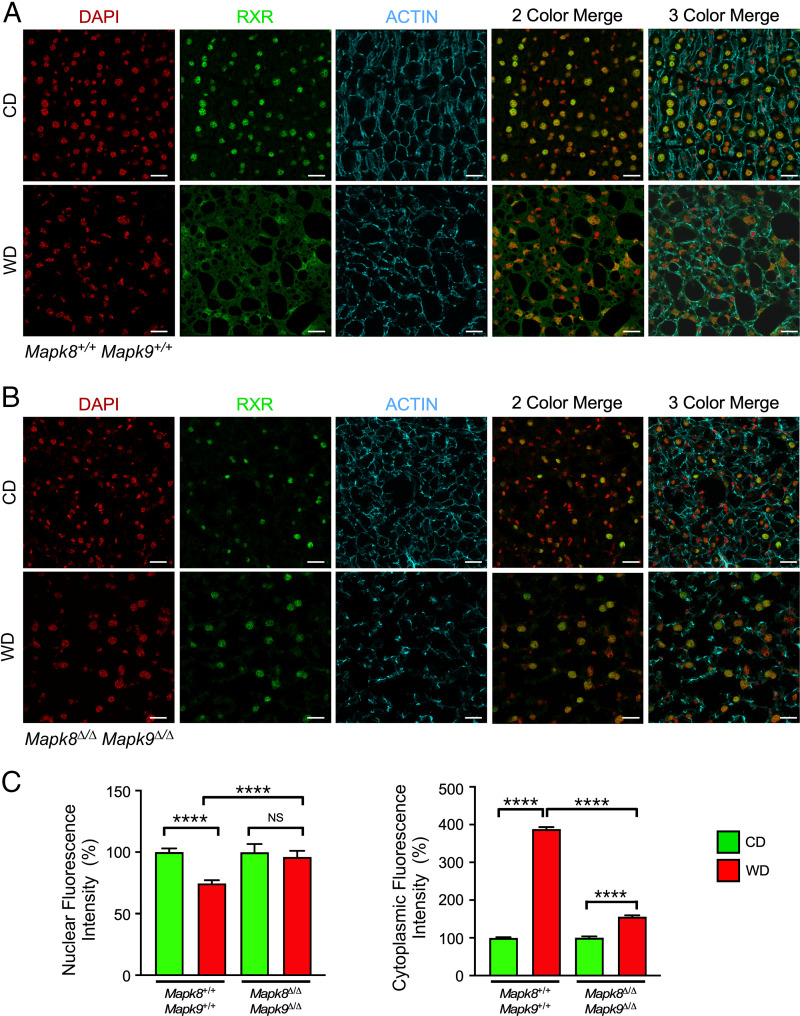
Dietary stress causes JNK-dependent cytoplasmic accumulation of RXRα. (A) WT mice and (B) Alb-Cre+/− Mapk8loxP/loxP Mapk9loxP/loxP mice (age 8 wk) were fed a CD or a WD (16 wk). Liver sections were stained with an antibody to RXRα. DNA was stained with DAPI, and actin was stained with phalloidin. The sections were examined using a Leica SP8 confocal microscope. Representative images are presented. Scale bar, 20 µm. (C) The nuclear and cytoplasmic RXRα immunofluorescence was quantitated and presented as fluorescence intensity (mean ± SEM; ****P < 0.0001; not significant (NS), P > 0.05; n = 19–42 cells).

References

    1. Sabio G., Davis R. J., cJun NH2-terminal kinase 1 (JNK1): Roles in metabolic regulation of insulin resistance. Trends Biochem. Sci. 35, 490–496 (2010). - PMC - PubMed
    1. Sabio G., et al. , Prevention of steatosis by hepatic JNK1. Cell Metab. 10, 491–498 (2009). - PMC - PubMed
    1. Vernia S., et al. , The PPARα-FGF21 hormone axis contributes to metabolic regulation by the hepatic JNK signaling pathway. Cell Metab. 20, 512–525 (2014). - PMC - PubMed
    1. Badman M. K., et al. , Hepatic fibroblast growth factor 21 is regulated by PPARalpha and is a key mediator of hepatic lipid metabolism in ketotic states. Cell Metab. 5, 426–437 (2007). - PubMed
    1. Inagaki T., et al. , Endocrine regulation of the fasting response by PPARalpha-mediated induction of fibroblast growth factor 21. Cell Metab. 5, 415–425 (2007). - PubMed

Publication types