


Surface Presentation of Hyaluronic Acid Modulates Nanoparticle-Cell Association
- PMID: 36282941
- PMCID: PMC9942780
- DOI: 10.1021/acs.bioconjchem.2c00412
Surface Presentation of Hyaluronic Acid Modulates Nanoparticle-Cell Association
Abstract
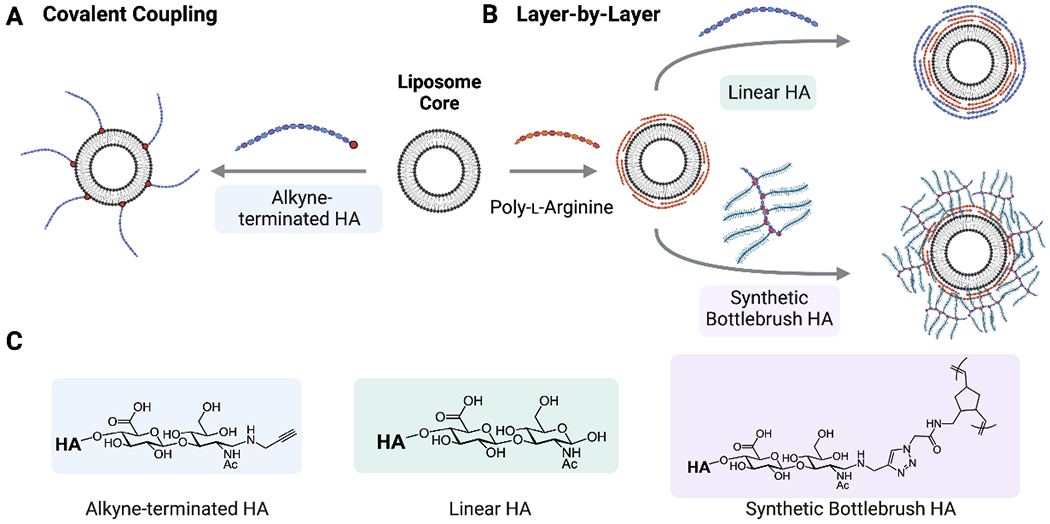
Nanoparticle (NP) drug carriers have revolutionized medicine and increased patient quality of life. Clinically approved formulations typically succeed because of reduced off-target toxicity of the cargo. However, increasing carrier accumulation at disease sites through precise targeting remains one of the biggest challenges in the field. Novel multivalent ligand presentations and self-assembled constructs can enhance cell association, but an inability to draw direct comparisons across formulations has hindered progress. Furthermore, how nanoparticle structure influences function often is unclear. In this report, we leverage the well-characterized hyaluronic acid (HA)-CD44 binding pair to investigate how the surface architecture of modified NPs impacts their association with ovarian cancer cells that overexpress CD44. We functionalized anionic liposomes with 5 kDa HA by either covalent conjugation via surface coupling or electrostatic self-assembly using the layer-by-layer (LbL) adsorption method. Comparing these two methods, we observed a consistent enhancement of NP-cell association with the self-assembly LbL technique, particularly with higher molecular weight (≥10 kDa) HA. To further optimize association, we increased the surface-available HA. We synthesized a bottlebrush glycopolymer composed of a polynorbornene backbone and pendant 5 kDa HA and layered this macromolecule onto NPs. Flow cytometry revealed that the LbL HA bottlebrush NP outperformed the LbL linear display of HA. Cellular visualization by deconvolution optical microscopy corroborated results from all three constructs. Using exogenous HA to block NP-CD44 interactions, we found the LbL HA bottlebrush NP had a 4-fold higher binding avidity than the best-performing LbL linear HA NP. We further observed that decreasing the density of HA bottlebrush side chains to 75% had minimal impact on LbL NP stability or cell association, though we did see a reduction in binding avidity with this side-chain-modified NP. Our studies indicate that LbL surfaces are highly effective for multivalent displays, and the mode in which they present a targeting ligand can be optimized for NP cell targeting.
Figures


References
-
- Bangham AD; Standish MM; Watkins JC, Diffusion of univalent ions across the lamellae of swollen phospholipids. J. Mol. Bio 1965, 13 (1), 238–IN27. - PubMed
-
- Allen TM; Cullis PR, Liposomal drug delivery systems: From concept to clinical applications. Adv. Drug Deliver. Rev 2013, 65 (1), 36–48. - PubMed
-
- Meyerhoff A, U.S. Food and Drug Administration Approval of AmBisome (Liposomal Amphotericin B) for Treatment of Visceral Leishmaniasis. Clin. Infect. Dis 1999, 28 (1), 42–48. - PubMed
-
- Drug Approval Package: Arikayce Services, U. S. D. o. H. H., Ed. U.S. Food & Drug Administration: Silver Spring, MD, 2019.
-
- Barenholz Y, Doxil® — The first FDA-approved nano-drug: Lessons learned. J. Control. Release 2012, 160 (2), 117–134. - PubMed
Publication types
MeSH terms
Substances
Grants and funding
LinkOut - more resources
Full Text Sources
Miscellaneous
