


A Systematic Review of the Current Evidence from Randomised Controlled Trials on the Impact of Medication Optimisation or Pharmacological Interventions on Quantitative Measures of Cognitive Function in Geriatric Patients
- PMID: 36284081
- PMCID: PMC9626423
- DOI: 10.1007/s40266-022-00980-9
A Systematic Review of the Current Evidence from Randomised Controlled Trials on the Impact of Medication Optimisation or Pharmacological Interventions on Quantitative Measures of Cognitive Function in Geriatric Patients
Abstract
Background: Cognitive decline is common in older people. Numerous studies point to the detrimental impact of polypharmacy and inappropriate medication on older people's cognitive function. Here we aim to systematically review evidence on the impact of medication optimisation and drug interventions on cognitive function in older adults.
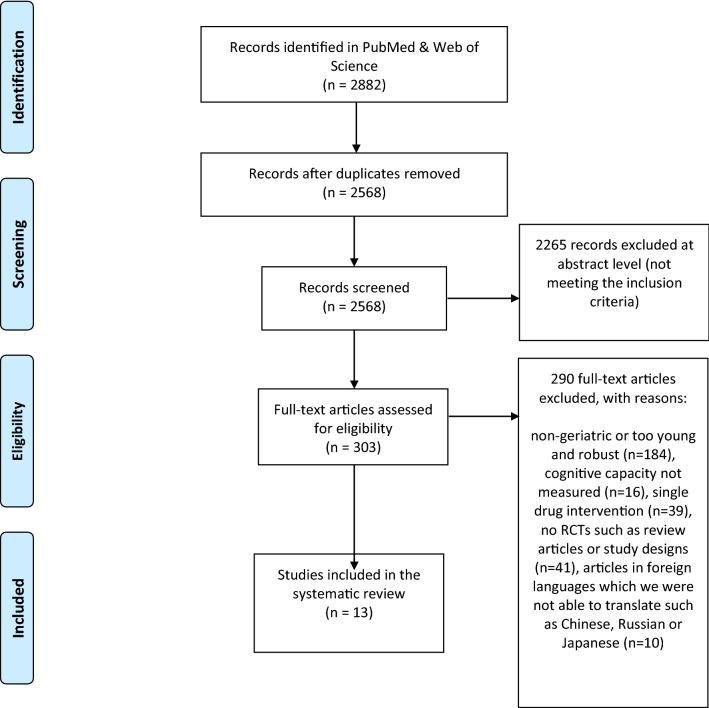
Methods: A systematic review was performed using MEDLINE and Web of Science on May 2021. Only randomised controlled trials (RCTs) addressing the impact of medication optimisation or pharmacological interventions on quantitative measures of cognitive function in older adults (aged > 65 years) were included. Single-drug interventions (e.g., on drugs for dementia) were excluded. The quality of the studies was assessed by using the Jadad score.
Results: Thirteen studies met the inclusion criteria. In five studies a positive impact of the intervention on metric measures of cognitive function was observed. Only one study showed a significant improvement of cognitive function by medication optimisation. The remaining four positive studies tested methylphenidate, selective oestrogen receptor modulators, folic acid and antipsychotics. The mean Jadad score was low (2.7).
Conclusion: This systematic review identified a small number of heterogenous RCTs investigating the impact of medication optimisation or pharmacological interventions on cognitive function. Five trials showed a positive impact on at least one aspect of cognitive function, with comprehensive medication optimisation not being more successful than focused drug interventions. More prospective trials are needed to specifically assess ways of limiting the negative impact of certain medication in particular and polypharmacy in general on cognitive function in older patients.
© 2022. The Author(s).
Conflict of interest statement
MW was employed by AstraZeneca R&D, Mölndal, as director of discovery medicine (translational medicine) from 2003 to 2006, while on sabbatical leave from his professorship at the University of Heidelberg. Since returning to this position in January 2007, he has received lecturing and consulting fees from Bristol Myers, Bayer, Boehringer-Ingelheim, LEO, Mundipharma, Novartis, Pfizer, Polyphor, Helsinn, Allergan, Allecra, Novo-Nordisk, Heel, AstraZeneca, Roche, Santhera, Sanofi-Aventis, Shire, Berlin-Chemie und Daichii-Sankyo. FP, MP, KI, GZ, ANP, KWT, BS, AG, WK, CR, AC, HB, MD, DOM, HG, MAF, TJMC, PC, JS, AM, ACJ, NVV, MSB, JASR, GS and RM have no COIs to declare.
Figures
References
Publication types
MeSH terms
Substances
LinkOut - more resources
Full Text Sources
Medical
Miscellaneous
