. 2022 Oct 25;13(1):6160.
doi: 10.1038/s41467-022-33627-9.

Global mortality of snakebite envenoming between 1990 and 2019

Collaborators

Global mortality of snakebite envenoming between 1990 and 2019

GBD 2019 Snakebite Envenomation Collaborators. Nat Commun. .

Abstract

Snakebite envenoming is an important cause of preventable death. The World Health Organization (WHO) set a goal to halve snakebite mortality by 2030. We used verbal autopsy and vital registration data to model the proportion of venomous animal deaths due to snakes by location, age, year, and sex, and applied these proportions to venomous animal contact mortality estimates from the Global Burden of Disease 2019 study. In 2019, 63,400 people (95% uncertainty interval 38,900-78,600) died globally from snakebites, which was equal to an age-standardized mortality rate (ASMR) of 0.8 deaths (0.5-1.0) per 100,000 and represents a 36% (2-49) decrease in ASMR since 1990. India had the greatest number of deaths in 2019, equal to an ASMR of 4.0 per 100,000 (2.3-5.0). We forecast mortality will continue to decline, but not sufficiently to meet WHO's goals. Improved data collection should be prioritized to help target interventions, improve burden estimation, and monitor progress.


Conflict of interest statement

The authors declare no competing interests.

Figures
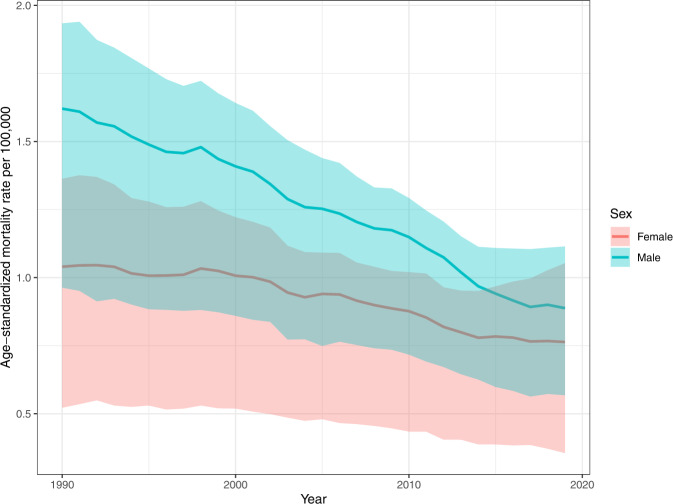
Fig. 1
Fig. 1. Global age-standardized mortality rate of snakebite envenoming in males and females from 1990 to 2019.
The upper and lower estimates of the 95% uncertainty interval are represented by the error bands around the mean estimate. Source data are provided as a Source Data file.
Fig. 2
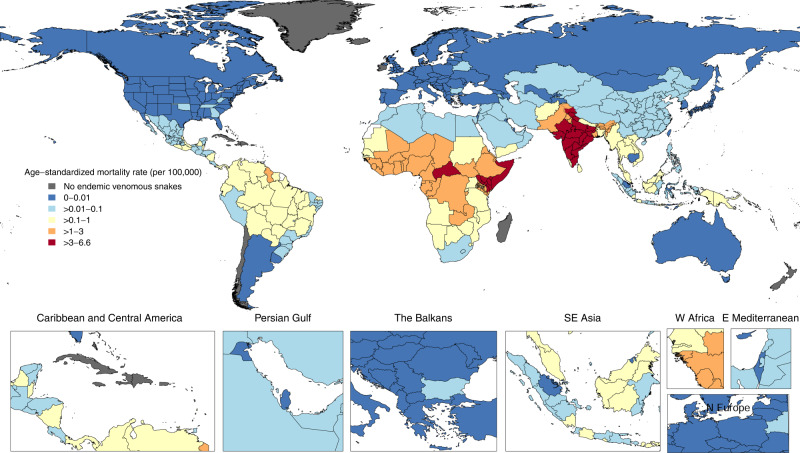
Fig. 2. Age-standardized mortality rate of snakebite envenoming in 2019 across 204 countries and territories.
Age-standardized snakebite envenoming mortality rates across both sexes combined in 2019. GBD 2019 did not publish state-level estimates for China, so each state is colored based on China’s national estimate. The endemic habitat of venomous snakes of medical importance was queried from the WHO Snakebite Information and Data Platform. Source data are provided as a Source Data file.
Fig. 3
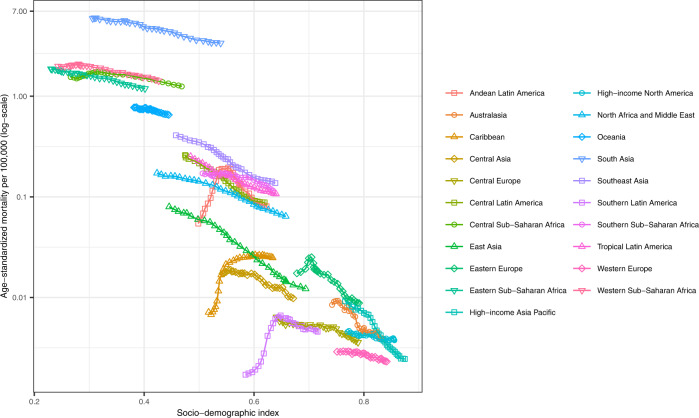
Fig. 3. Regional age-standardized mortality rate from snakebite envenoming from 1990 to 2019 by Socio-demographic Index value of the region.
Age-standardized snakebite envenoming mortality rate per 100,000 by region and Socio-demographic Index. Each point represents the age-standardized mortality in a given year from 1990 to 2019 in the region. Y-axis is on log scale. Source data are provided as a Source Data file.
Fig. 4
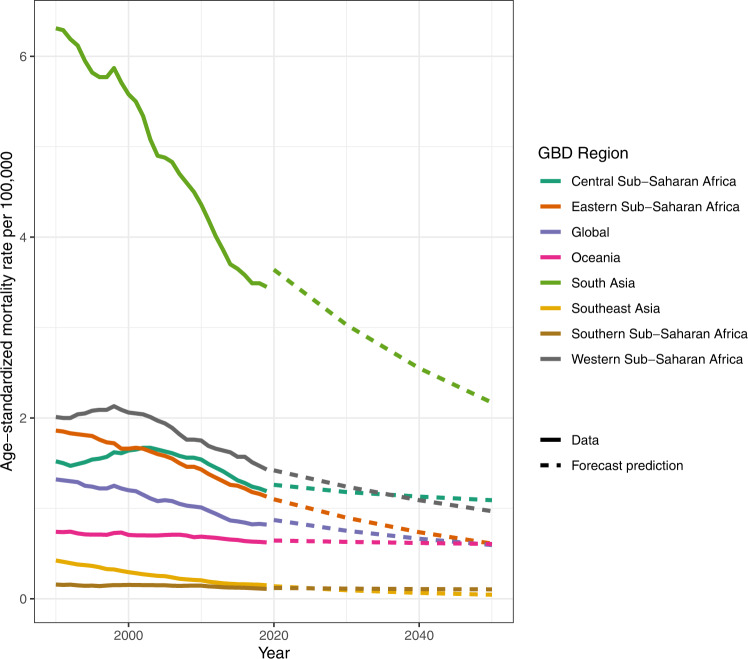
Fig. 4. Global and regional age-standardized snakebite envenoming mortality rate from 1990 to 2019 with forecasting to 2050 of the seven regions with the highest snakebite envenoming burden.
Age-standardized snakebite envenoming mortality rate per 100,000 by region and year, forecasted to 2050. The plot shows the top seven regions in terms of age-standardized rates in 2019, all of which had age-standardized mortality rates greater than 0.1 per 100,000. Lines in bold are the snakebite envenoming estimates from the primary statistical analysis pipeline, while dotted lines are the predictions from the forecast regression. No steps were made to align GBD 2019 cause-specific mortality rate estimates with the predicted forecast from 2020, and predictions are made based on the average annualized rate of change from 1990 to 2019 and the age-sex demographic composition of each region. Source data are provided as a Source Data file.
Fig. 5
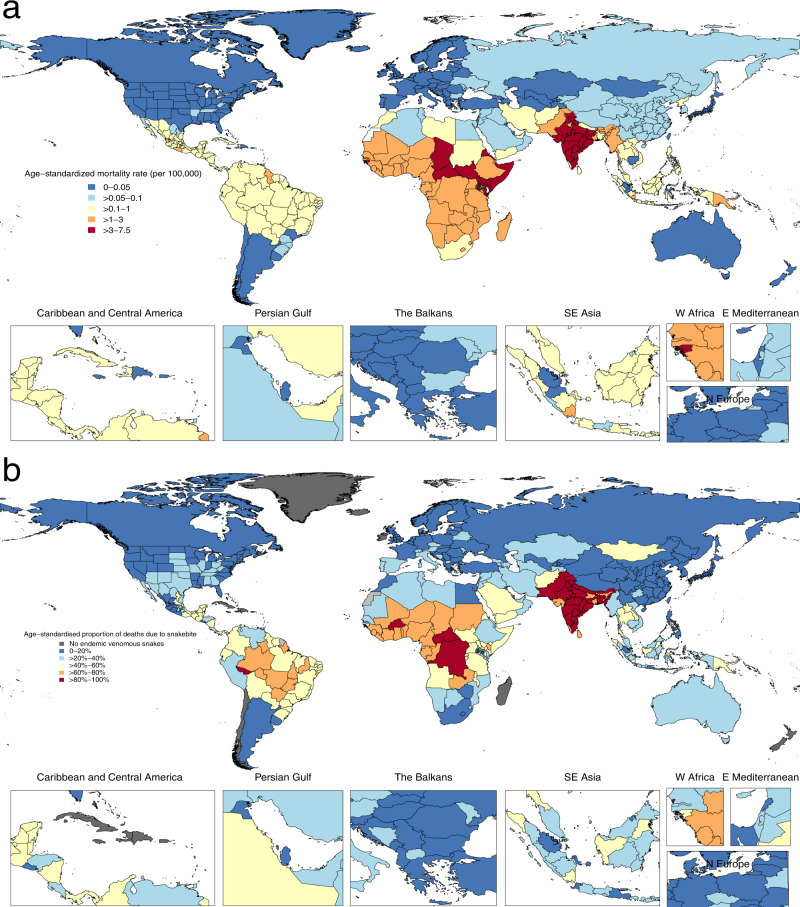
Fig. 5. Age-standardized mortality rate from all venomous animal contact and the age-standardized proportion due specifically to snakebite envenoming.
a GBD 2019 estimates of the age-standardized mortality rate from venomous animal contact for both sexes combined in 2019. b Estimated age-standardized proportion of all venomous animal contact deaths due to only snakebites in 2019. GBD 2019 did not publish state-level estimates for China, and each state is colored based on China’s national estimate. The endemic habitats of venomous snakes of medical importance was queried from the WHO Snakebite Information and Data Platform.

References

    1. Gutiérrez JM, et al. Snakebite envenoming. Nat. Rev. Dis. Prim. 2017;3:17063. doi: 10.1038/nrdp.2017.63. - DOI - PubMed
    1. Chippaux J-P. Snakebite envenomation turns again into a neglected tropical disease! J. Venom. Anim. Toxins Incl. Trop. Dis. 2017;23:38. doi: 10.1186/s40409-017-0127-6. - DOI - PMC - PubMed
    1. Bagcchi, S. Experts call for snakebite to be re-established as a neglected tropical disease. BMJ.351, h5313 (2015). - PubMed
    1. World Health Organization. Snakebite envenoming: a strategy for prevention and control (2019). - PubMed
    1. Chippaux JP. Snake-bites: appraisal of the global situation. Bull. World Health Organ. 1998;76:515–524. - PMC - PubMed

Publication types