


Cost-effectiveness models for Alzheimer's disease and related dementias: IPECAD modeling workshop cross-comparison challenge
- PMID: 36284403
- PMCID: PMC10126209
- DOI: 10.1002/alz.12811
Cost-effectiveness models for Alzheimer's disease and related dementias: IPECAD modeling workshop cross-comparison challenge
Abstract
Introduction: The credibility of model-based economic evaluations of Alzheimer's disease (AD) interventions is central to appropriate decision-making in a policy context. We report on the International PharmacoEconomic Collaboration on Alzheimer's Disease (IPECAD) Modeling Workshop Challenge.
Methods: Two common benchmark scenarios, for the hypothetical treatment of AD mild cognitive impairment (MCI) and mild dementia, were developed jointly by 29 participants. Model outcomes were summarized, and cross-comparisons were discussed during a structured workshop.
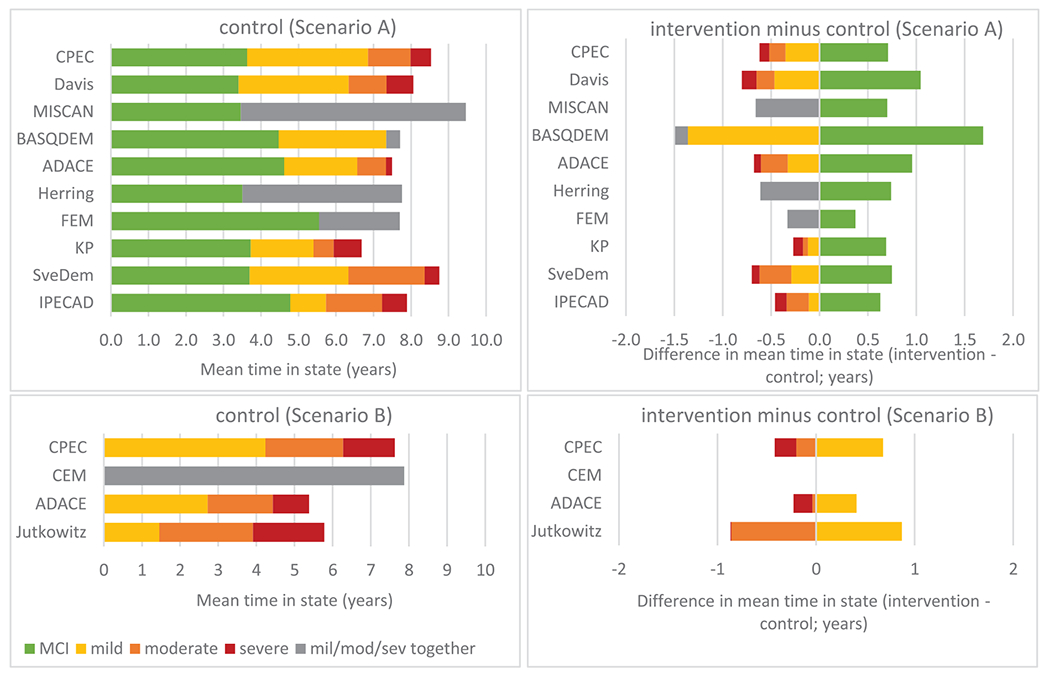
Results: A broad concordance was established among participants. Mean 10-year restricted survival and time in MCI in the control group ranged across 10 MCI models from 6.7 to 9.5 years and 3.4 to 5.6 years, respectively; and across 4 mild dementia models from 5.4 to 7.9 years (survival) and 1.5 to 4.2 years (mild dementia).
Discussion: The model comparison increased our understanding of methods, data used, and disease progression. We established a collaboration framework to assess cost-effectiveness outcomes, an important step toward transparent and credible AD models.
Keywords: Alzheimer's disease; cross-comparison; decision-analytic modeling; dementia; economic evaluation; model validation.
© 2022 The Authors. Alzheimer's & Dementia published by Wiley Periodicals LLC on behalf of Alzheimer's Association.
Conflict of interest statement
A.G.: Anders Gustavsson is a partner of Quantify Research, providing consultancy services to pharmaceutical companies and other private and public organizations and institutions. A.G. reports the following in the past 3 years outside this work: stock or stock options in Mindmore AB. A.K.: From January 2021 Andreas Karlsson has been a full-time employee of Swedbank, Sweden. A.S.: Anders Sköldunger reports no conflicts of interest. A.T.: Ali Tafazzoli is an employee of Evidera, which provides consulting and other research services to pharmaceutical, medical device, and related organizations. Data collection and sharing for Alzheimer’s Disease Archimedes condition event simulator (ADACE) was funded in part by the Alzheimer’s Disease Neuroimaging Initiative (ADNI) (National Institutes of Health Grant U01 AG024904) and DOD ADNI (Department of Defense award number W81XWH-12-2-0012). Jorgen Moller and Weicheng Ye contributed to the design of the workshop scenarios. A.W.: Anders Wimo reports the following to conduct this study: grants from ELI-LILLY European Union Innovative Medicines Initiative 2 (IMI2) project grant. Anders Wimo reports the following outside this study: consulting fees from Biogen, consulting fees from EISAI, grants from MSD (research grant, payment to my institution – Karolinska Institutet, Sweden), grants from World Health Organization (WHO) (payment to my institution – Karolinska Institutet, Sweden), grants from Swedish Government – Swedish Study on Aging and Care (SNAC) project (payment to my institution – Karolinska Institutet, Sweden), grants from H2020 EU project Alzheimer’s Disease Archimedes condition event simulator (PRODEMOS): (payment to my institution - Karolinska Institutet, Sweden), grants from Merck; license/royalty from Resource Use in Dementia (RUD) Instrument. SveDem is supported by the Swedish Associations of Local Authorities and Regions, the Swedish Research Council (grant # 2016-02317), FORTE (grant# 2017-0164),Svenska Sällskapet för Medicinsk Forskning, the Swedish Order of St John, the Swedish Stroke Association, and grants from the Regional Agreement on Medical Training and Clinical Research (ALF) between Stockholm County Council and Karolinska Institutet. B.T.: The contributions of Bryan Tysinger and Jakub Hlávka were supported by the National Institute on Aging of the National Institutes of Health under Award Numbers R01AG062277, P30AG024968, and P30AG066589. The content is solely the responsibility of the authors and does not necessarily represent the official views of the National Institutes of Health. B.T. reports the following in the past 3 years outside the submitted work: participation in the International Microsimulation Association (no payments are involved). B.W.: Bengt Winblad was supported by grant from the Swedish Research Council (2018-02843) and Margaretha af Ugglas’ foundation. B.W. reports participation in SAB for Alzhemed, Axon Neuroscience, Biogen, and Resverlogix. B.W. reports no conflicts of interest. C.B.: Chiara Brück is supported by funding from the Dutch Research Council (grant number 016.Veni.198.020). Chiara Brück reports no competing interest. C.G.: From November 2020 Colin Green has been a full-time employee of Biogen Idec, United Kingdom (UK). C.G. reports the following in the past 3 years outside this study: grants from Institutional funding/grant – To University of Exeter, UK – from the UK Multiple Sclerosis Society, through their open competitive grant funding scheme; consulting fees from payments from Shift Health (Canada) for methods advice on research related to Huntington’s disease; support for attending meetings and/or travel from Gates Foundation for travel/accommodation expenses to attend Expert Advisory Committee Meeting on Alzheimers Disease. E.J.: Dr. Jutkowitz is supported by grants from the National Institute on Aging (1R21AG059623, 1R01AG060871, RF1AG069771). E.J. reports the following in the past 3 years outside this study: Grants to my institution (1R21AG059623, 1R01AG060871, and RF1AG069771) and funding from the Veterans Affairs (VA) National Center on Homelessness Among Veterans; participation in Data Safety Monitoring Board for a National Institute on Aging study awarded to the Indiana University School of Nursing. E.S.: Eldon Spackman reports no competing interest. E.S. reports the following in the past 3 years outside this work: grants from Canadian Institute of Health Research (payment to institution), Alberta Health Services (payment to institution); Alberta Innovates (payment to institution); consulting fees from Canadian Agency for Drugs and Technologies in Health – payment to me Institute for Clinical and Economic Review (payment to me); participation in data safety advisory board GSK (fees payment to me). J.H.: The contributions of Bryan Tysinger and Jakub Hlavka were supported by the National Institute on Aging of the National Institutes of Health under Award Numbers R01AG062277, P30AG024968, and P30AG066589. The content is solely the responsibility of the authors and does not necessarily represent the official views of the National Institutes of Health. In the past 3 years, J.P.H. has received speaker fees from FTI Consulting and Alzheimer Foundation Czech Republic. J.M.: Basque dementia model project was supported by an unrestricted grant from Nutricia. J.M. reports the following in the past 3 years outside this work: Member of the Board of Spanish Public Health Society. L.J.: Linus Jönsson is an employee of H. Lundbeck A/S, Valby, Denmark, a pharmaceutical company that develops and markets treatments for Alzheimer’s disease and other conditions. L.J. Linus Jönsson reports the following in the past 3 years outside the submitted work: grants from FORTE (research Grant to Karolinska Institutet); license/royalty from Resource Use in Dementia (RUD) instrument license fees (to own company EPS AB); honoraria for lecture Karolinska Institutet Biogen AB (paid to me); board membership of Institute for Health Economics Bengt Jönssons foundation for Health economics research. M.B.: Mark Belger is an employee and minor shareholder in Eli Lilly. M.L.M.: Mauricio Lopez Mendez reports no competing interest. P.L.: Pei-Jung Lin is supported by a grant from the National Institutes of Health (R01AG060165). P.L. Pei-Jung Lin reports the following in the last 3 years outside this work: Research funding support from Alzheimer’s Association, Genentech, and Janssen to Tufts Medical Center. P.S.: Peter Shewmaker reports no competing interest. R.A.: Care Policy Evaluation Centre (CPEC) study was funded by Alzheimer’s Research UK. Robert Anderson reports the following in the past 3 years to conduct this study: payments from Care Policy Evaluation Centre, London School of Economics. R.A. reports the following in the past 3 years outside this study: payments from Nuffield Department of Primary Care Health Sciences, University of Oxford. R.E.: Development of an earlier version of the DAVIS model was supported by funding from Takeda Pharmaceuticals International; no funding was provided for the adaptation presented here. R.H.: Ron Handels reports the following to conduct the study: financial support from the Dutch Alzheimer’s Association, ‘Alzheimer Nederland’, grant number WE.15-2016-09. The funding bodies had no role in the design of the analysis, interpretation of data, and in writing the manuscript. R.H. reports the following in the past 3 years outside this study: consulting fees from Biogen, Eisai, and Erasmus University Rotterdam; public and private-public grants from international frameworks (H2020, Joint Programming Neurodegenerative Diseases (JPND), IMI), national frameworks (Netherlands: ZonMw; Sweden: SNAC and SveDem), and patient organizations (Alzheimer Netherlands). W.H.: William L Herring is an employee of RTI Health Solutions (RTI-HS), an independent nonprofit research organization. Model development and workshop participation were funded in part through research contracts with Janssen Global Services, LLC and Janssen Scientific Affairs, LLC. Josephine Mauskopf of RTI-HS and Alex Keenan and Frank Wiegand of Janssen Global Services, LLC contributed to the model development. Cheryl Neslusan of Janssen Scientific Affairs, LLC contributed to the design of the workshop scenarios. Author disclosures are available in the supporting information.
Figures
References
Publication types
MeSH terms
Grants and funding
LinkOut - more resources
Full Text Sources
Medical
