. 2020 Nov 25;1(1):ltaa008.
doi: 10.1093/immadv/ltaa008. eCollection 2021 Jan.

Vitamin D3 replacement enhances antigen-specific immunity in older adults

Affiliations

Vitamin D3 replacement enhances antigen-specific immunity in older adults

Emma S Chambers et al. Immunother Adv. .

Abstract

Introduction: Ageing is associated with increased number of infections, decreased vaccine efficacy and increased systemic inflammation termed inflammageing. These changes are reflected by reduced recall responses to varicella zoster virus (VZV) challenge in the skin of older adults. Vitamin D deficiency is more common in the old and has been associated with frailty and increased inflammation. In addition, vitamin D increases immunoregulatory mechanisms and therefore has the potential to inhibit inflammageing.

Objectives: We investigated the use of vitamin D3 replacement to enhance cutaneous antigen-specific immunity in older adults (≥65 years).

Methods: Vitamin D insufficient older adults (n = 18) were administered 6400IU of vitamin D3/day orally for 14 weeks. Antigen-specific immunity to VZV was assessed by clinical score assessment of the injection site and transcriptional analysis of skin biopsies collected from challenged injection sites pre- and post-vitamin D3 replacement.

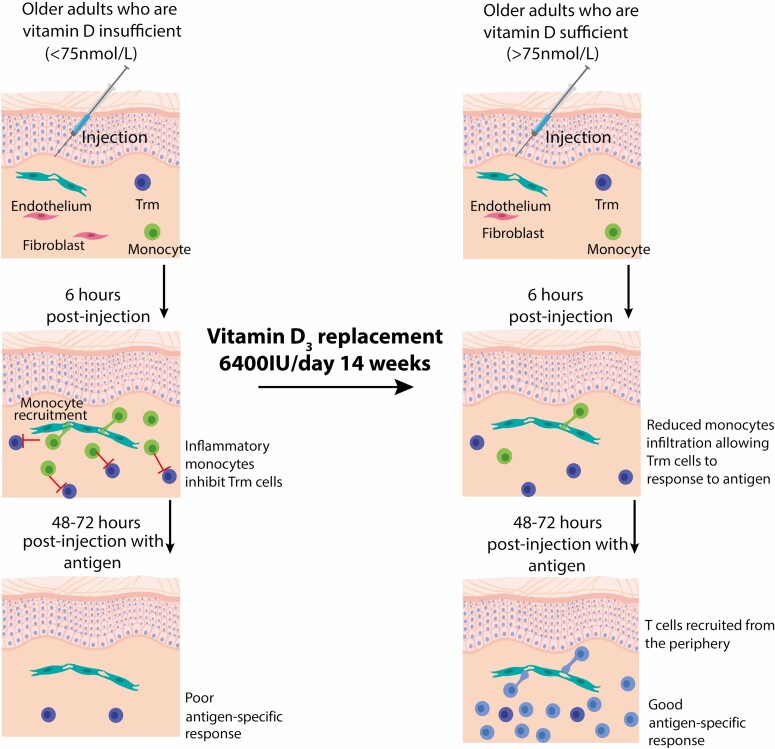
Results: We showed that older adults had reduced VZV-specific cutaneous immune response and increased non-specific inflammation as compared to young. Increased non-specific inflammation observed in the skin of older adults negatively correlated with vitamin D sufficiency. We showed that vitamin D3 supplementation significantly increased the response to cutaneous VZV antigen challenge in older adults. This enhancement was associated with a reduction in inflammatory monocyte infiltration with a concomitant enhancement of T cell recruitment to the site of antigen challenge in the skin.

Conclusion: Vitamin D3 replacement can boost antigen-specific immunity in older adults with sub-optimal vitamin D status.

Keywords: ageing; skin; varicella zoster virus; vitamin D.


Figures

Graphical Abstract
Graphical Abstract
Figure 1.
Figure 1.
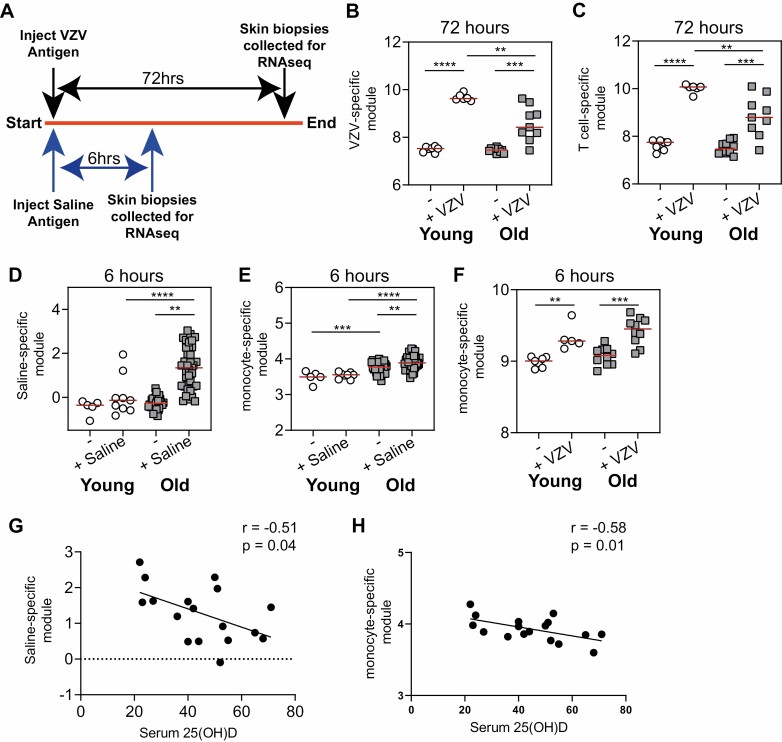
Decreased cutaneous immunity with age correlates with vitamin D insufficiency. (A) study schematic, young (white) and old (grey) individuals were injected with either antigen or saline and biopsies were collected at specified time points and RNAseq or microarray analysis was performed. Samples were compared to normal [unmanipulated; - (young n = 5 and old n = 32)] skin. (B) Antigen-specific gene module was generated and (C) T cell-specific gene module in VZV-injected skin (72 hours post-injection; young n = 6 and young n = 9). (D) saline-specific gene module and (E) monocyte-specific gene module in saline injected skin (6 hours post-injection; young n = 9 and old n = 37). (F) Monocyte-specific gene module in VZV injected skin (6 hours post-injection; young n = 6 and young n = 9). (G) Saline-specific module and (H) monocyte-specific module in saline-injected skin from old donors was correlated with serum 25(OH)D concentrations (nmol/l). B–F were analysed with an unpaired t test and G and H were analysed by a Pearson correlation test. **P < 0.01; ***P < 0.001; ****P < 0.0001.
Figure 2.
Figure 2.
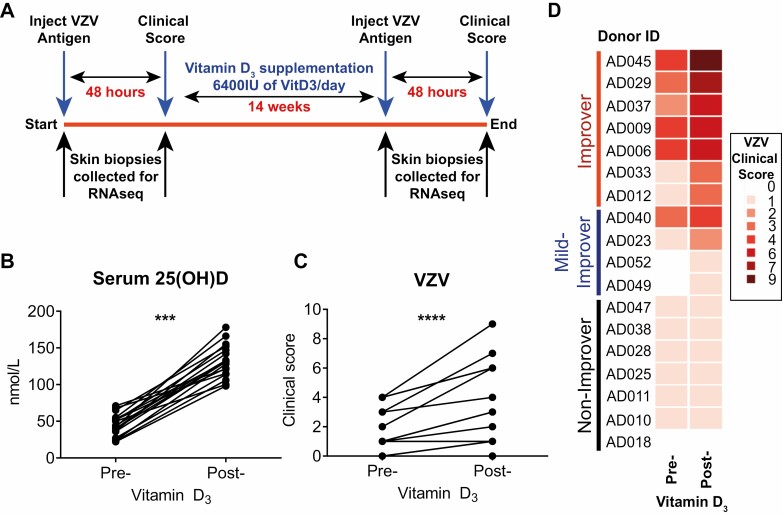
Vitamin D3 supplementation significantly improves VZV-specific cutaneous immunity. (A) Clinical study schematic. (B) Serum 25(OH)D concentrations and C and D, VZV clinical scores in older adults pre- and post-supplementation (n = 18). B and C were analysed with a paired t test. ***P < 0.001; ****P < 0.0001.
Figure 3.
Figure 3.
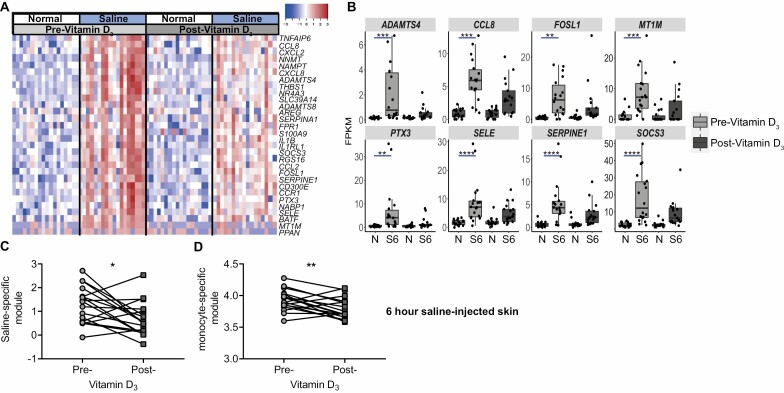
Vitamin D3 supplementation is associated with reduced inflammatory monocyte recruitment in response to saline. (A) RNAseq analysis of 3 mm biopsies collected from normal and saline-injected skin (6 hours post-injection) pre- and post-vitamin D3 supplementation. The top 30 genes upregulated in saline-injected skin as compared to normal skin before pre-Vitamin D3 and (B) dot plots of top eight upregulated saline-associated genes pre-vitamin D3. (C) Saline-specific module and (D) monocyte-specific module in saline-injected skin pre- and post-vitamin D3 supplementation (n = 17). B, analysed by C and D, analysed with a Wilcoxon-matched paired test. *P < 0.05; **P < 0.01; ***P < 0.001; ****P < 0.0001.
Figure 4.
Figure 4.
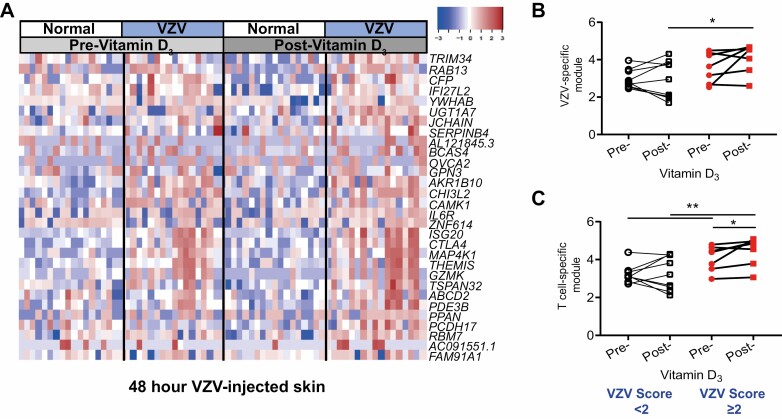
Vitamin D3 supplementation increases the accumulation of T cells at the site of VZV challenge. (A) RNAseq analysis of 3 mm biopsies collected from normal and VZV-injected skin (48 hours post-injection) pre- and post-vitamin D. The top 30 genes upregulated in VZV injected skin as compared to normal skin before post-Vitamin D3 (n = 16). (B) VZV-specific module and (C) T cell specific module in VZV-injected skin pre- and post-vitamin D3 supplementation separated based upon improvement in VZV score change of <2 (white; n = 9) and change ≥2 (red; n = 7). Paired data were analysed using a Wilcoxon-matched paired test and unpaired data with Mann–Whitney test. *P < 0.05; **P < 0.01.

References

    1. Gavazzi G, Krause KH. Ageing and infection. Lancet Infect Dis 2002;2:659–66. 10.1016/s1473-3099(02)00437-1 - DOI - PubMed
    1. Diffey BL, Langtry JA. Skin cancer incidence and the ageing population. Br J Dermatol 2005;153:679–80. 10.1111/j.1365-2133.2005.06799.x - DOI - PubMed
    1. Ciabattini A, Nardini C, Santoro F et al. Vaccination in the elderly: The challenge of immune changes with aging. Semin Immunol 2018;40:83–94. 10.1016/j.smim.2018.10.010 - DOI - PubMed
    1. Franceschi C, Garagnani P, Vitale G et al. Inflammaging and ‘Garb-aging’. Trends Endocrinol Metab 2017;28:199–212. 10.1016/j.tem.2016.09.005 - DOI - PubMed
    1. Furman D, Chang J, Lartigue L et al. Expression of specific inflammasome gene modules stratifies older individuals into two extreme clinical and immunological states. Nat Med 2017;23:174–84. 10.1038/nm.4267 - DOI - PMC - PubMed