Review
. 2022 Oct 28;8(43):eabn1702.
doi: 10.1126/sciadv.abn1702. Epub 2022 Oct 26.

Beyond autophagy: LC3-associated phagocytosis and endocytosis

Affiliations
Review

Beyond autophagy: LC3-associated phagocytosis and endocytosis

Carolina Peña-Martinez et al. Sci Adv. .

Abstract

Noncanonical functions of the autophagy machinery in pathways including LC3-associated phagocytosis and LC3-associated endocytosis have garnered increasing interest in both normal physiology and pathobiology. New discoveries over the past decade of noncanonical uses of the autophagy machinery in these distinct molecular mechanisms have led to robust investigation into the roles of single-membrane LC3 lipidation. Noncanonical autophagy pathways have now been implicated in the regulation of multiple processes ranging from debris clearance, cellular signaling, and immune regulation and inflammation. Accumulating evidence is demonstrating roles in a variety of disease states including host-pathogen responses, autoimmunity, cancer, and neurological and neurodegenerative pathologies. Here, we broadly summarize the differences in the mechanistic regulation between autophagy and LAP and LANDO and highlight some of the key roles of LAP and LANDO in innate immune function, inflammation, and disease pathology.


Figures
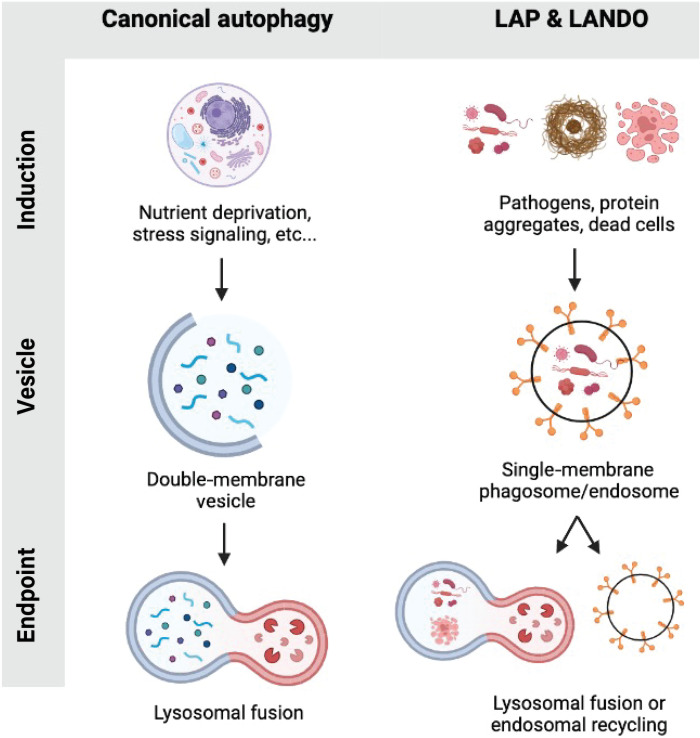
Fig. 1.
Fig. 1.. Comparison of canonical autophagy and LAP and LANDO.
Graphical overview of select activation stimuli, vesicle dynamics, and pathway endpoint (lysosomal fusion or recycling) are illustrated.
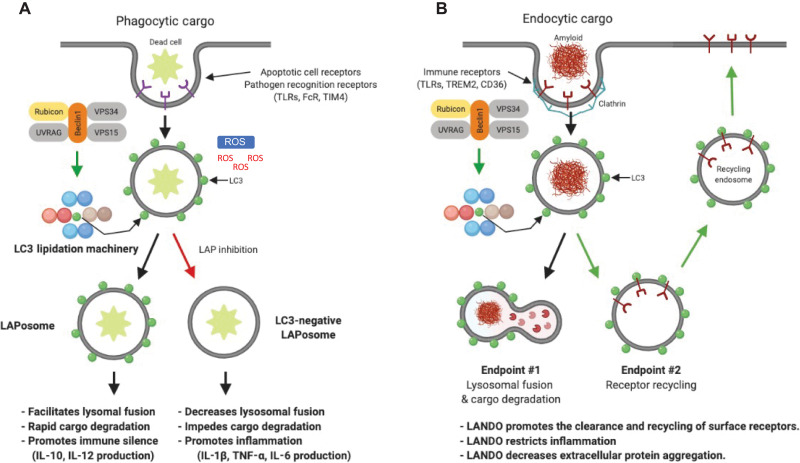
Fig. 2.
Fig. 2.. Comparison of LAP versus LANDO.
(A) Phagocytic cargo such as apoptotic cells activates LAP. The LAP/LANDO PI3KC3 complex including Rubicon is assembled, leading to LC3 lipidation onto the sealed phagosome. The LC3+ LAPosome facilitates cargo degradation and restricts inflammatory immune responses. Abrogation of LC3 lipidation leads to defective cargo clearance and increases inflammation. (B) Endocytic cargo including protein aggregates binds to cognate receptors including TLRs and TREM2, leading to clathrin recruitment and endosome internalization. The LAP/LANDO PI3KC3 complex containing Rubicon is assembled, and LC3 lipidation occurs in a similar manner to LAP. Unlike LAP, LANDO activation leads to multiple endpoints including cargo degradation in the lysosome in addition to the recycling of receptors to the plasma membrane. LANDO promotes the recycling of a subset of cell surface receptors including TLR4, TREM2, and CD36 and restricts inflammatory immune activation. LANDO impairment leads to extracellular accumulation of cargo due to decreased surface receptors and promotes robust inflammatory cytokine production.
Fig. 3.
Fig. 3.. PhosphoSite analysis of human Rubicon indication over 50 putative phosphorylation sites.
The number of literature references corresponding to each putative site is plotted on the y axis.
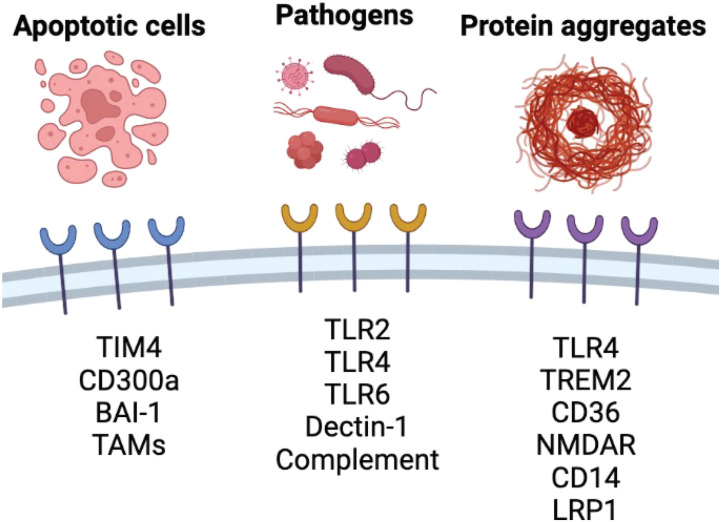
Fig. 4.
Fig. 4.. Overview of select receptors involved in the recognition of phagocytic and endocytic cargoes including apoptotic/dying cells, extracellular pathogens, and protein aggregates, which subsequently activate LC3 lipidation in LAP and LANDO.

References

    1. Baba M., Takeshige K., Baba N., Ohsumi Y., Ultrastructural analysis of the autophagic process in yeast: Detection of autophagosomes and their characterization. J. Cell Biol. 124, 903–913 (1994). - PMC - PubMed
    1. Ohsumi Y., Historical landmarks of autophagy research. Cell Res. 24, 9–23 (2014). - PMC - PubMed
    1. Mizushima N., Levine B., Autophagy in human diseases. N. Engl. J. Med. 383, 1564–1576 (2020). - PubMed
    1. Levine B., Kroemer G., Biological functions of autophagy genes: A disease perspective. Cell 176, 11–42 (2019). - PMC - PubMed
    1. Wang H., Zheng Y., Huang J., Li J., Mitophagy in antiviral immunity. Front. Cell Dev. Biol. 9, 723108 (2021). - PMC - PubMed

Substances