. 2022 Oct 26;8(1):43.
doi: 10.1038/s41526-022-00240-5.

On the growth dynamics of the cyanobacterium Anabaena sp. PCC 7938 in Martian regolith

Affiliations

On the growth dynamics of the cyanobacterium Anabaena sp. PCC 7938 in Martian regolith

Tiago P Ramalho et al. NPJ Microgravity. .

Abstract

The sustainability of crewed infrastructures on Mars will depend on their abilities to produce consumables on site. These abilities may be supported by diazotrophic, rock-leaching cyanobacteria: from resources naturally available on Mars, they could feed downstream biological processes and lead to the production of oxygen, food, fuels, structural materials, pharmaceuticals and more. The relevance of such a system will be dictated largely by the efficiency of regolith utilization by cyanobacteria. We therefore describe the growth dynamics of Anabaena sp. PCC 7938 as a function of MGS-1 concentration (a simulant of a widespread type of Martian regolith), of perchlorate concentration, and of their combination. To help devise improvement strategies and predict dynamics in regolith of differing composition, we identify the limiting element in MGS-1 - phosphorus - and its concentration-dependent effect on growth. Finally, we show that, while maintaining cyanobacteria and regolith in a single compartment can make the design of cultivation processes challenging, preventing direct physical contact between cells and grains may reduce growth. Overall, we hope for the knowledge gained here to support both the design of cultivation hardware and the modeling of cyanobacterium growth within.


Conflict of interest statement

The authors declare no competing interests.

Figures

Fig. 1
Fig. 1. Artistic representation of a system where diazotrophic, rock-leaching cyanobacteria are grown using materials available on Mars.
In that system, the necessary water is mined from the ground; carbon and nitrogen are sourced from the atmosphere and provided at a low (though higher than Mars-ambient) pressure; and mineral nutrients are obtained from the regolith,,,. Lighting is provided as collected sunlight supplemented, when needed, with LEDs. Cyanobacteria could produce consumables such as O2 and dietary proteins, but also support the growth of secondary producers – which, in turn, could generate products ranging from food to materials to pharmaceuticals to fuels. Here, cyanobacteria are depicted in a photobioreactor containing regolith, deposited at the bottom, and a liquid phase stirred by bubbling. The photobioreactor is buried to protect cultures, hardware and operators against dust and radiation, as well as to improve thermal stability. The mining of water is represented with an extraction plant on the left, and that of regolith with excavation rovers. A gas separation and compression module, on the right, symbolizes the provision of gases from the Martian atmosphere. Lighting is shown as Fresnel lenses and light guides. Cultivation products are represented by an oxygen storage tank and a greenhouse in the background. Artwork: Joris Wegner, University of the Arts Bremen.
Fig. 2
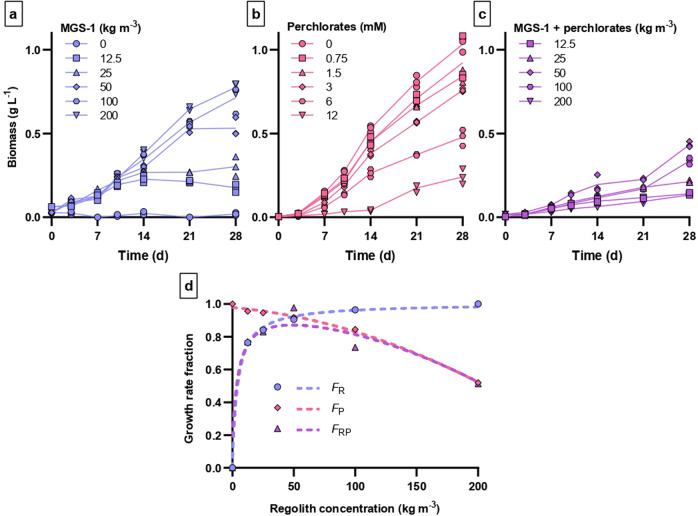
Fig. 2. Growth of Anabaena sp. PCC 7938 with regolith and perchlorates.
a Growth curves in bi-distilled and de-ionized water (ddH2O) supplemented with various concentrations of a perchlorate-free simulant of Martian regolith (MGS-1). b Growth in BG110 spiked with various concentrations of perchlorate ions. c Growth in ddH2O supplemented with various concentrations of MGS-1, and spiked with perchlorate ions at concentrations corresponding to 0.6 wt% of the indicated regolith concentrations. d Normalized growth rate as a function of regolith concentration (FR), perchlorate concentration (FP), or concentration of perchlorate-containing regolith (FRP). Symbols correspond to experimental data. Lines represent equations fitted to the corresponding experimental results (FP, FR) or the product of these equations (FRP = FP × FR).
Fig. 3
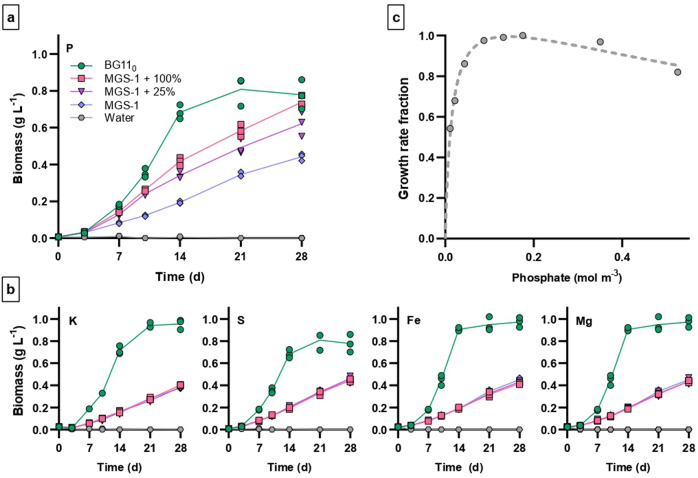
Fig. 3. Identification of the element which is limiting when Anabaena sp. PCC 7938 utilizes MGS-1 as a nutrient source.
a, b Growth curves in BG110 (circles), in ddH2O (hexagons), or in ddH2O containing MGS-1, unsupplemented (diamonds) or supplemented with phosphorus (Na2HPO4; P); potassium (KCl; K); sulfur (Na2SO4; S); iron (FeCl3; Fe) or magnesium (MgCl; Mg) at concentrations corresponding to those found in BG110 (squares) or a quarter of them (triangles). c Normalized growth rate in BG110 as a function of the concentration of phosphate (provided as Na2HPO4).
Fig. 4
Fig. 4. Shading effect of suspended MGS-1.
a Spectral irradiance measured underneath 3.3 cm of water, or of water containing MGS-1 (grain size <100 µm) at the indicated concentrations. b Attenuation coefficients of a suspension of MGS-1 in water, as a function of regolith concentration and for different spectral ranges (calculated from spectral irradiance measurements). c Light intensity as a function of depth, for different concentrations of suspended regolith, assuming an intensity of 500 μmolph m−2 s−1 at the surface (calculated from the PAR attenuation coefficient).
Fig. 5
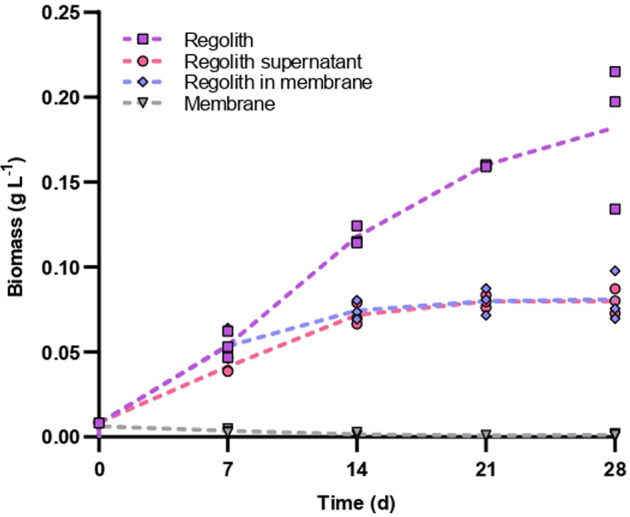
Fig. 5. Growth of Anabaena sp. PCC 7938 when utilizing MGS-1, with or without direct cell-grain contact.
Cyanobacteria were grown in ddH2O containing 200 kg m−3 of MGS-1 (regolith; squares), ddH2O in which MGS-1 had been incubated for 28 days and from which it had been removed (regolith supernatant; circles), ddH2O with 200 kg m−3 of MGS-1 contained in a cellulose hydrate dialysis membrane (regolith in membrane; diamonds), or ddH2O with an empty dialysis membrane (membrane; triangles). Cultures were shaken but in such a way that MGS-1 would remain at the bottom of the flasks, thereby minimizing cell shading.

References

    1. ISECG. The Global Exploration Roadmap. 3rd edn. NASA headquarters (Washington, DC). NP-2020-07-2888-HQ (2018).
    1. Musk E. Making humans a multi-planetary species. New Space. 2017;5:46–61.
    1. Hendrickx L, Mergeay M. From the deep sea to the stars: human life support through minimal communities. Curr. Opin. Microbiol. 2007;10:231–237. - PubMed
    1. Nangle SN, et al. The case for biotech on Mars. Nat. Biotechnol. 2020;38:401–407. - PubMed
    1. Berliner AJ, et al. Towards a Biomanufactory on Mars. Front. Astron. Space Sci. 2021;8:711550.