. 2022 Oct 26;23(1):51.
doi: 10.1186/s12865-022-00526-z.

Restoration of dendritic cell homeostasis and Type I/Type III interferon levels in convalescent COVID-19 individuals

Affiliations

Restoration of dendritic cell homeostasis and Type I/Type III interferon levels in convalescent COVID-19 individuals

Anuradha Rajamanickam et al. BMC Immunol. .

Abstract

Background: Plasmacytoid and myeloid dendritic cells play a vital role in the protection against viral infections. In COVID-19, there is an impairment of dendritic cell (DC) function and interferon secretion which has been correlated with disease severity.

Results: In this study, we described the frequency of DC subsets and the plasma levels of Type I (IFNα, IFNβ) and Type III Interferons (IFNλ1), IFNλ2) and IFNλ3) in seven groups of COVID-19 individuals, classified based on days since RT-PCR confirmation of SARS-CoV2 infection. Our data shows that the frequencies of pDC and mDC increase from Days 15-30 to Days 61-90 and plateau thereafter. Similarly, the levels of IFNα, IFNβ, IFNλ1, IFNλ2 and IFNλ3 increase from Days 15-30 to Days 61-90 and plateau thereafter. COVID-19 patients with severe disease exhibit diminished frequencies of pDC and mDC and decreased levels of IFNα, IFNβ, IFNλ1, IFNλ2 and IFNλ3. Finally, the percentages of DC subsets positively correlated with the levels of Type I and Type III IFNs.

Conclusion: Thus, our study provides evidence of restoration of homeostatic levels in DC subset frequencies and circulating levels of Type I and Type III IFNs in convalescent COVID-19 individuals.

Keywords: Acute and convalescent COVID-19; COVID-19; Dendritic cell subsets; Type I IFNs; Type III IFNs; mDC; pDC.


Conflict of interest statement

The authors declare that they have no competing interests.

Figures

Fig. 1
Fig. 1
Increased frequencies of dendritic cell subsets and circulating levels of Type I and Type III IFNs in convalescent COVID-19 individuals over time. A Analysis of DC subsets from acute and convalescent COVID-19 individuals classified as groups based on days since RT-PCR confirmation. The frequencies of DC subsets (pDC and mDC) are shown with a preferred model for the best fit curve. B Analysis of Type I Interferons (IFNα and IFNβ) from acute and convalescent COVID-19 individuals classified as groups based on days since RT-PCR confirmation. The circulating levels of IFNα and IFNβ are shown with a preferred model for the best fit curve (C). Analysis of Type III Interferons (IFNλ1, IFNλ2 and IFNλ3) from convalescent COVID-19 individuals classified as groups based on days since RT-PCR confirmation. The circulating levels of IFNλ1, IFNλ2 and IFNλ3 were shown with a preferred model for the best fit curve. The blue colour dot represents mild and the red colour dot represents severely infected individuals. Each dot represents a single individual. The thick black line represents the best fit curve
Fig. 2
Fig. 2
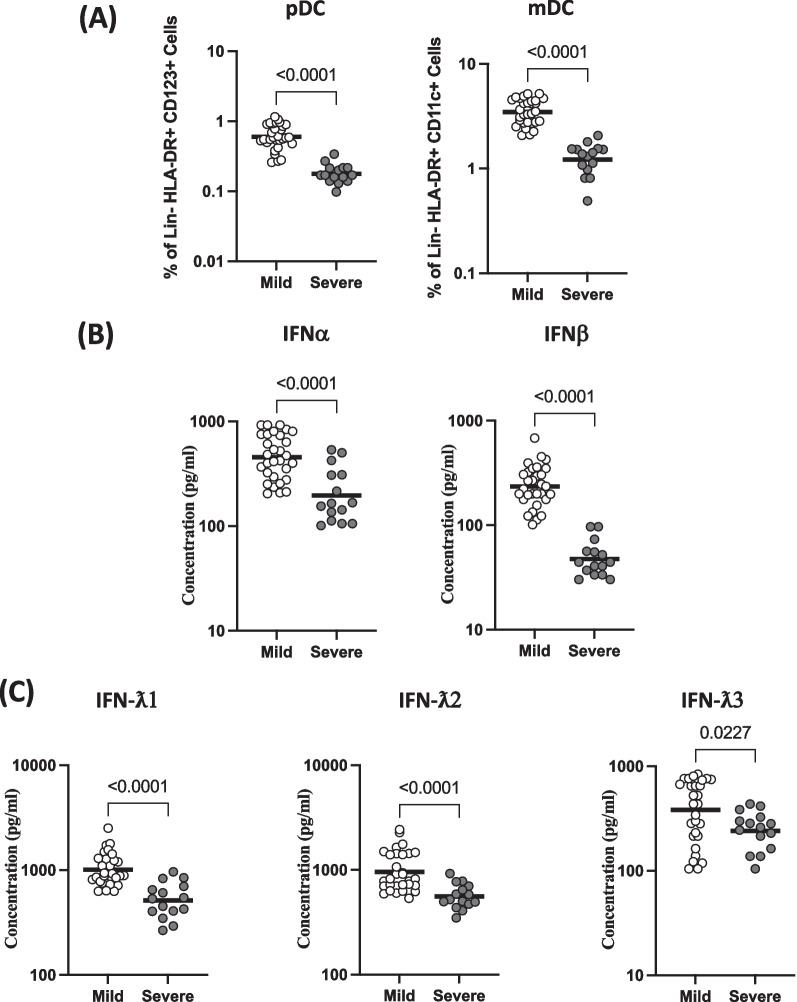
Severe COVID-19 disease is associated with decreased frequencies of DC subsets and circulating levels of Type I and Type III IFN. A The frequencies of DC (pDC and mDC) subsets in mild (n = 30) and severe (n = 15) COVID-19 individuals sampled between days 15 to 60 following RT-PCR confirmation. B Circulating plasma levels of Type I Interferons (IFNα and IFNβ) in mild (n = 30) and severe (n = 15) COVID-19 individuals sampled between days 15 to 60 following RT-PCR confirmation. C Circulating plasma levels of Type III Interferons (IFNλ1, IFNλ2 and IFNλ3) in mild (n = 30) and severe (n = 15) COVID-19 individuals sampled between days 15 to 60 following RT-PCR confirmation. The data are represented as scatter plots with each circle representing a single individual. p values were calculated using the Mann– Whitney U-test
Fig. 3
Fig. 3
Association between DC subsets and the levels of Type I and Type III IFNs. A Correlation analysis between DC subsets Vs Type I and III levels in mild COVID-19 individuals. B Correlation analysis between DC subsets Vs Type I and III levels in severe COVID-19 individuals

References

    1. Perez-Gomez A, Vitalle J, Gasca-Capote C, Gutierrez-Valencia A, Trujillo-Rodriguez M, Serna-Gallego A, et al. Dendritic cell deficiencies persist seven months after SARS-CoV-2 infection. Cell Mol Immunol. 2021. - PMC - PubMed
    1. Park A, Iwasaki A. Type I and Type III interferons - induction, signaling, evasion, and application to combat COVID-19. Cell Host Microbe. 2020;27(6):870–878. doi: 10.1016/j.chom.2020.05.008. - DOI - PMC - PubMed
    1. Kvedaraite E, Hertwig L, Sinha I, Ponzetta A, Hed Myrberg I, Lourda M, et al. Major alterations in the mononuclear phagocyte landscape associated with COVID-19 severity. Proc Natl Acad Sci U S A. 2021;118(6). - PMC - PubMed
    1. Zhou R, To KK, Wong YC, Liu L, Zhou B, Li X, et al. Acute SARS-CoV-2 infection impairs dendritic cell and T Cell Responses. Immunity. 2020;53(4):864–77. doi: 10.1016/j.immuni.2020.07.026. - DOI - PMC - PubMed
    1. Sanchez-Cerrillo I, Landete P, Aldave B, Sanchez-Alonso S, Sanchez-Azofra A, Marcos-Jimenez A, et al. COVID-19 severity associates with pulmonary redistribution of CD1c+ DCs and inflammatory transitional and nonclassical monocytes. J Clin Invest. 2020;130(12):6290–6300. doi: 10.1172/JCI140335. - DOI - PMC - PubMed

Publication types