


Clinical Characteristics and Outcome of MDR/XDR Bacterial Infections in a Neuromuscular Semi-Intensive/Sub-Intensive Care Unit
- PMID: 36290069
- PMCID: PMC9598219
- DOI: 10.3390/antibiotics11101411
Clinical Characteristics and Outcome of MDR/XDR Bacterial Infections in a Neuromuscular Semi-Intensive/Sub-Intensive Care Unit
Abstract
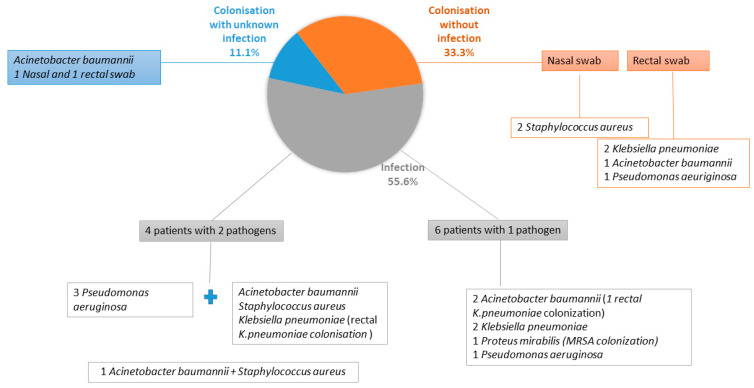
(1) Background: The aim of this study was to assess the clinical and microbiological characteristics of multidrug-resistant infections in a neuromuscular semi-intensive/sub-intensive care unit; (2) Methods: Retrospective analysis on data from 18 patients with NMD with proven MDRO/XDRO colonisation/infection from August 2021 to March 2022 was carried out; (3) Results: Ten patients were males (55.6%), with a median age of 54 years, and there were fourteen patients (77.8%) with amyotrophic lateral sclerosis. All patients had at least one invasive device. Ten (55.6%) patients developed MDRO/XDRO infection (with a median time of 24 days) while six (33.3%) were colonised. The Charlson comorbidity index was >2 in both groups but higher in the infected compared with the colonised (4.5 vs. 3). Infected patients were mostly females (seven patients) with a median age of 62 years. The most common pathogens were Acinetobacter baumannii and Pseudomonas aeruginosa, infecting four (28.6%) patients each. Of eighteen infectious episodes, nine were pneumonia (hospital-acquired in seven cases). Colistin was the most commonly active antibiotic while carbapenems were largely inactive. Eradication of infection occurred in seven infectious episodes (38.9%). None of those with infection died; (4) Conclusions: MDRO/XDRO infections are common in patients with neuromuscular diseases, with carbapenem-resistant non-fermenting Gram-negative bacilli prevailing. These infections were numerically associated with the female sex, greater age, and comorbidities. Both eradication and infection-related mortality appeared low. We highlight the importance of infection prevention in this vulnerable population.
Keywords: MDRO/XDRO; carbapenem; colonisation; invasive device; neuromuscular disease.
Conflict of interest statement
Authors have no conflict of interest to disclose relevant to the content of this study. EDM received grant support and personal fees, outside of this work, from Roche, Pfizer, MSD, Angelini, Bio-Merieux, Abbvie, Nordic Pharma, Sanofi-Aventis, Medtronic and DiaSorin.
Figures
References
-
- Santoro A., Franceschini E., Meschiari M., Menozzi M., Zona S., Venturelli C., DiGaetano M., Rogati C., Guaraldi G., Paul M., et al. Epidemiology and Risk Factors Associated With Mortality in Consecutive Patients With Bacterial Bloodstream Infection: Impact of MDR and XDR Bacteria. Open Forum Infect. Dis. 2020;7:ofaa461. doi: 10.1093/ofid/ofaa461. - DOI - PMC - PubMed
-
- Suetens C., Latour K., Kärki T., Ricchizzi E., Kinross P., Moro M.L., Jans B., Hopkins S., Hansen S., Lyytikäinen O., et al. Prevalence of healthcare-associated infections, estimated incidence and composite antimicrobial resistance index in acute care hospitals and long-term care facilities: Results from two European point prevalence surveys, 2016 to 2017. Eurosurveillance. 2018;23:1800516. doi: 10.2807/1560-7917.ES.2018.23.46.1800516. - DOI - PMC - PubMed
-
- Lat I., Daley M.J., Shewale A., Pangrazzi M.H., Hammond D., Olsen K.M., DEFINE Study Group and the Discovery Research Network A Multicenter, Prospective, Observational Study to Determine Predictive Factors for Multidrug-Resistant Pneumonia in Critically Ill Adults: The DEFINE Study. Pharmacotherapy. 2019;39:253–260. doi: 10.1002/phar.2171. - DOI - PubMed
-
- Tabah A., Koulenti D., Laupland K., Misset B., Valles J., Bruzzi de Carvalho F., Paiva J.A., Çakar N., Ma X., Eggimann P., et al. Characteristics and determinants of outcome of hospital-acquired bloodstream infections in intensive care units: The EUROBACT International Cohort Study. Intensive Care Med. 2012;38:1930–1945. doi: 10.1007/s00134-012-2695-9. - DOI - PubMed
LinkOut - more resources
Full Text Sources
