


Antimicrobial Peptides-Mechanisms of Action, Antimicrobial Effects and Clinical Applications
- PMID: 36290075
- PMCID: PMC9598582
- DOI: 10.3390/antibiotics11101417
Antimicrobial Peptides-Mechanisms of Action, Antimicrobial Effects and Clinical Applications
Abstract
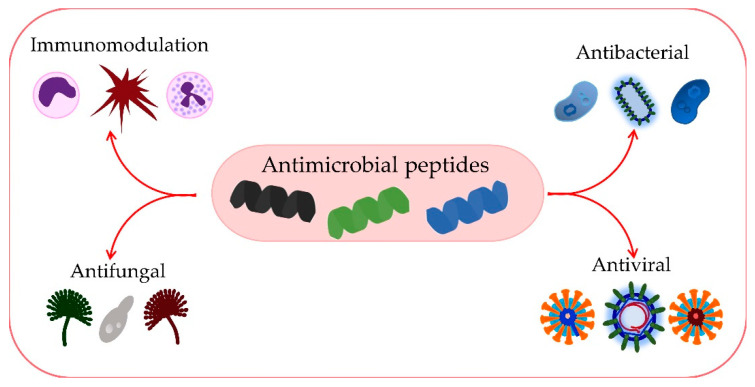
The growing emergence of antimicrobial resistance represents a global problem that not only influences healthcare systems but also has grave implications for political and economic processes. As the discovery of novel antimicrobial agents is lagging, one of the solutions is innovative therapeutic options that would expand our armamentarium against this hazard. Compounds of interest in many such studies are antimicrobial peptides (AMPs), which actually represent the host's first line of defense against pathogens and are involved in innate immunity. They have a broad range of antimicrobial activity against Gram-negative and Gram-positive bacteria, fungi, and viruses, with specific mechanisms of action utilized by different AMPs. Coupled with a lower propensity for resistance development, it is becoming clear that AMPs can be seen as emerging and very promising candidates for more pervasive usage in the treatment of infectious diseases. However, their use in quotidian clinical practice is not without challenges. In this review, we aimed to summarize state-of-the-art evidence on the structure and mechanisms of action of AMPs, as well as to provide detailed information on their antimicrobial activity. We also aimed to present contemporary evidence of clinical trials and application of AMPs and highlight their use beyond infectious diseases and potential challenges that may arise with their increasing availability.
Keywords: antibacterial activity; antifungal activity; antimicrobial effects; antimicrobial peptides; antimicrobial resistance; antiviral activity; clinical trials; infections; microorganisms; treatment.
Conflict of interest statement
The authors declare no conflict of interest. The funders had no role in the design of the study; in the collection, analyses, or interpretation of data; in the writing of the manuscript; or in the decision to publish the results.
Figures
References
Publication types
LinkOut - more resources
Full Text Sources
Research Materials
