


Optimization of a Plasma Rich in Growth Factors Membrane for the Treatment of Inflammatory Ocular Diseases
- PMID: 36290475
- PMCID: PMC9598884
- DOI: 10.3390/bioengineering9100508
Optimization of a Plasma Rich in Growth Factors Membrane for the Treatment of Inflammatory Ocular Diseases
Abstract
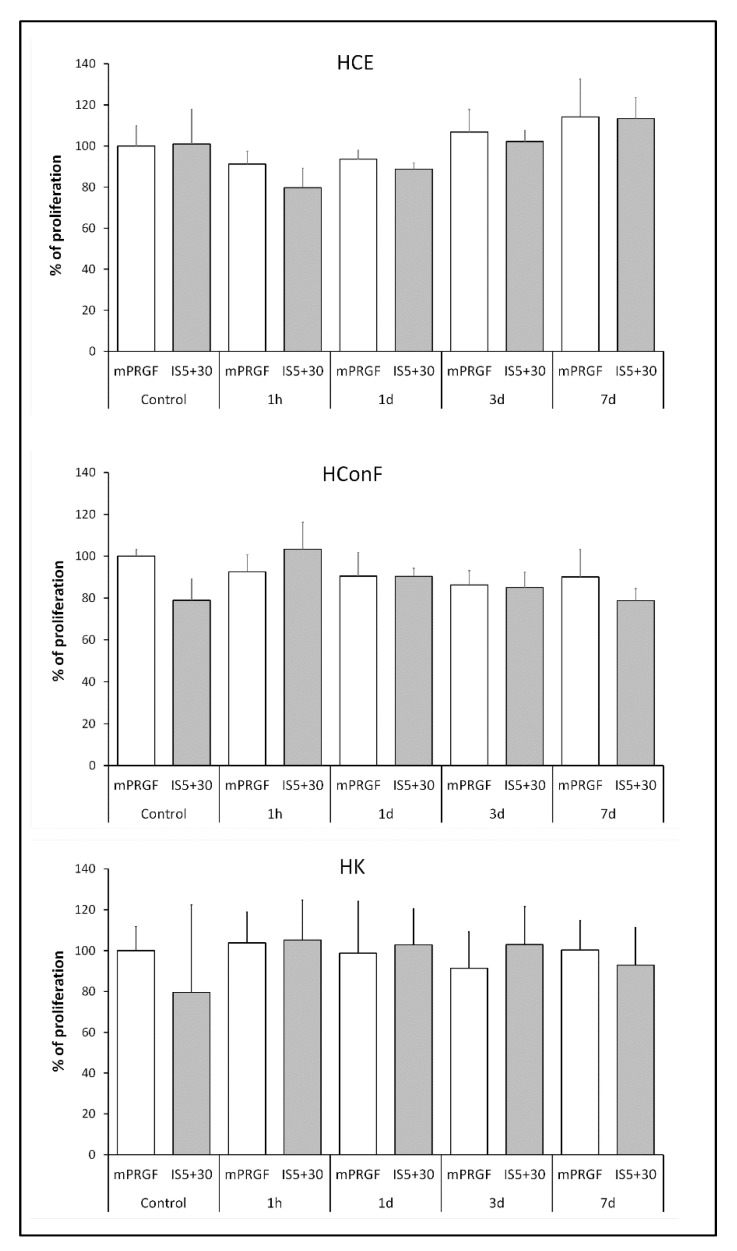
The main purpose of the present study is to develop an immunosafe fibrin membrane obtained by plasma rich in growth factors technology (is-mPRGF) with improved mechanical properties that could be applied in patients with inflammatory ocular diseases. Blood was drawn from three healthy donors and centrifuged, and the collected PRGF was activated and distributed into two groups: (i) mPRGF: a PRGF membrane maintained at 37 °C for 30 min; (ii) IS5+30: mPRGF incubated at 37 °C for 5 min and then incubated at 56 °C for 30 min. The content of both membranes was analyzed for several growth factors such as IgE and the complement activation, as well as biological activity on different ocular surface cells. Furthermore, the physical and mechanical characterizations were also evaluated. IS5+30 completely reduced the complement activity and decreased the IgE while preserving the concentration of the main growth factors. IS5+30 induced similar biological activity regarding mPRGF on the different ocular surface cells analyzed. Furthermore, no significant differences in release kinetics or fibrin degradation were observed between both membranes. Summarizing, IS5+30 totally reduces complement activity while preserving the concentration of most growth factors and their biological activity. Furthermore, the physical and mechanical properties of the fibrin membrane are preserved after heat inactivation.
Keywords: PRP; autoimmune diseases; complement system; fibrin membrane; heat inactivation; ocular surface diseases; plasma rich in growth factors; platelet rich plasma.
Conflict of interest statement
The authors declare the following potential conflicts of interest with respect to the research, authorship, and/or publication of this article: E.A. is the Scientific Director and M.d.l.F. and F.M. are scientists at BTI Biotechnology Institute, which is a company that investigates in the fields of oral implantology and PRGF-Endoret technology.
Figures


References
-
- Reed G.L., Fitzgerald M.L., Polgar J. Molecular mechanisms of platelet exocytosis: Insights into the “secrete” life of thrombocytes. Blood. 2000;96:3334–3342. - PubMed
-
- Kon E., Di Matteo B., Delgado D., Cole B.J., Dorotei A., Dragoo J.L., Filardo G., Fortier L.A., Giuffrida A., Jo C.H., et al. Platelet-rich plasma for the treatment of knee osteoarthritis: An expert opinion and proposal for a novel classification and coding system. Expert Opin. Biol. Ther. 2020;20:1447–1460. doi: 10.1080/14712598.2020.1798925. - DOI - PubMed
-
- Acebes-Huerta A., Arias-Fernández T., Bernardo Á., Muñoz-Turrillas M.C., Fernández-Fuertes J., Seghatchian J., Gutiérrez L. Platelet-derived bio-products: Classification update, applications, concerns and new perspectives. Transfus. Apher. Sci. 2020;59:102716. doi: 10.1016/j.transci.2019.102716. - DOI - PubMed
Grants and funding
LinkOut - more resources
Full Text Sources
Research Materials
