Review
. 2022 Oct 11;14(20):4968.
doi: 10.3390/cancers14204968.

Mining the Immunopeptidome for Antigenic Peptides in Cancer

Affiliations
Review

Mining the Immunopeptidome for Antigenic Peptides in Cancer

Ricardo A León-Letelier et al. Cancers (Basel). .

Abstract

Although harnessing the immune system for cancer therapy has shown success, response to immunotherapy has been limited. The immunopeptidome of cancer cells presents an opportunity to discover novel antigens for immunotherapy applications. These neoantigens bind to MHC class I and class II molecules. Remarkably, the immunopeptidome encompasses protein post-translation modifications (PTMs) that may not be evident from genome or transcriptome profiling. A case in point is citrullination, which has been demonstrated to induce a strong immune response. In this review, we cover how the immunopeptidome, with a special focus on PTMs, can be utilized to identify cancer-specific antigens for immunotherapeutic applications.

Keywords: PTM; cancer vaccine; immunopeptidome; immunotherapy.


Conflict of interest statement

The authors declare no conflict of interest.

Figures
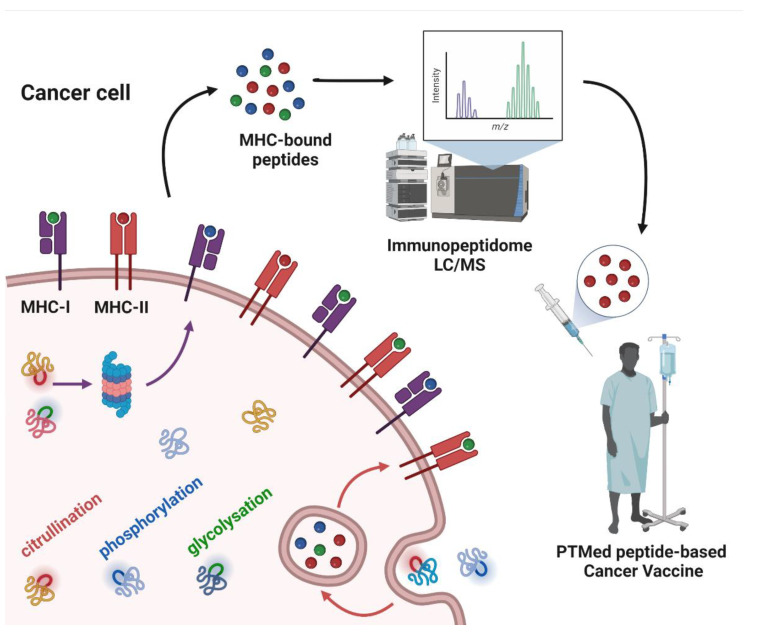
Figure 1
Figure 1
Post-translationally modified peptide-based cancer vaccine workflow. The figure depicts cancer cell antigen processing of intracellular and extracellular proteins, subsequently as peptides bound to MHC-I or MHC-II. Some of the proteins have PTMs in their structure, which are sketched in colors (citrullination: red; phosphorylation: blue; glycosylation: green) as well as in MHC-bound peptides. The MHC-bound peptides are identified by means of liquid chromatography-mass spectrometry (LC/MS), to derive the cancer cell immunopeptidome. From the immunopeptidome data, peptides with PTMs can be selected as antigens for cancer vaccines.

References

    1. Abbott M., Ustoyev Y. Cancer and the Immune System: The History and Background of Immunotherapy. Semin. Oncol. Nurs. 2019;35:150923. doi: 10.1016/j.soncn.2019.08.002. - DOI - PubMed
    1. Kote S., Pirog A., Bedran G., Alfaro J., Dapic I. Mass Spectrometry-Based Identification of MHC-Associated Peptides. Cancers. 2020;12:535. doi: 10.3390/cancers12030535. - DOI - PMC - PubMed
    1. Okada M., Shimizu K., Fujii S.I. Identification of Neoantigens in Cancer Cells as Targets for Immunotherapy. Int. J. Mol. Sci. 2022;23:2594. doi: 10.3390/ijms23052594. - DOI - PMC - PubMed
    1. Kotsias F., Cebrian I., Alloatti A. Antigen processing and presentation. Int. Rev. Cell Mol. Biol. 2019;348:69–121. doi: 10.1016/bs.ircmb.2019.07.005. - DOI - PubMed
    1. Freudenmann L.K., Marcu A., Stevanovic S. Mapping the tumour human leukocyte antigen (HLA) ligandome by mass spectrometry. Immunology. 2018;154:331–345. doi: 10.1111/imm.12936. - DOI - PMC - PubMed
