


Holistic Assessment of Factors Associated with Exhaustion, the Main Symptom of Burnout: A Meta-Analysis of Longitudinal Studies
- PMID: 36293607
- PMCID: PMC9602979
- DOI: 10.3390/ijerph192013037
Holistic Assessment of Factors Associated with Exhaustion, the Main Symptom of Burnout: A Meta-Analysis of Longitudinal Studies
Abstract
Background: This meta-analysis summarized longitudinal findings pertaining to exhaustion's predictors. In so doing, our aim was ultimately to identify target factors for the prevention of burnout.
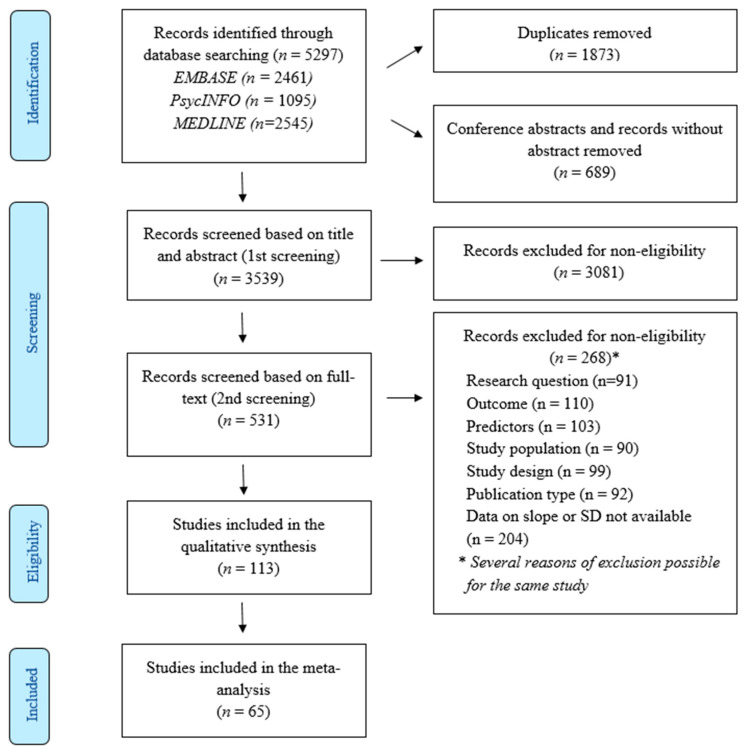
Methods: We searched for studies that (a) examined predictors of exhaustion longitudinally and (b) reported correlation coefficients as an effect estimate. We conducted our literature search in three databases: MEDLINE, PsycINFO, and Embase. We focused on studies published between January 1990 and November 2020. Predictors were grouped into families, subfamilies, and subgroups. A meta-analysis of z-transformed correlation coefficients (rho) was performed. The results were scrutinized in relation to studies' follow-up length.
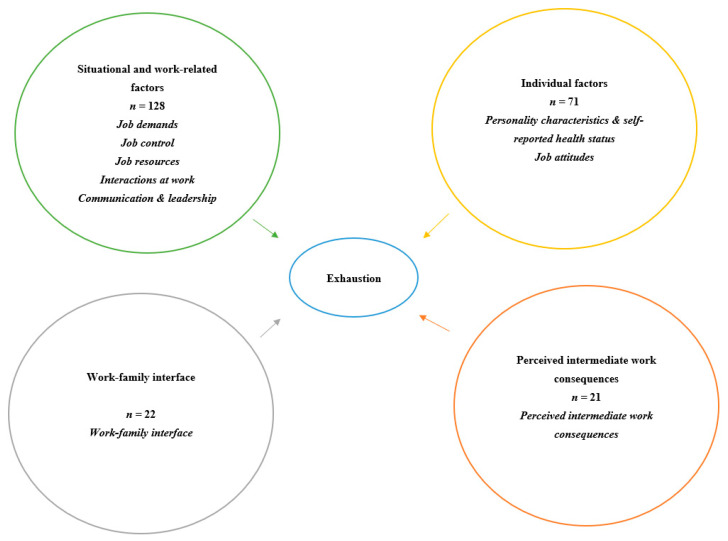
Results: We included 65 studies assessing 242 predictors of different types captured across different occupations. Our findings highlighted mostly weak associations (rho < 0.30). For six predictors-Job control, Job resources, Interactions at work, Communication and leadership, Job attitudes, and Work-family interface-longer length of follow-up involved weaker associations with exhaustion. The quality of the evidence available was generally low.
Conclusions: The evidence available does not point to clear target factors for preventing burnout. The decrease in associations as the follow-up length increases may suggest a relatively short latency period, followed by recovery. Higher-quality cohorts should be conducted to better understand the etiology and course of burnout.
Keywords: exposure assessment; exposure-response relationship; latency period; outcome measurement; predictor; stress.
Conflict of interest statement
The authors declare no conflict of interest. The funders had no role in the design of the study; in the collection, analyses, or interpretation of data; in the writing of the manuscript; or in the decision to publish the results.
Figures
References
-
- Word Health Organization Burn-Out an “Occupational Phenomenon”: International Classification of Diseases. [(accessed on 28 May 2019)]. Available online: https://www.who.int/news/item/28-05-2019-burn-out-an-occupational-phenom....
-
- American Psychiatric Association . Diagnostic and Statistical Manual of Mental Disorders. American Psychiatric Association; Washington, DC, USA: 2013.
-
- Guseva Canu I., Marca S.C., Dell’Oro F., Balázs Á., Bergamaschi E., Besse C., Bianchi R., Bislimovska J., Koscec Bjelajac A., Bugge M., et al. Harmonized definition of occupational burnout: A systematic review, semantic analysis, and Delphi consensus in 29 countries. Scand. J. Work. Environ. Health. 2021;47:95–107. doi: 10.5271/sjweh.3935. - DOI - PMC - PubMed
-
- Shirom A., Melamed S. A comparison of the construct validity of two burnout measures in two groups of professionals. Int. J. Stress Manag. 2006;13:176–200. doi: 10.1037/1072-5245.13.2.176. - DOI
Publication types
MeSH terms
Grants and funding
LinkOut - more resources
Full Text Sources
