


Biomass, Carbon and Nitrogen Partitioning and Water Use Efficiency Differences of Five Types of Alpine Grasslands in the Northern Tibetan Plateau
- PMID: 36293622
- PMCID: PMC9602644
- DOI: 10.3390/ijerph192013026
Biomass, Carbon and Nitrogen Partitioning and Water Use Efficiency Differences of Five Types of Alpine Grasslands in the Northern Tibetan Plateau
Abstract
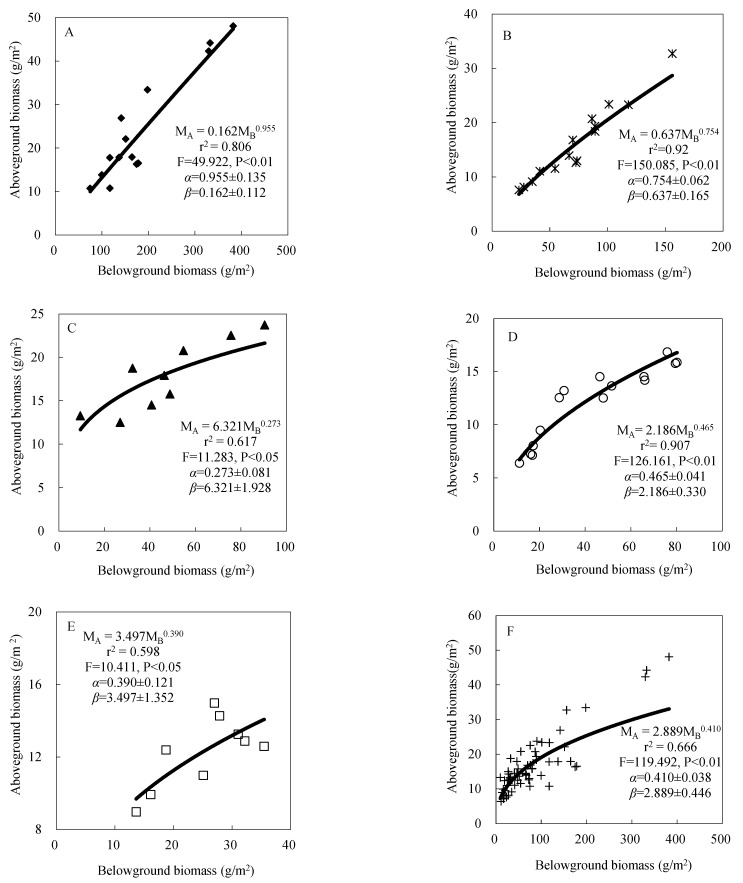
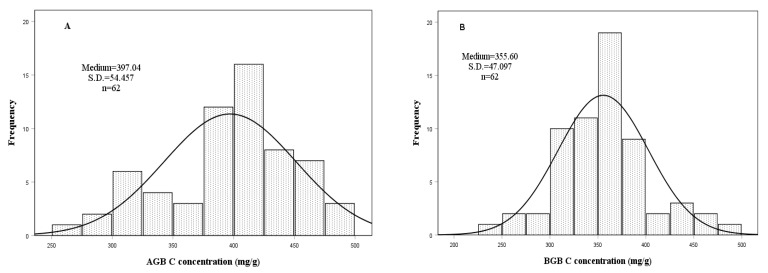
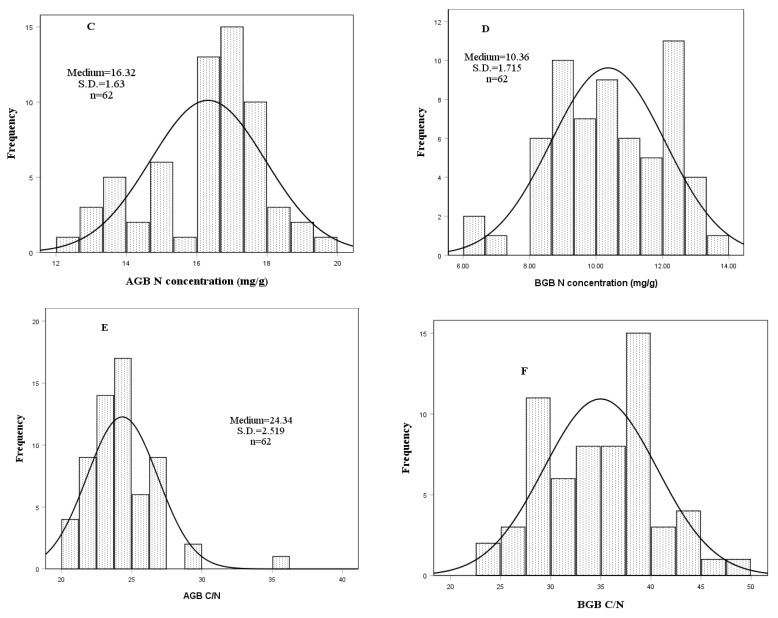
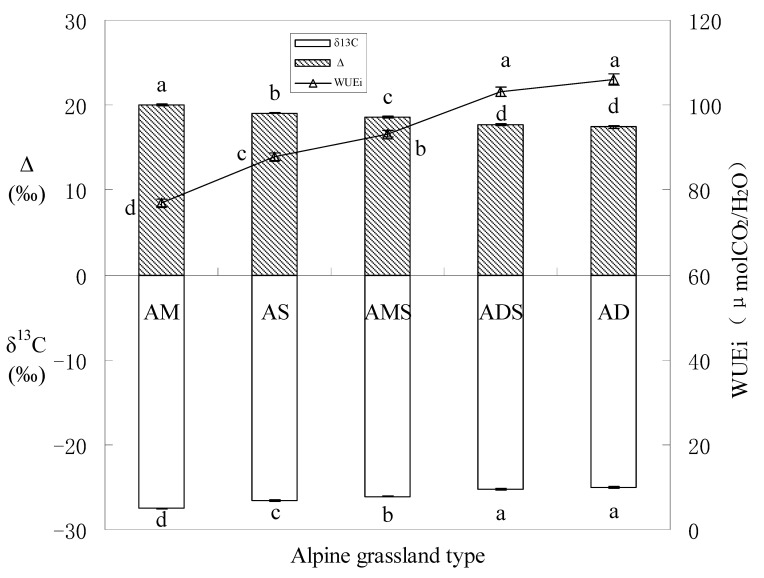
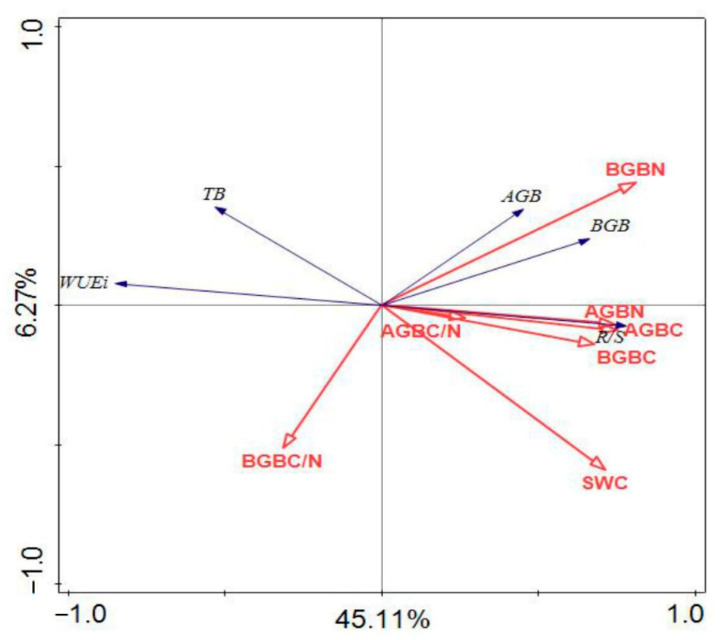
(1) Background: Grassland covers most areas of the northern Tibetan Plateau along with important global terrestrial carbon (C) and nitrogen (N) pools, so there is a need to better understand the different alpine grassland growth associated with ecosystem C, N storage and water use efficiency (WUE). (2) Methods: The plant biomass and C, N concentrations, stocks and vegetation WUE of five kinds of alpine grassland types were investigated in northern Tibetan Plateau. (3) Results: The results showed that there were significant differences among five types of alpine grasslands in aboveground biomass (AGB), belowground biomass (BGB), total biomass (TB) and root:shoot (R/S) ratio while the highest value of different indices was shown in alpine meadow type (AM). The AGB and BGB partitioning results significantly satisfied the allometric biomass partitioning theory. The C, N concentrations and C/N of the vegetation in AGB and BGB showed significant grassland type differences. The highest C, N stocks of BGB were in AM which was almost six or seven times more than the C, N stocks of AGB in alpine desert type (AD). There were significant differences in δ13C and intrinsic water use efficiency (WUEi) under five alpine grassland types while the highest mean values of foliar δ13C and WUEi were in AD. Significant negative correlations were found between WUEi and C, N concentrations, C/N of AGB and soil water content (SWC) while the correlation with BGB C/N was not significant. For AGB, BGB, TB and R/S, there were positive correlations with C, N concentrations of AGB, BGB and SWC while it had significant negative correlations with C/N of BGB. (4) Conclusions: With regard to its types, it is suggested that the AM or AS may be an actively growing grassland type in the northern Tibetan Plateau.
Keywords: C stocks; N stocks; alpine grassland; biomass; water use efficiency.
Conflict of interest statement
All the authors declare no competing interests.
Figures
References
-
- Sun J., Cheng G.W., Li W.P. Meta-analysis of relationships between environmental factors and aboveground biomass in the alpine grassland on the Tibetan Plateau. Biogeosciences. 2013;10:1707–1715. doi: 10.5194/bg-10-1707-2013. - DOI
-
- Chapin F.S., III, Randerson J.T., McGuire A.D., Foley J.A., Field C.B. Changing feedbacks in the climate-biosphere system. Front. Ecol. Environ. 2008;6:313–320. doi: 10.1890/080005. - DOI
-
- Wang X., Li M.-H., Liu S., Liu G. Fractal characteristics of soils under different land-use patterns in the arid and semiarid regions of the Tibetan Plateau, China. Geoderma. 2006;134:56–61. doi: 10.1016/j.geoderma.2005.08.014. - DOI
-
- Mueller C., Kogel-Knabner I. Soil organic carbon stocks, distribution, and composition affected by historic land use changes on adjacent sites. Biol. Fertil Soil. 2009;45:347–359. doi: 10.1007/s00374-008-0336-9. - DOI
Publication types
MeSH terms
Substances
Grants and funding
- 41601016, 41771036/the National Natural Science Foundation of China
- 2015JM4136/Special Support Program for High-Level Personnel Recruitment (Youth Top-Talent) of Shaanxi province, National Natural Science Foundation of Shaanxi province
- PXY-BSQD-2022039/Doctoral research start-up fee of Pingdingshan University
- 20JS011/Key projects of Shaanxi Provincial Department of Education
LinkOut - more resources
Full Text Sources
