


Physical Activity and Body Image Perception in Adolescents: A Systematic Review
- PMID: 36293770
- PMCID: PMC9603811
- DOI: 10.3390/ijerph192013190
Physical Activity and Body Image Perception in Adolescents: A Systematic Review
Abstract
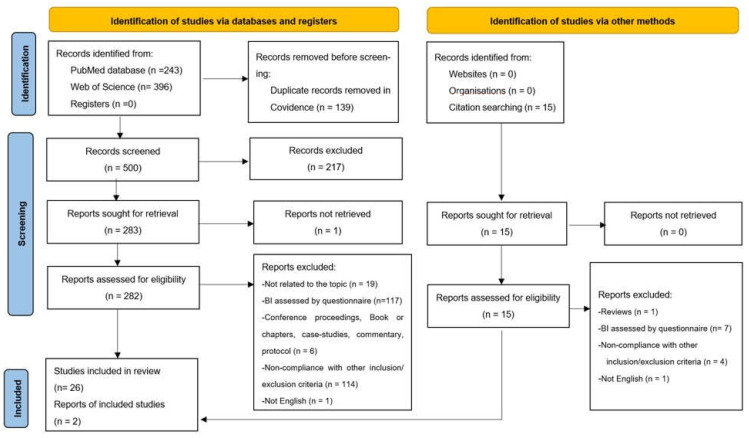
Adolescence represents a vulnerable phase of life for psychological health. The practice of physical activity (PA) appears to have a positive influence on adolescents, increasing self-esteem and producing a more positive body image. A systematic review of published articles over the past 10 years until June 2022 was conducted according to the PRISMA statement employing the electronic databases MEDLINE and Web of Science (639 records) to summarize the literature on the relationship between body image dissatisfaction (BID) and assessed by figural scales and practice of structured and unstructured PA in adolescents (10-18 years), taking into account BMI and/or weight status. All articles were independently reviewed using inclusion/exclusion criteria, retrieved data, and assessed quality with the adapted Newcastle-Ottawa Scale for observational studies. The main finding of interest that emerged from most of the 28 included studies is the negative association between BID and PA during adolescence: as PA increases, BID decreases. However, this updated systematic review also identified some flaws in the existing literature, highlighting the need for high-quality adolescent research using validated figural scales and objective PA assessments. In conclusion, the reviewed studies showed that PA involvement can be efficacious in protecting from body image perception concerns and enhancing body satisfaction. Future interventions should promote structured and unstructured PA during adolescence to improve self-esteem and body image.
Keywords: adolescence; body dissatisfaction; body image; body mass index; physical activity.
Conflict of interest statement
The authors declare no conflict of interest.
Figures
References
-
- NCD Risk Factor Collaboration (NCD-RisC) Worldwide trends in body-mass index, underweight, overweight, and obesity from 1975 to 2016: A pooled analysis of 2416 population-based measurement studies in 128·9 million children, adolescents, and adults. Lancet. 2017;390:2627–2642. doi: 10.1016/S0140-6736(17)32129-3. - DOI - PMC - PubMed
-
- Childhood Obesity Surveillance Initiative HIGHLIGHTS 2015-17. [(accessed on 30 August 2022)]. Available online: https://www.euro.who.int/__data/assets/pdf_file/0006/372426/WH14_COSI_fa....
-
- Lange S.J., Kompaniyets L., Freedman D.S., Kraus E.M., Porter R., Blanck H.M., Goodman A.B. Longitudinal Trends in Body Mass Index Before and During the COVID-19 Pandemic Among Persons Aged 2–19 Years—United States, 2018–2020. Morb. Mortal. Wkly. Rep. 2021;70:1278–1283. doi: 10.15585/mmwr.mm7037a3. - DOI - PMC - PubMed
Publication types
MeSH terms
LinkOut - more resources
Full Text Sources
Medical
Miscellaneous
