


Spending Time in Nature Serves as a Protective Factor against Problematic Alcohol Use: A Structural Equation Modeling Approach
- PMID: 36293937
- PMCID: PMC9603149
- DOI: 10.3390/ijerph192013356
Spending Time in Nature Serves as a Protective Factor against Problematic Alcohol Use: A Structural Equation Modeling Approach
Abstract
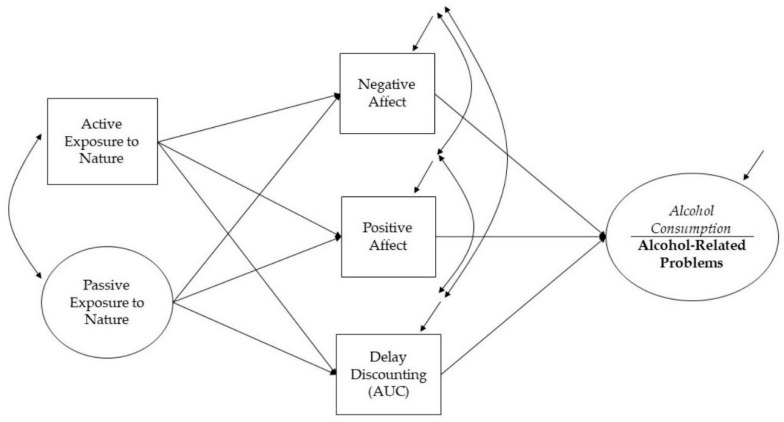
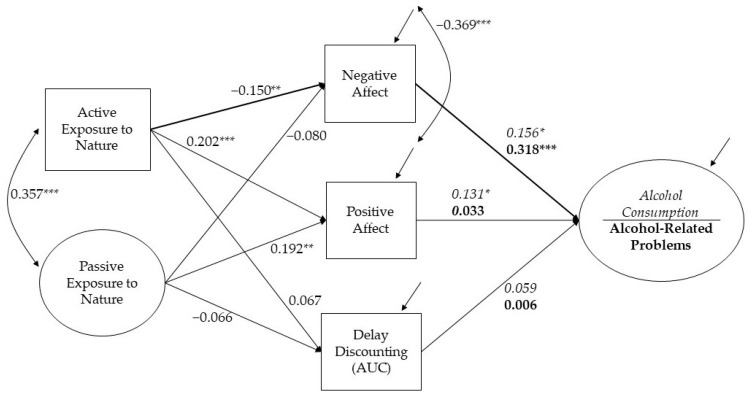
Alcohol use in the U.S. continues to be a prevalent behavior with the potential for far-reaching personal and public health consequences. Risk factors for problematic drinking include negative affect and impulsive decision-making. Research suggests exposure to nature reduces negative affect, increases positive affect, and reduces impulsive choice. The purpose of the current study was to explore the relationships between exposure to nature (actively going out to nature and the level of greenness around the participant's daily life), affect, impulsive decision-making, and alcohol use, using structural equation modeling. Cross-sectional data (N = 340) collected online on Amazon MTurk were used to test the hypothesized relationships separately for alcohol consumption and alcohol-related problems. Actively spending time in nature was associated with lower negative affect and higher positive affect, while passive exposure to nature was only associated with higher positive affect. In turn, negative affect was positively related to both alcohol measures, while positive affect was related to increased alcohol consumption, but not alcohol-related problems. Impulsive decision-making was not related to nature or alcohol measures. Findings suggest that intentionally spending time in nature may protect against problematic alcohol use by reducing negative affect. These results warrant further research on nature as an adjunct treatment for reducing alcohol and substance-related harms and carry implications for public education and increasing accessibility to natural spaces.
Keywords: affect; alcohol use; delay discounting; greenspace; nature exposure; substance use.
Conflict of interest statement
The authors declare no conflict of interest.
Figures
References
-
- McMahan E.A., Estes D. The effect of contact with natural environments on positive and negative affect: A meta-analysis. J. Posit. Psychol. 2015;10:507–519. doi: 10.1080/17439760.2014.994224. - DOI
Publication types
MeSH terms
Substances
Grants and funding
LinkOut - more resources
Full Text Sources
Medical
