


Effects of Parental Migration on Dental Caries of Six- to Eight-Year-Old Children Using Structural Equation Modeling
- PMID: 36294059
- PMCID: PMC9602841
- DOI: 10.3390/ijerph192013470
Effects of Parental Migration on Dental Caries of Six- to Eight-Year-Old Children Using Structural Equation Modeling
Abstract
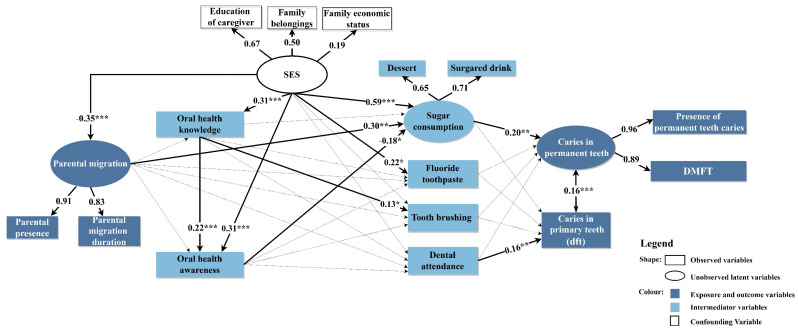
This cross-sectional study aimed to document the relationship between dental caries, oral health behaviors, and the duration of parental migration in rural Yunnan, China, from September to December 2020. Seven rural primary schools with high parental migration were studied. The oral health status of 500 six- to eight-year-old students was assessed using clinical examination and caregivers' interviews. A total of 51.8% of the children had at least one parent absent for at least 6 months (left-behind children). Among those children with parental migration <6 months, 40.0% consumed sugar twice or more daily and 82.8% of those with parental migration from 6 to 12 months brushed once a day or less. The percentage of daily sugar consumption twice or more and brushing once or less among those without parental migration were 36.0% and 68.6%. Prevalence of caries in permanent teeth (DMFT) in children without parental migration and those whose parental migration <6 months, 6 to <12 months, and ≤12 months were 30.9%, 20.0%, 28.7% and 19.8%, respectively. Out of several other causal pathways between parental migration and dental caries, our structural equation model delineated that sugar consumption is the important mediator variable. Special education programs may be needed to educate caregivers on sugar consumption for the left-behind children in rural areas.
Keywords: dental decay; dietary sugars; family separation; latent class analysis; left-behind children; oral hygiene; structural equation modeling; toothbrushing.
Conflict of interest statement
The authors declare no conflict of interest.
Figures
References
-
- National Bureau of Statistics of China (NBSC) Major Figures on 2020 Population Census of China. China Statistics Press; Beijing, China: 2020.
-
- United Nations Children’s Fund (UNICEF) Children “Left Behind”. United Nations Children’s Fund; New York, NY, USA: 2020.
-
- United Nations Children’s Fund (UNICEF) National Working Committee on Children and Women (NWCCW) National Bureau of Statistics of China (NBSC) Children in China: An Atlas of Social Indicators. United Nations Children’s Fund; Beijing, China: 2018.
-
- United Nations Educational Scientific and Cultural Organization (UNESCO) Bangkok . Policy Briefs on Internal Migration in Southeast Asia. United Nations Educational Scientific and Cultural Organization; Bangkok, Thailand: 2018.
-
- Fellmeth G., Rose-Clarke K., Zhao C., Busert L.K., Zheng Y., Massazza A., Sonmez H., Eder B., Blewitt A., Lertgrai W., et al. Health impacts of parental migration on left-behind children and adolescents: A systematic review and meta-analysis. Lancet. 2018;392:2567–2582. doi: 10.1016/S0140-6736(18)32558-3. - DOI - PMC - PubMed
Publication types
MeSH terms
Substances
LinkOut - more resources
Full Text Sources
Medical
