


Approach to Knee Arthropathy through 180-Degree Immersive VR Movement Visualization in Adult Patients with Severe Hemophilia: A Pilot Study
- PMID: 36294536
- PMCID: PMC9605271
- DOI: 10.3390/jcm11206216
Approach to Knee Arthropathy through 180-Degree Immersive VR Movement Visualization in Adult Patients with Severe Hemophilia: A Pilot Study
Abstract
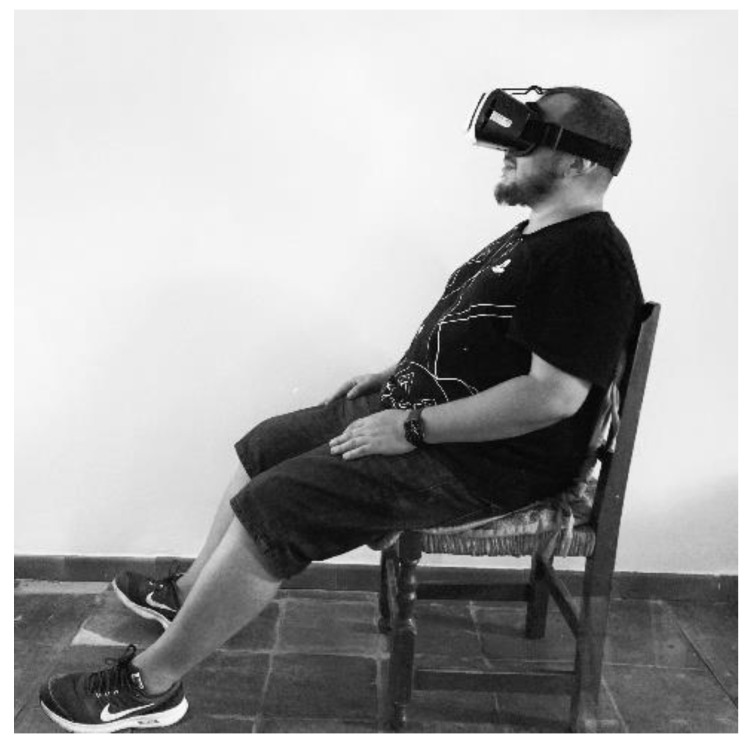
(1) Background: Hemarthrosis is a typical clinical manifestation in patients with hemophilia. Its recurrence causes hemophilic arthropathy, characterized by chronic joint pain. Watching movement recorded from a first-person perspective and immersively can be effective in the management of chronic pain. The objective of this study was to evaluate the effectiveness of an immersive virtual reality intervention in improving the pain intensity, joint condition, muscle strength and range of motion in patients with hemophilic knee arthropathy. (2) Methods: Thirteen patients with hemophilic knee arthropathy were recruited. The patients wore virtual reality glasses and watched a flexion-extension movement of the knee on an immersive 180° video, recorded from a first-person perspective over a 28-day period. The primary variable was the pain intensity (visual analog scale). The secondary variables were the joint status (Hemophilia Joint Health Score), quadriceps and hamstring strength (dynamometry), and range of motion (goniometry). (3) Results: After the intervention period, statistically significant differences were observed in the intensity of the joint pain (Standard error [SE] = 19.31; 95% interval confidence [95%CI] = -1.05; -0.26), joint condition (SE = 18.68; 95%CI = -1.16; -0.52) and quadriceps strength (SE = 35.00; 95%CI = 2.53; 17.47). We found that 38.46% and 23.07% of the patients exhibited an improvement in their quadriceps muscle strength and joint condition above the minimum detectable change for both variables (8.21% and 1.79%, respectively). (4) Conclusions: One hundred and eighty degree immersive VR motion visualization can improve the intensity of joint pain in patients with hemophilic knee arthropathy. An intervention using immersive virtual reality can be an effective complementary approach to improve the joint condition and quadriceps strength in these patients.
Keywords: hemophilia; joint pain; knee; physiotherapy; virtual reality exposure therapy.
Conflict of interest statement
The authors declare no conflict of interest. The funders had no role in the design of the study; in the collection, analyses, or interpretation of data; in the writing of the manuscript; or in the decision to publish the results.
Figures
References
-
- Soucie J.M., Cianfrini C., Janco R.L., Kulkarni R., Hambleton J., Evatt B., Forsyth A., Geraghty S., Hoots K., Abshire T., et al. Joint range-of-motion limitations among young males with hemophilia: Prevalence and risk factors. Blood. 2004;103:2467–2473. doi: 10.1182/blood-2003-05-1457. - DOI - PubMed
-
- Manco-Johnson M.J., Abshire T.C., Shapiro A.D., Riske B., Hacker M.R., Kilcoyne R., Ingram J.D., Manco-Johnson M.L., Funk S., Jacobson L., et al. Prophylaxis versus Episodic Treatment to Prevent Joint Disease in Boys with Severe Hemophilia. N. Engl. J. Med. 2007;357:535–544. doi: 10.1056/NEJMoa067659. - DOI - PubMed
-
- St-Louis J., Abad A., Funk S., Tilak M., Classey S., Zourikian N., McLaughlin P., Lobet S., Hernandez G., Akins S., et al. The Hemophilia Joint Health Score version 2.1 Validation in Adult Patients Study: A multicenter international study. Res. Pract. Thromb. Haemost. 2022;6:e12690. doi: 10.1002/rth2.12690. - DOI - PMC - PubMed
Grants and funding
LinkOut - more resources
Full Text Sources
