


Exogenous Regulators Enhance the Yield and Stress Resistance of Chlamydospores of the Biocontrol Agent Trichoderma harzianum T4
- PMID: 36294583
- PMCID: PMC9604748
- DOI: 10.3390/jof8101017
Exogenous Regulators Enhance the Yield and Stress Resistance of Chlamydospores of the Biocontrol Agent Trichoderma harzianum T4
Abstract
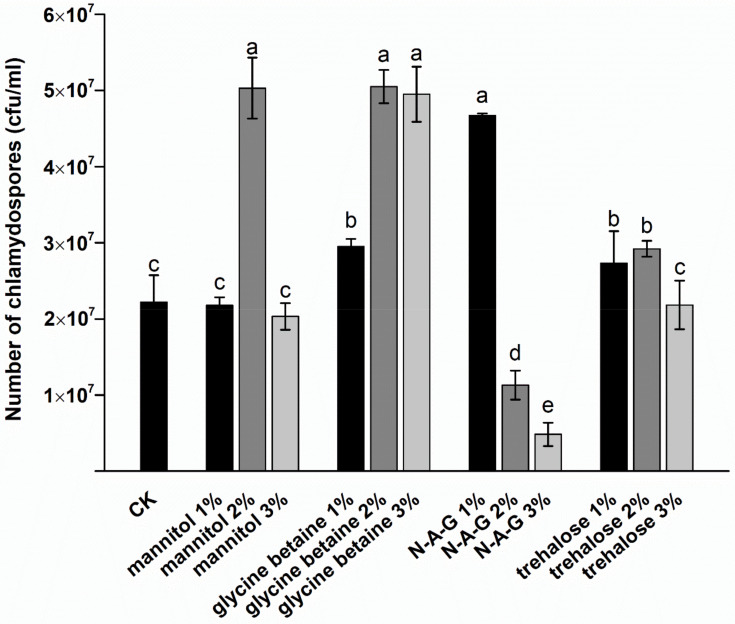
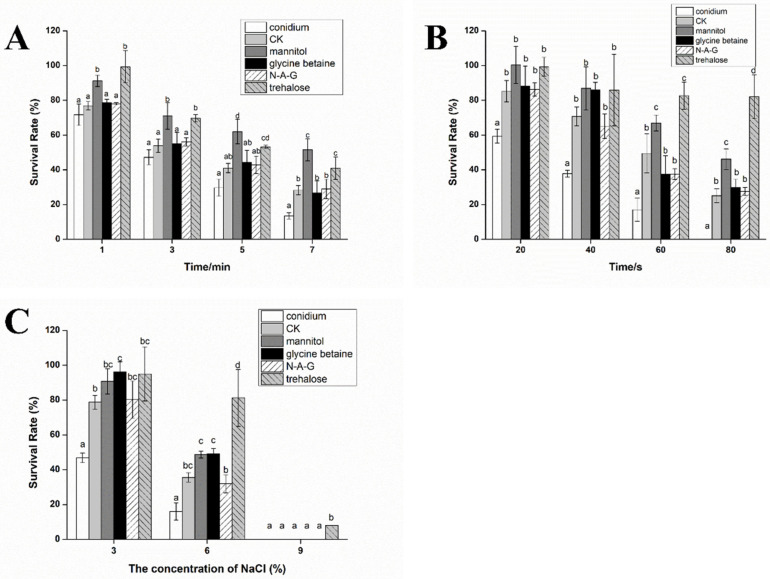
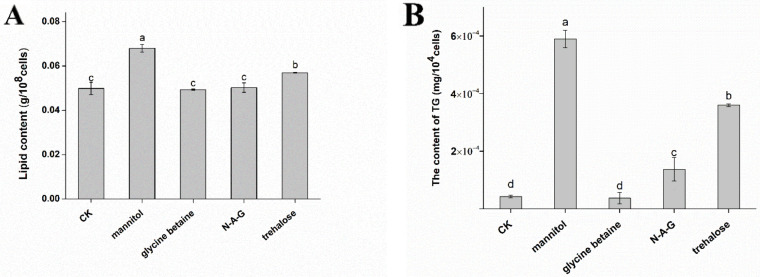
Trichoderma strains have been successfully used in plant disease control. However, the poor stress resistance of mycelia and conidia makes processing and storage difficult. Furthermore, they cannot produce chlamydospores in large quantities during fermentation, which limits the industrialization process of chlamydospore preparation. It is important to explore an efficient liquid fermentation strategy for ensuring chlamydospore production in Trichoderma harzianum. We found that the addition of mannitol, glycine betaine, and N-acetylglucosamine (N-A-G) during liquid fermentation effectively increases the yield of chlamydospores. Furthermore, we provided evidence that chlamydospores have stronger tolerance to high temperature, ultraviolet, and hypertonic stress after the addition of mannitol and trehalose. Lipids are an important component of microbial cells and impact the stress resistance of microorganisms. We studied the internal relationship between lipid metabolism and the stress resistance of chlamydospores by detecting changes in the lipid content and gene expression. Our results showed that mannitol and trehalose cause lipid accumulation in chlamydospores and increase the unsaturated fatty acid content. In conclusion, we verified that these exogenous regulators increase the production of chlamydospores and enhance their stress resistance by regulating lipid metabolism. In addition, we believe that lipid metabolism is an important part of the chlamydospore production process and impacts the stress resistance of chlamydospores. Our findings provide clues for studying the differentiation pathway of chlamydospores in filamentous fungi and a basis for the industrial production of chlamydospores.
Keywords: Trichoderma harzianum T4; chlamydospore; exogenous regulators; lipid metabolism; stress resistance; unsaturated fatty acids.
Conflict of interest statement
The authors hereby declare that they have no conflict of interest.
Figures


References
-
- Zeilinger S., Gruber S., Bansal R., Mukherjee P.K. Secondary metabolism in Trichoderma—Chemistry meets genomics. Fungal Biol. Rev. 2016;30:74–90. doi: 10.1016/j.fbr.2016.05.001. - DOI
-
- Pei W.L., Wang W. Preparation and Field Efficacy of Chlamydospore Water Dispersible Granule of Trichoderma harzianum. Chin. J. Biol. Control. 2020;36:241–248.
-
- Fei X., Zhang Y., Xu R., Wang W. Effect of Trichoderma harzianum T4 on Bacterial Community in Watermelon (Citrullus lanatus) Rhizosphere Soil. Chin. J. Biol. Control. 2013;29:232–241.
Grants and funding
LinkOut - more resources
Full Text Sources
Medical
