Review
. 2022 Oct 9;12(10):1682.
doi: 10.3390/jpm12101682.

Machine Learning in Predicting Tooth Loss: A Systematic Review and Risk of Bias Assessment

Affiliations
Review

Machine Learning in Predicting Tooth Loss: A Systematic Review and Risk of Bias Assessment

Akira Hasuike et al. J Pers Med. .

Abstract

Predicting tooth loss is a persistent clinical challenge in the 21st century. While an emerging field in dentistry, computational solutions that employ machine learning are promising for enhancing clinical outcomes, including the chairside prognostication of tooth loss. We aimed to evaluate the risk of bias in prognostic prediction models of tooth loss that use machine learning. To do this, literature was searched in two electronic databases (MEDLINE via PubMed; Google Scholar) for studies that reported the accuracy or area under the curve (AUC) of prediction models. AUC measures the entire two-dimensional area underneath the entire receiver operating characteristic (ROC) curves. AUC provides an aggregate measure of performance across all possible classification thresholds. Although both development and validation were included in this review, studies that did not assess the accuracy or validation of boosting models (AdaBoosting, Gradient-boosting decision tree, XGBoost, LightGBM, CatBoost) were excluded. Five studies met criteria for inclusion and revealed high accuracy; however, models displayed a high risk of bias. Importantly, patient-level assessments combined with socioeconomic predictors performed better than clinical predictors alone. While there are current limitations, machine-learning-assisted models for tooth loss may enhance prognostication accuracy in combination with clinical and patient metadata in the future.

Keywords: boosting; deep learning; machine learning; periodontitis; prognosis; tooth loss.


Conflict of interest statement

The authors declare no conflict of interest. The funders had no role in the design of the study; in the collection, analyses, or interpretation of data; in the writing of the manuscript; or in the decision to publish results.

Figures
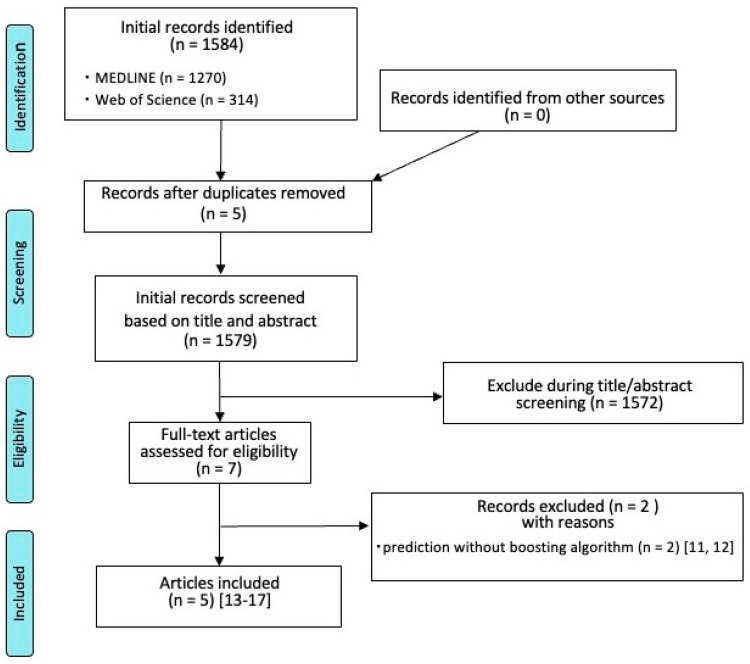
Figure 1
Figure 1
Flow diagram for the selection of studies.
Figure 2
Figure 2
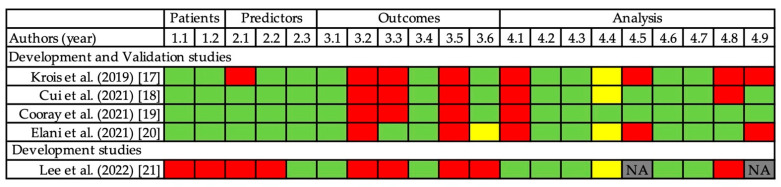
Risk-of-bias assessment with PROBAST signaling questions in four domains [14]. Low (green), high (red), unclear risk of bias (yellow), and not applicable (NA). PROBAST items: 1.1. Were appropriate data sources used? 1.2. Were all inclusions and exclusions of participants appropriate? 2.1. Were predictors defined and assessed in a similar way for all participants? 2.2. Were predictor assessments made without knowledge of outcome data? 2.3. Are all predictors available at the time the model is intended to be used? 3.1. Was the outcome determined appropriately? 3.2. Was a prespecified or standard outcome definition used? 3.3. Were predictors excluded from the outcome definition? 3.4. Was the outcome defined and determined in a similar way for all participants? 3.5. Was the outcome determined without knowledge of predictor information? 3.6. Was the time interval between predictor assessment and outcome determination appropriate? 4.1. Were there a reasonable number of participants with the outcome? 4.2. Were continuous and categorical predictors handled appropriately? 4.3. Were all enrolled participants included in the analysis? 4.4. Were participants with missing data handled appropriately? 4.5. Was the selection of predictors based on univariable analysis avoided? 4.6. Were complexities in the data accounted for appropriately? 4.7. Were relevant model performance measures evaluated appropriately? 4.8. Were model overfitting and optimism in model performance accounted for? 4.9. Do predictors and their assigned weights in the final model correspond to the results from the reported multivariable analysis?

References

    1. Saydzai S., Buontempo Z., Patel P., Hasan F., Sun C., Akcalı A., Lin G., Donos N., Nibali L. Comparison of the efficacy of periodontal prognostic systems in predicting tooth loss. J. Clin. Periodontol. 2022;49:740–748. doi: 10.1111/jcpe.13672. - DOI - PMC - PubMed
    1. Hirschfeld L., Wasserman B. A Long-Term Survey of Tooth Loss in 600 Treated Periodontal Patients. J. Periodontol. 1978;49:225–237. doi: 10.1902/jop.1978.49.5.225. - DOI - PubMed
    1. McGuire M.K. Prognosis Versus Actual Outcome: A Long-Term Survey of 100 Treated Periodontal Patients Under Maintenance Care. J. Periodontol. 1991;62:51–58. doi: 10.1902/jop.1991.62.1.51. - DOI - PubMed
    1. Kwok V., Caton J.G. Commentary: Prognosis Revisited: A System for Assigning Periodontal Prognosis. J. Periodontol. 2007;78:2063–2071. doi: 10.1902/jop.2007.070210. - DOI - PubMed
    1. Avila G., Galindo-Moreno P., Soehren S., Misch C.E., Morelli T., Wang H.-L. A Novel Decision-Making Process for Tooth Retention or Extraction. J. Periodontol. 2009;80:476–491. doi: 10.1902/jop.2009.080454. - DOI - PubMed

LinkOut - more resources