


Can Persistent Homology Features Capture More Intrinsic Information about Tumors from 18F-Fluorodeoxyglucose Positron Emission Tomography/Computed Tomography Images of Head and Neck Cancer Patients?
- PMID: 36295874
- PMCID: PMC9610853
- DOI: 10.3390/metabo12100972
Can Persistent Homology Features Capture More Intrinsic Information about Tumors from 18F-Fluorodeoxyglucose Positron Emission Tomography/Computed Tomography Images of Head and Neck Cancer Patients?
Abstract
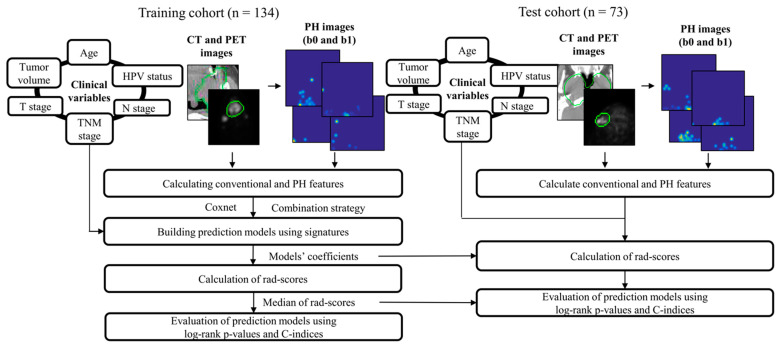
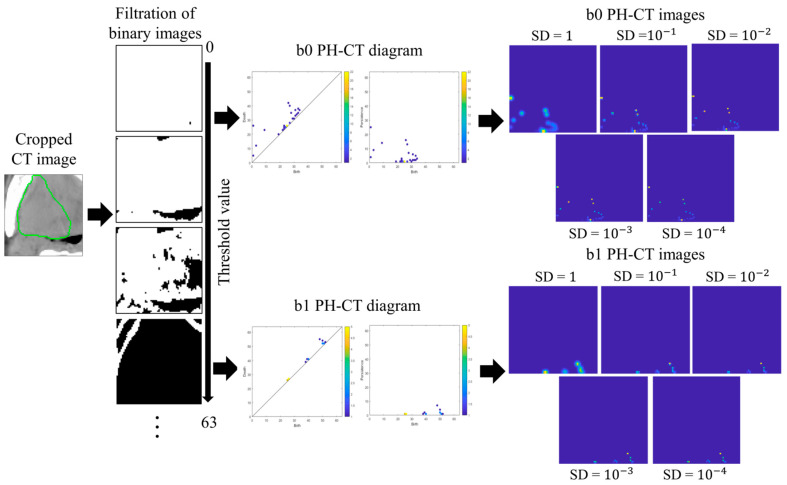
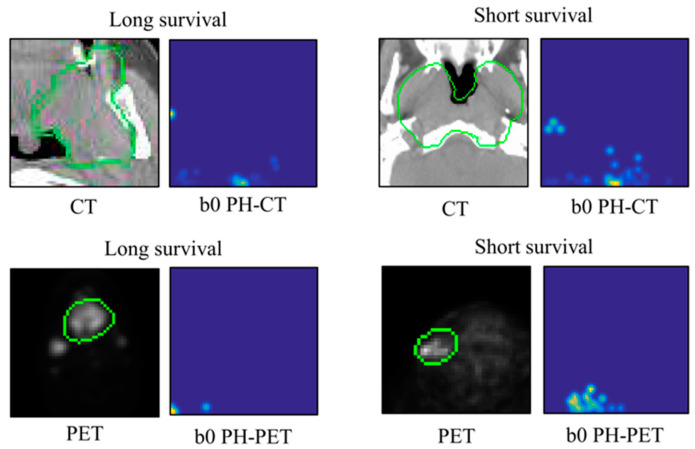
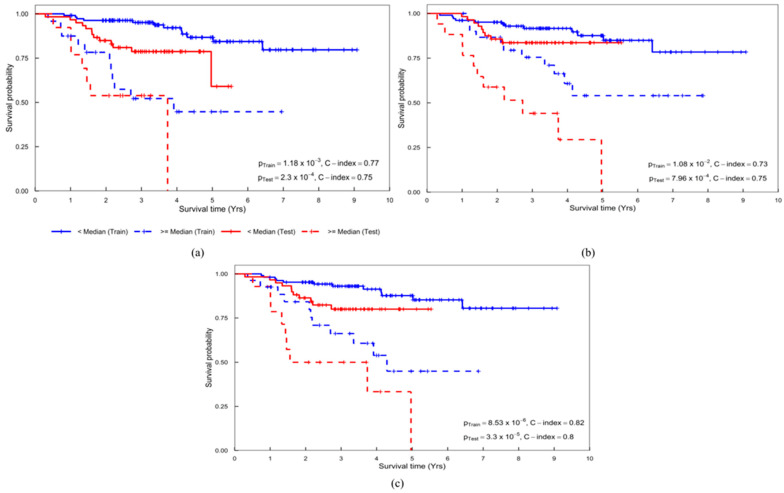
This study hypothesized that persistent homology (PH) features could capture more intrinsic information about the metabolism and morphology of tumors from 18F-fluorodeoxyglucose positron emission tomography (PET)/computed tomography (CT) images of patients with head and neck (HN) cancer than other conventional features. PET/CT images and clinical variables of 207 patients were selected from the publicly available dataset of the Cancer Imaging Archive. PH images were generated from persistent diagrams obtained from PET/CT images. The PH features were derived from the PH PET/CT images. The signatures were constructed in a training cohort from features from CT, PET, PH-CT, and PH-PET images; clinical variables; and the combination of features and clinical variables. Signatures were evaluated using statistically significant differences (p-value, log-rank test) between survival curves for low- and high-risk groups and the C-index. In an independent test cohort, the signature consisting of PH-PET features and clinical variables exhibited the lowest log-rank p-value of 3.30 × 10⁻⁵ and C-index of 0.80, compared with log-rank p-values from 3.52 × 10⁻² to 1.15 × 10⁻⁴ and C-indices from 0.34 to 0.79 for other signatures. This result suggests that PH features can capture the intrinsic information of tumors and predict prognosis in patients with HN cancer.
Keywords: head and neck cancer; persistent homology; prognostic prediction; radiomics.
Conflict of interest statement
The authors declare no conflict of interest.
Figures
References
Grants and funding
LinkOut - more resources
Full Text Sources
