Review
. 2022 Oct 18;27(20):7009.
doi: 10.3390/molecules27207009.

The Hydrophobic Effects: Our Current Understanding

Affiliations
Review

The Hydrophobic Effects: Our Current Understanding

Qiang Sun. Molecules. .

Abstract

Hydrophobic interactions are involved in and believed to be the fundamental driving force of many chemical and biological phenomena in aqueous environments. This review focuses on our current understanding on hydrophobic effects. As a solute is embedded into water, the interface appears between solute and water, which mainly affects the structure of interfacial water (the topmost water layer at the solute/water interface). From our recent structural studies on water and air-water interface, hydration free energy is derived and utilized to investigate the origin of hydrophobic interactions. It is found that hydration free energy depends on the size of solute. With increasing the solute size, it is reasonably divided into initial and hydrophobic solvation processes, and various dissolved behaviors of the solutes are expected in different solvation processes, such as dispersed and accumulated distributions in solutions. Regarding the origin of hydrophobic effects, it is ascribed to the structural competition between the hydrogen bondings of interfacial and bulk water. This can be applied to understand the characteristics of hydrophobic interactions, such as the dependence of hydrophobic interactions on solute size (or concentrations), the directional natures of hydrophobic interactions, and temperature effects on hydrophobic interactions.

Keywords: hydrogen bonding; hydrophobic effects; interface; solute; water.


Conflict of interest statement

The authors declare no conflict of interest.

Figures

Figure 1
Figure 1
The “iceberg” structural model of hydrophobic effects. The ordered water structure is expected to form around the solute. As two “caged” solutes become together, the “structured” water in the region between them may be returned to the bulk.
Figure 2
Figure 2
The Raman OH stretching bands of water from 298 to 248 K under 0.1 MPa. Based on normalized intensity, an isosbestic point is found around 3330 cm−1.
Figure 3
Figure 3
The dependence of the OH stretching frequency on hydrogen bondings of water molecular clusters, (H2O)n. Different symbols are used to discriminate OH vibrations engaged in various local hydrogen-bonded networks of a water molecule. Various structures of hexamers are also shown.
Figure 4
Figure 4
The Raman OH stretching band of ambient water may be deconvoluted into five sub-bands, located at 3041, 3220, 3430, 3572, and 3636 cm−1, and assigned to the νDAA-OH, νDDAA-OH, νDA-OH, νDDA-OH, and free OH symmetric stretching vibrations, respectively. At ambient conditions, the main local hydrogen-bonded networks for a water molecule are expected to be DDAA, DDA, DAA, and DA hydrogen bondings. Hydrogen bondings are drawn with dashed lines.
Figure 5
Figure 5
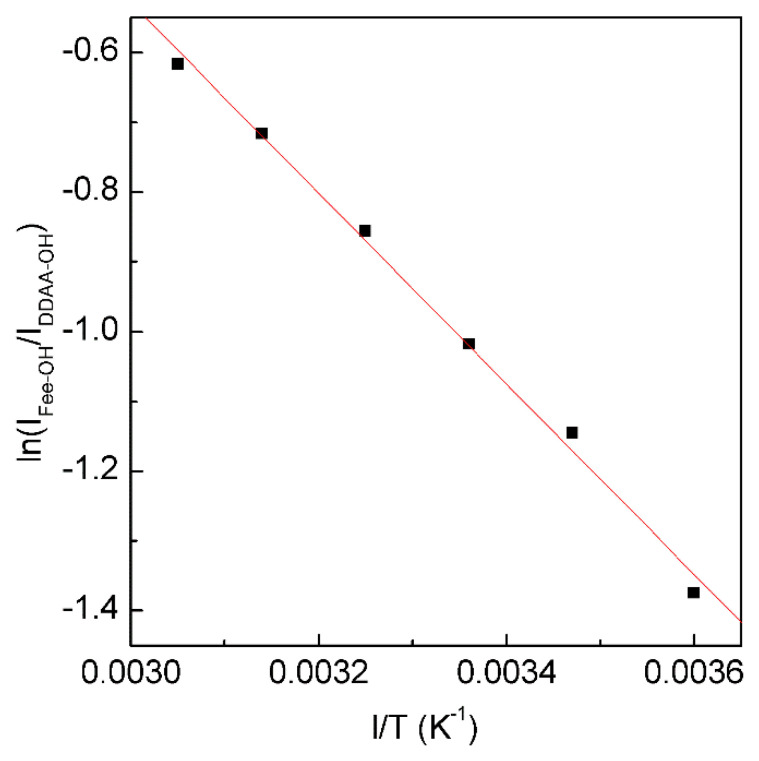
The dependence of ln(IFree-OH/IDDAA-OH) on 1/T. The solid line represents linear fit (R2 = 0.9975) with a slope of −∆H/R. This is used to determine the thermodynamic characteristics of tetrahedral hydrogen bonding.
Figure 6
Figure 6
Structural changes across the solute-water interface. The dissolved solute mainly affects the structure of interfacial water (topmost water layer at the interface).
Figure 7
Figure 7
Hydration free energy at 293 K and 0.1 MPa. Hydration free energy is related to the size of solute, and critical radius (Rc) is expected. With increasing the solute size, it is divided into initial and hydrophobic solvation processes.
Figure 8
Figure 8
Different dissolved behaviors of solutes in aqueous solutions may be expected in initial (a) and hydrophobic (b) solvation processes.
Figure 9
Figure 9
The dependence of hydrophobic interactions on solute size. Based on the calculated potential of mean forces (PMFs) between C60 fullerenes in water and under vacuum (a), the water-induced PMF between C60 fullerenes is determined (b). It is fitted as, ΔG = −3.35 + γ·3.80/(r − 10). During the H1w process, γ = 1. In the H2s process, solutes become contact in solutions. The fitted results at various γ (0.8, 0.6, 0.4) are drawn in squares. From the PMFs between CH4 dimers in water and under vacuum (c), these are used to determine the water-induced PMF between CH4 dimers (d). Stable configurations are also shown.
Figure 10
Figure 10
The thermodynamic characteristics of hydrophobic interactions. Based on the calculated PMFs of C60-C60 fullerenes and CH4-CH4 in water at different temperatures (300 K, 320 K and 340 K), water contributions to Gibbs energy (ΔGW) are determined, which are used to calculate the enthalpic (ΔHW) and entropic (-T·ΔSW) contributions. Different thermodynamic characteristics may be expected in initial (a) and hydrophobic (b) solvation processes.
Figure 11
Figure 11
The changes of interfacial (a) and bulk (b) water during two C60 fullerenes are aggregated in solutions. The dashed line represents the corresponding time of RH.
Figure 12
Figure 12
The homogeneous nucleation mechanism of dissolved solutes in water. The dissolved behaviors of solutes in water are related to the ion concentrations, which affect the nucleation mechanism of crystal in water. Due to the formation of solute aggregate, this lowers the height of nucleation barrier.
Figure 13
Figure 13
Hydrophobic-interaction-driven model (HDM) of molecular recognition. The solutes mainly affect the structure of interfacial water (dashed line). Due to hydrophobic interactions, the solutes are attracted and approach in the direction with the lowest energy barrier in the H1w process. As the solutes become contact in the H2s process, they are accumulated in a specific direction to minimize the surface area to volume ratio. Additionally, with decreasing separation between the solutes in the H2s process, the solute-solute interactions become stronger. The affinity of molecular recognition is related to both the hydrophobic interactions and the solute-solute interactions.
Figure 14
Figure 14
The temperature effects on hydration free energy at 0.1 MPa. Regarding the dependence of hydration free energy on temperature, it is related to the size of solute. With increasing temperature, this decreases the Rc.
Figure 15
Figure 15
The mechanism of protein unfolding. Inlet shows the dependence of Rc on temperature as two identical solutes are embedded into water. With increasing (or decreasing) temperature, obvious structural changes are expected as the solute size passing through Rc. This is reflected on the global and local (interior) structures of protein. Regarding the molecular mechanism of protein unfolding, cold denaturation may be different from heat unfolding.

References

    1. Scheraga H.A. Theory of hydrophobic interactions. J. Biomol. Struct. Dyn. 1998;16:447–460. doi: 10.1080/07391102.1998.10508260. - DOI - PubMed
    1. Blokzijl W., Engberts J.B.F.N. Hydrophobic effects. Opinions and facts. Angew. Chem. Int. Ed. 1993;32:1545–1579. doi: 10.1002/anie.199315451. - DOI
    1. Makowski M., Czaplewski C., Liwo A., Scheraga H.A. Potential of mean force of association of large hydrophobic particles: Toward the nanoscale limit. J. Phys. Chem. B. 2010;114:993–1003. doi: 10.1021/jp907794h. - DOI - PMC - PubMed
    1. Sobolewski E., Makowski M., Czaplewski C., Liwo A., Ołdziej S., Scheraga H.A. Potential of mean force of hydrophobic association: Dependence on solute size. J. Phys. Chem. B. 2007;111:10765–10774. doi: 10.1021/jp070594t. - DOI - PubMed
    1. Bartosik A., Wiśniewska M., Makowski M. Potentials of mean force for hydrophobic interactions between hydrocarbons in water solution: Dependence on temperature, solute shape, and solute size. J. Phys. Org. Chem. 2015;28:10–16. doi: 10.1002/poc.3387. - DOI