. 2022 Oct 19;27(20):7065.
doi: 10.3390/molecules27207065.

Evaluation of the Intracellular Signaling Activities of κ-Opioid Receptor Agonists, Nalfurafine Analogs; Focusing on the Selectivity of G-Protein- and β-Arrestin-Mediated Pathways

Affiliations

Evaluation of the Intracellular Signaling Activities of κ-Opioid Receptor Agonists, Nalfurafine Analogs; Focusing on the Selectivity of G-Protein- and β-Arrestin-Mediated Pathways

Masahiro Yamaguchi et al. Molecules. .

Abstract

Opioid receptors (ORs) are classified into three types (μ, δ, and κ), and opioid analgesics are mainly mediated by μOR activation; however, their use is sometimes restricted by unfavorable effects. The selective κOR agonist nalfurafine was initially developed as an analgesic, but its indication was changed because of the narrow safety margin. The activation of ORs mainly induces two intracellular signaling pathways: a G-protein-mediated pathway and a β-arrestin-mediated pathway. Recently, the expectations for κOR analgesics that selectively activate these pathways have increased; however, the structural properties required for the selectivity of nalfurafine are still unknown. Therefore, we evaluated the partial structures of nalfurafine that are necessary for the selectivity of these two pathways. We assayed the properties of nalfurafine and six nalfurafine analogs (SYKs) using cells stably expressing κORs. The SYKs activated κORs in a concentration-dependent manner with higher EC50 values than nalfurafine. Upon bias factor assessment, only SYK-309 (possessing the 3S-hydroxy group) showed higher selectivity of G-protein-mediated signaling activities than nalfurafine, suggesting the direction of the 3S-hydroxy group may affect the β-arrestin-mediated pathway. In conclusion, nalfurafine analogs having a 3S-hydroxy group, such as SYK-309, could be considered G-protein-biased κOR agonists.

Keywords: G-protein-biased agonists; analgesic; bias factor; nalfurafine; κ-opioid receptor.


Conflict of interest statement

The principal author and one coauthor (Y.K.) are employees of a pharmaceutical company (Pfizer Japan Inc. and Viatris Pharmaceuticals Japan Inc., respectively). However, the present study has no financial or other relationships with these companies, as it was entirely sponsored by and performed at the Jikei University School of Medicine, National Cancer Center Research Institute, and Juntendo University Graduate School of Medicine.

Figures
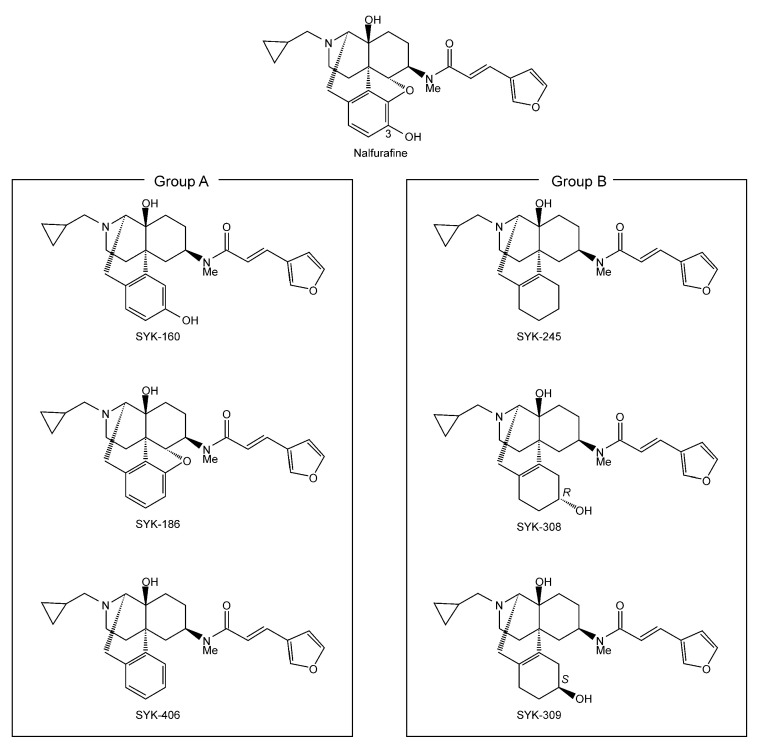
Figure 1
Figure 1
Molecular structures of nalfurafine and six nalfurafine analogs. Nalfurafine analogs were divided into two groups according to their structural characteristics. Group A (SYK-160, -186, and -406) includes nalfurafine analogs with a maintained benzene ring. Group B (SYK-245, -308, and -309) includes nalfurafine analogs with a cyclohexene ring converted from the benzene ring.
Figure 2
Figure 2
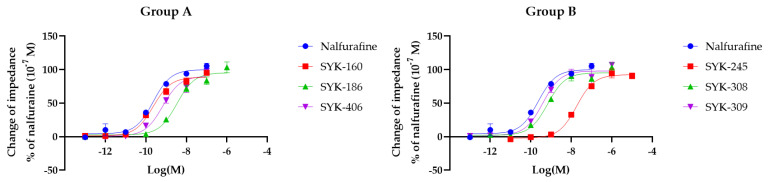
Effect of nalfurafine and six nalfurafine analogs on κORs observed using the CellKeyTM system. The cells expressing κORs were treated with nalfurafine (positive control) and six nalfurafine analogs (Group A: SYK-160, -186, -406; Group B: SYK-245, -308, -309) at concentrations of 10−13–10−5 M, and changes in impedance (ΔZiec) were measured using the CellKeyTM system. Concentration-response curves were prepared by calculating ΔZiec relative to the data obtained for the positive control: 10−7 M nalfurafine. All data points are presented as means ± standard error of the mean (SEM) (n = 3–6).
Figure 3
Figure 3
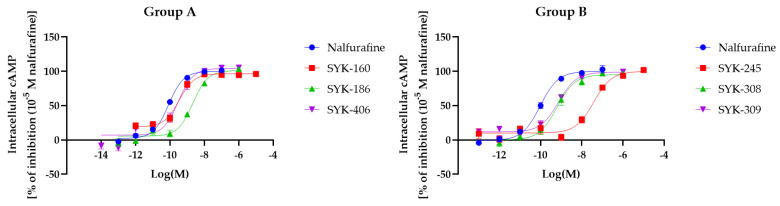
Changes in intracellular cAMP levels induced by nalfurafine (positive control) and six nalfurafine analogs (Group A: SYK-160, -186, -406; Group B: SYK-245, -308, -309). Cells expressing κORs were treated with the listed compounds (10−14–10−5 M), and intracellular cAMP levels were measured with the GloSensor® cAMP assay. Concentration-response curves were prepared by calculating cAMP levels relative to the data obtained with 10−7 M nalfurafine. Data are presented as means ± SEM (n = 3–9).
Figure 4
Figure 4
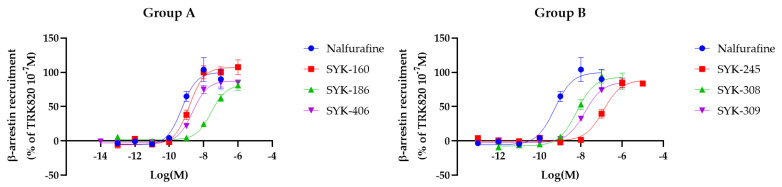
Levels of β-arrestin recruitment through κORs induced by nalfurafine and six nalfurafine analogs. We performed a PathHunter® β-arrestin assay in cells expressing κORs by treatment with nalfurafine (positive control) and the six nalfurafine analogs (Group A: SYK-160, -186, -406; Group B: SYK-245, -308, -309) at concentrations of 10−14–10−5 M. Concentration-response curves were prepared by calculating intracellular β-arrestin levels relative to the data obtained for nalfurafine (positive control: 10−7 M). All data points are presented as means ± SEM (n = 5–8).

References

    1. Kivell B., Prisinzano T.E. Kappa Opioids and the Modulation of Pain. Psychopharmacology. 2010;210:109–119. doi: 10.1007/s00213-010-1819-6. - DOI - PubMed
    1. Berterame S., Erthal J., Thomas J., Fellner S., Vosse B., Clare P., Hao W., Johnson D.T., Mohar A., Pavadia J., et al. Use of and Barriers to Access to Opioid Analgesics: A Worldwide, Regional, and National Study. Lancet. 2016;387:1644–1656. doi: 10.1016/S0140-6736(16)00161-6. - DOI - PubMed
    1. Caudill-Slosberg M.A., Schwartz L.M., Woloshin S. Office Visits and Analgesic Prescriptions for Musculoskeletal Pain in US: 1980 vs. 2000. Pain. 2004;109:514–519. doi: 10.1016/j.pain.2004.03.006. - DOI - PubMed
    1. Olsen Y., Daumit G.L., Ford D.E. Opioid Prescriptions by U.S. Primary Care Physicians From 1992 to 2001. J. Pain. 2006;7:225–235. doi: 10.1016/j.jpain.2005.11.006. - DOI - PubMed
    1. Machelska H., Celik M.Ö. Advances in Achieving Opioid Analgesia Without Side Effects. Front. Pharmacol. 2018;9:1388. doi: 10.3389/fphar.2018.01388. - DOI - PMC - PubMed