


Lessons Learned from the COVID-19 Pandemic and How Blood Operators Can Prepare for the Next Pandemic
- PMID: 36298680
- PMCID: PMC9608827
- DOI: 10.3390/v14102126
Lessons Learned from the COVID-19 Pandemic and How Blood Operators Can Prepare for the Next Pandemic
Abstract
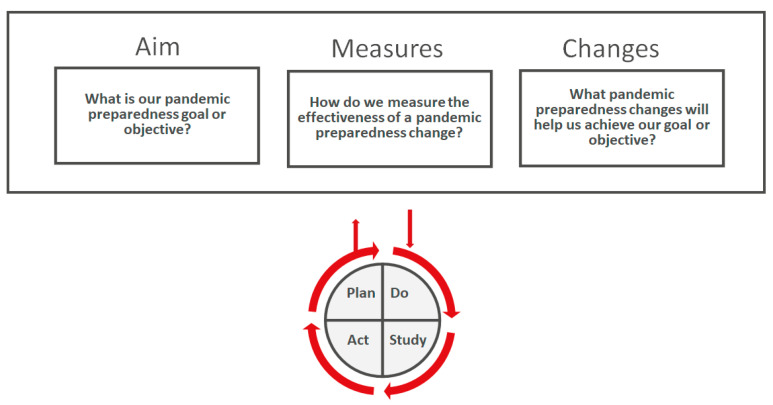
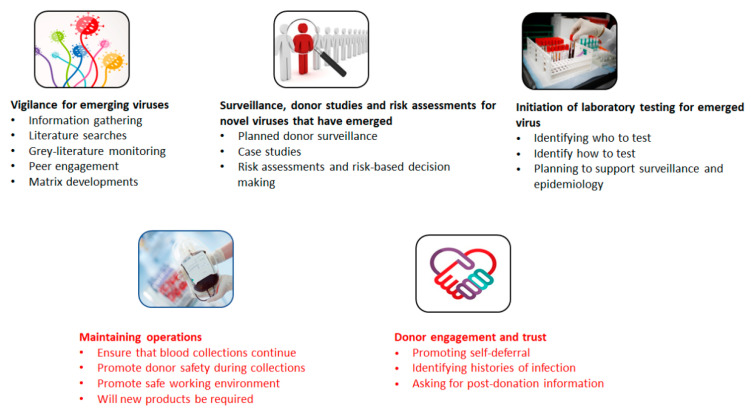
Humans interact with virus-infected animal hosts, travel globally, and maintain social networks that allow for novel viruses to emerge and develop pandemic potential. There are key lessons-learned from the coronavirus diseases 2019 (COVID-19) pandemic that blood operators can apply to the next pandemic. Warning signals to the COVID-19 pandemic included outbreaks of Severe acute respiratory syndrome-related coronavirus-1 (SARS-CoV-1) and Middle East respiratory syndrome-related coronavirus (MERS-CoV) in the prior two decades. It will be critical to quickly determine whether there is a risk of blood-borne transmission of a new pandemic virus. Prior to the next pandemic blood operators should be prepared for changes in activities, policies, and procedures at all levels of the organization. Blood operators can utilize "Plan-Do-Study-Act" cycles spanning from: vigilance for emerging viruses, surveillance activities and studies, operational continuity, donor engagement and trust, and laboratory testing if required. Occupational health and donor safety issues will be key areas of focus even if the next pandemic virus is not transfusion transmitted. Blood operators may also be requested to engage in new activities such as the development of therapeutics or supporting public health surveillance activities. Activities such as scenario development, tabletop exercises, and drills will allow blood operators to prepare for the unknowns of the next pandemic.
Keywords: blood operators; blood-borne agents; emerging viral pathogens; pandemic planning.
Conflict of interest statement
Steven J Drews has functioned as a content expert for respiratory viruses for Johnson & Johnson (Janssen) and has received funding in-kind from Abbott. He has also acted as a paid consultant to Roche on Arboviruses and Malaria.
Figures
References
-
- Pulit-Penaloza J.A., Jones J., Sun X., Jang Y., Thor S., Belser J.A., Zanders N., Creager H.M., Ridenour C., Wang L., et al. Antigenically Diverse Swine Origin H1N1 Variant Influenza Viruses Exhibit Differential Ferret Pathogenesis and Transmission Phenotypes. J. Virol. 2018;92:e00095-18. doi: 10.1128/JVI.00095-18. - DOI - PMC - PubMed
-
- Garten R.J., Davis C.T., Russell C.A., Shu B., Lindstrom S., Balish A., Sessions W.M., Xu X., Skepner E., Deyde V., et al. Antigenic and genetic characteristics of swine-origin 2009 A(H1N1) influenza viruses circulating in humans. Science. 2009;325:197–201. doi: 10.1126/science.1176225. - DOI - PMC - PubMed
Publication types
MeSH terms
Grants and funding
LinkOut - more resources
Full Text Sources
Medical
Miscellaneous
