


Neighbourhood disadvantage impacts on pulmonary function in patients with sarcoidosis
- PMID: 36299359
- PMCID: PMC9589334
- DOI: 10.1183/23120541.00357-2022
Neighbourhood disadvantage impacts on pulmonary function in patients with sarcoidosis
Abstract
Background: This multicentre, international, prospective cohort study evaluated whether patients with pulmonary sarcoidosis living in neighbourhoods with greater material and social disadvantage experience worse clinical outcomes.
Methods: The area deprivation index and the Canadian Index of Multiple Deprivation evaluate neighbourhood-level disadvantage in the US and Canada, with higher scores reflecting greater disadvantage. Multivariable linear regression evaluated associations of disadvantage with baseline forced vital capacity (FVC) or diffusing capacity of the lung for carbon monoxide (D LCO) and linear mixed effects models for associations with rate of FVC or D LCO decline, and competing hazards models were used for survival analyses in the US cohort, evaluating competing outcomes of death or lung transplantation. Adjustments were made for age at diagnosis, sex, race and smoking history.
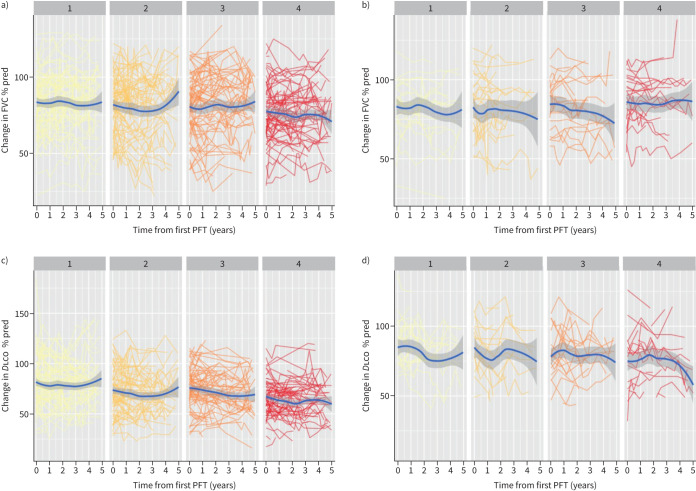
Results: We included 477 US and 122 Canadian patients with sarcoidosis. Higher disadvantage was not associated with survival or baseline FVC. The highest disadvantage quartile was associated with lower baseline D LCO in the US cohort (β = -6.80, 95% CI -13.16 to -0.44, p=0.04), with similar findings in the Canadian cohort (β = -7.47, 95% CI -20.28 to 5.33, p=0.25); with more rapid decline in FVC and D LCO in the US cohort (FVC β = -0.40, 95% CI -0.70 to -0.11, p=0.007; D LCO β = -0.59, 95% CI -0.95 to -0.23, p=0.001); and with more rapid FVC decline in the Canadian cohort (FVC β = -0.80, 95% CI -1.37 to -0.24, p=0.003).
Conclusion: Patients with sarcoidosis living in high disadvantage neighbourhoods experience worse baseline lung function and more rapid lung function decline, highlighting the need for better understanding of how neighbourhood-level factors impact individual patient outcomes.
Copyright ©The authors 2022.
Conflict of interest statement
Conflict of interest: G.C. Goobie receives research funding and support through the Pulmonary Fibrosis Foundation Scholars Award Program and the University of British Columbia Clinician Investigator Program. C.J. Ryerson, D. Assayag and M.R.J. Kolb report personal fees and grants from Boehringer Ingelheim and Hoffman La Roche outside the submitted work. K.A. Johannson reports personal fees, nonfinancial support and other support from Boehringer Ingelheim and the Three Lakes Foundation, personal fees from Hoffman-La Roche Ltd, and grants from the University Hospital Foundation, the University of Calgary Cumming School of Medicine, and the Pulmonary Fibrosis Society of Calgary. V. Marcoux reports grants and personal fees from Boehringer Ingelheim Canada, Hoffman La-Roche Ltd and AstraZeneca, and grants from the University of Saskatchewan and the Royal University Hospital Foundation. M.R.J. Kolb also reports personal fees and grants from GSK, Gilead, Actelion, Respivert, Genoa, Alkermes, Pharmaxis, Prometric, Indalo and Third Pole. H. Manganas reports grants from Hoffman-La Roche Ltd, Galapagos and BMS, and personal fees and research grants from Boehringer Ingelheim. D. Assayag also reports personal fees and grants from Novartis. J.H. Fisher reports grants from the Canadian Pulmonary Fibrosis Foundation, and personal fees from Boehringer Ingelheim and AstraZeneca, outside of the submitted work. D.J. Kass is supported in part by AR060780, HL133232, UL1 TR001857 and AR076024 (NIH grants), Boehringer Ingelheim grants, and receives collaborative research funding from Regeneron Pharmaceuticals, outside of the submitted work. Y. Zhang is supported in part by AR076024 (NIH grant). S. Keil, E. Schikowski, N. Khalil, X. Chen, K.F. Gibson and K.O. Lindell report no competing interests. S.M. Nouraie receives grant support from Boehringer Ingelheim USA.
Figures

References
-
- Hunninghake GW, Costabel U, Ando M, et al. . Statement on sarcoidosis. Joint Statement of the American Thoracic Society (ATS), the European Respiratory Society (ERS) and the World Association of Sarcoidosis and Other Granulomatous Disorders (WASOG) adopted by the ATS Board of Directors and by the ER. Am J Respir Crit Care Med 1999; 160: 736–755. doi:10.1164/ajrccm.160.2.ats4-99 - DOI - PubMed
Grants and funding
LinkOut - more resources
Full Text Sources