Understanding basic principles of Artificial Intelligence: a practical guide for intensivists
- PMID: 36300214
- PMCID: PMC9686179
- DOI: 10.23750/abm.v93i5.13626
Understanding basic principles of Artificial Intelligence: a practical guide for intensivists
Abstract
Background and aim: Artificial intelligence was born to allow computers to learn and control their environment, trying to imitate the human brain structure by simulating its biological evolution. Artificial intelligence makes it possible to analyze large amounts of data (big data) in real-time, providing forecasts that can support the clinician's decisions. This scenario can include diagnosis, prognosis, and treatment in anesthesiology, intensive care medicine, and pain medicine. Machine Learning is a subcategory of AI. It is based on algorithms trained for decisions making that automatically learn and recognize patterns from data. This article aims to offer an overview of the potential application of AI in anesthesiology and analyzes the operating principles of machine learning Every Machine Learning pathway starts from task definition and ends in model application.
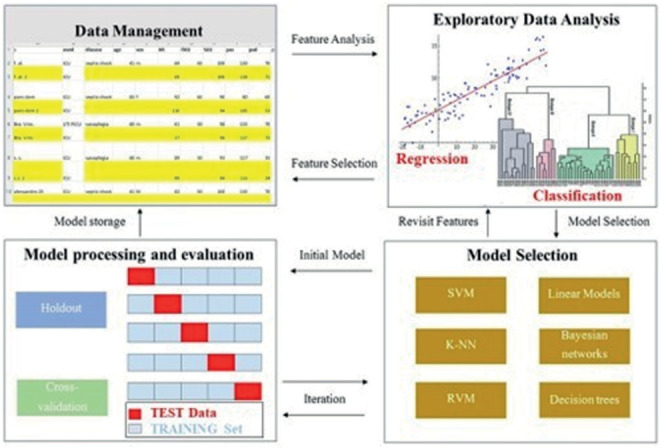
Conclusions: High-performance characteristics and strict quality controls are needed during its progress. During this process, different measures can be identified (pre-processing, exploratory data analysis, model selection, model processing and evaluation). For inexperienced operators, the process can be facilitated by ad hoc tools for data engineering, machine learning, and analytics.
Conflict of interest statement
Each author declares that he or she has no commercial associations (e.g. consultancies, stock ownership, equity interest, patent/licensing arrangement etc.) that might pose a conflict of interest in connection with the submitted article.
Figures
References
-
- Melanie M. An Introduction to Genetic Algorithms (Fifth printing ed. Vol3). A Bradford Book The MIT Press, Cambridge, 221s. 1999
-
- McCarthy J. What is artificial intelligence. 2004 accessible on:: http://www-formal.stanford.edu/jmc/whatisai.html .
-
- Kaul V, Enslin S, Gross SA. History of artificial intelligence in medicine. Gastrointest Endosc. 2020 Oct;92(4):807–812. doi: 10.1016/j.gie.2020.06.040. - PubMed
MeSH terms
LinkOut - more resources
Full Text Sources