Radial nerve entrapment after fracture of the supracondylar humerus: a rare case of a 6-year-old
- PMID: 36300558
- PMCID: PMC9682549
- DOI: 10.5152/j.aott.2022.22062
Radial nerve entrapment after fracture of the supracondylar humerus: a rare case of a 6-year-old
Erratum in
-
Erratum.Acta Orthop Traumatol Turc. 2022 Nov;56(6):421. doi: 10.5152/j.aott.2022.23001. Acta Orthop Traumatol Turc. 2022. PMID: 36441051 Free PMC article. No abstract available.
Abstract
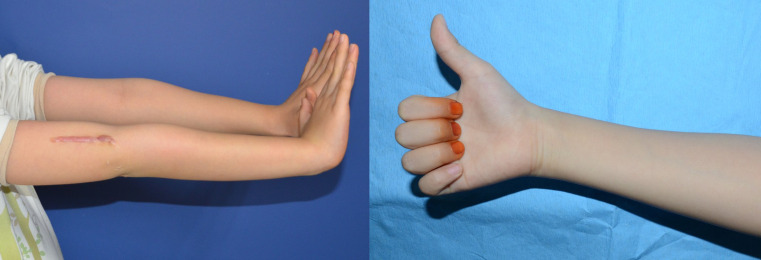
Supracondylar fracture of the humerus is one of the most common fractures seen in children, and posteromedial displacement of the distal fragment in extension-type supracondylar humerus fractures can cause injury to the radial nerve. A 6-year old girl who presented with symptoms of radial nerve injury after a supracondylar fracture of the right humerus with complete posteromedial displacement of the distal fragment (Gartland type III) underwent surgery where closed reduction and percutaneous pinning was performed. The patient was routinely followed up and at 6 months postoperatively no neurological improvement was seen. Exploratory surgery revealed complete discontinuation of the radial nerve at the fracture site and entrapment of the nerve stumps in healed bone callus. A gap of 2 cm was observed between nerve stumps, and sural nerve cable grafting was performed with good results. If neurological symptoms do not improve over time, appropriate differential diagnosis and, if necessary, exploratory surgery should be considered. Despite limited reports and their conflicting outcomes, sural nerve cable grafting could be a useful option to bridge the gap of discontinued nerve injury. Level of Evidence: Level IV, Case Report.
Figures



References
Publication types
MeSH terms
LinkOut - more resources
Full Text Sources
Medical
Miscellaneous