


Early resource scarcity alters motivation for natural rewards in a sex- and reinforcer-dependent manner
- PMID: 36301314
- PMCID: PMC9817039
- DOI: 10.1007/s00213-022-06264-9
Early resource scarcity alters motivation for natural rewards in a sex- and reinforcer-dependent manner
Abstract
Rationale: Early life adversity impacts reward-related behaviors, including reward seeking for drugs of abuse. However, the effects of early stress on natural rewards, such as food and social rewards, which have strong implications for symptoms of psychiatric conditions such as major depressive disorder (MDD), are understudied. To fill this gap, we used the limited bedding and nesting (LBN) procedure to assess the impact of early resource scarcity on motivational drive for both food and social rewards in rats.
Methods: Male and female Long Evans rats were reared in either an LBN environment, with limited nesting materials and no enrichment, from their postnatal day 2-9 or control environment with ample nesting materials and enrichment. As adults, they were tested for reward-seeking behavior on progressive ratio operant tasks: food reward (sucrose) or social reward (access to a same-sex/age conspecific).
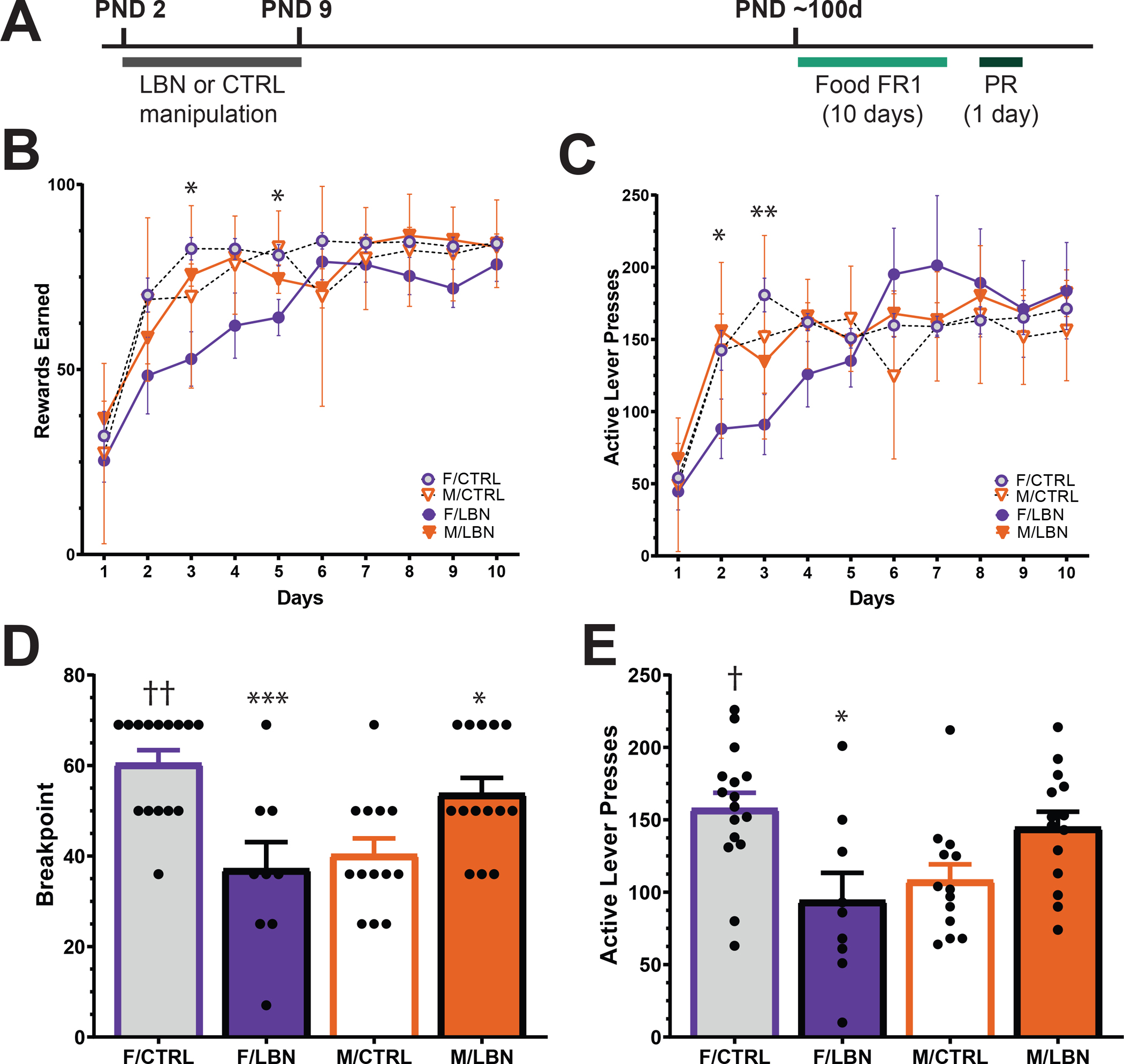
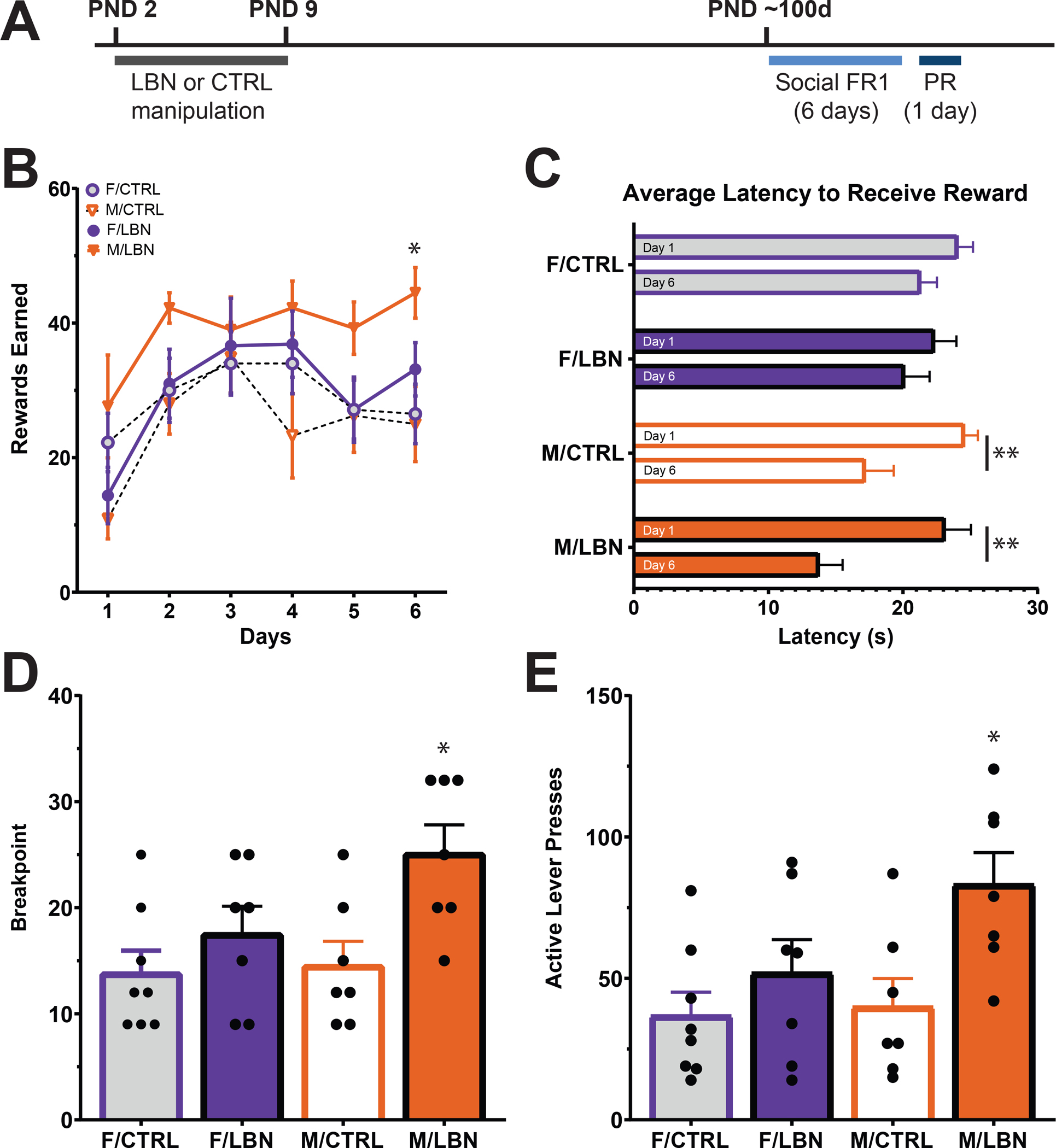
Results: We observed sex differences in the impact of LBN on motivation for natural rewards. In males, LBN increased motivation for both a sucrose and social reward. In females, LBN reduced motivation for sucrose but had no effect on social reward.
Conclusions: These results suggest that the effects of LBN on motivation for natural rewards are both sex- and reinforcer-dependent, with males and females showing differential motivation for food and social rewards following early scarcity. Our previous data revealed an LBN-driven reduction in motivation for morphine in males and no effect in females, highlighting the reinforcer-dependent impact of early resource scarcity on motivated behavior more widely.
Keywords: Early life stress; Food reward; LBN; Natural reward; Sex difference; Social motivation.
© 2022. The Author(s), under exclusive licence to Springer-Verlag GmbH Germany, part of Springer Nature.
Conflict of interest statement
Figures
References
-
- Agmo A (1997) Male rat sexual behavior. Brain Res Brain Res Protoc 1: 203–9. - PubMed
-
- Bari AA, Pierce RC (2005) D1-like and D2 dopamine receptor antagonists administered into the shell subregion of the rat nucleus accumbens decrease cocaine, but not food, reinforcement. Neuroscience 135: 959–68. - PubMed
-
- Baskin-Sommers AR, Foti D (2015) Abnormal reward functioning across substance use disorders and major depressive disorder: Considering reward as a transdiagnostic mechanism. International Journal of Psychophysiology 98: 227–239. - PubMed
MeSH terms
Substances
Grants and funding
LinkOut - more resources
Full Text Sources
Research Materials
Miscellaneous
