


Growth differentiation factor 15 and cardiovascular risk: individual patient meta-analysis
- PMID: 36303404
- PMCID: PMC10066747
- DOI: 10.1093/eurheartj/ehac577
Growth differentiation factor 15 and cardiovascular risk: individual patient meta-analysis
Abstract
Aims: Levels of growth differentiation factor 15 (GDF-15), a cytokine secreted in response to cellular stress and inflammation, have been associated with multiple types of cardiovascular (CV) events. However, its comparative prognostic performance across different presentations of atherosclerotic cardiovascular disease (ASCVD) remains unknown.
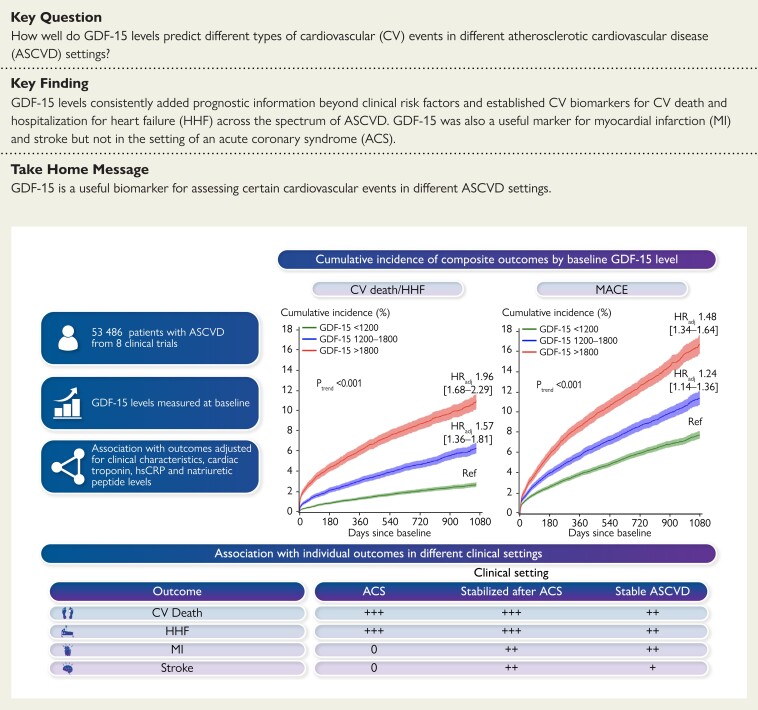
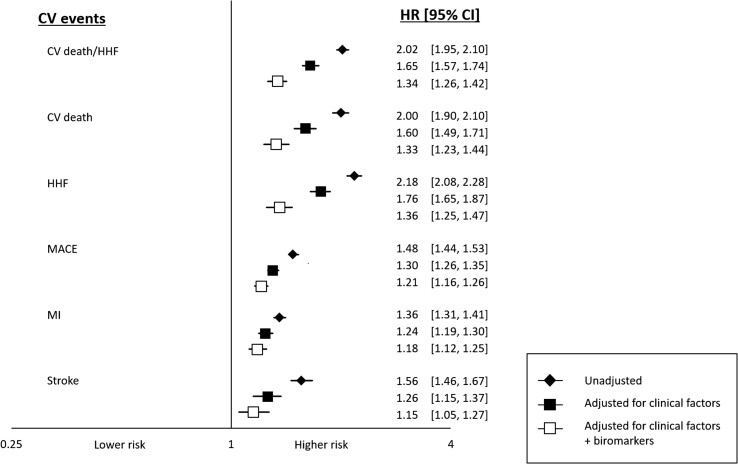
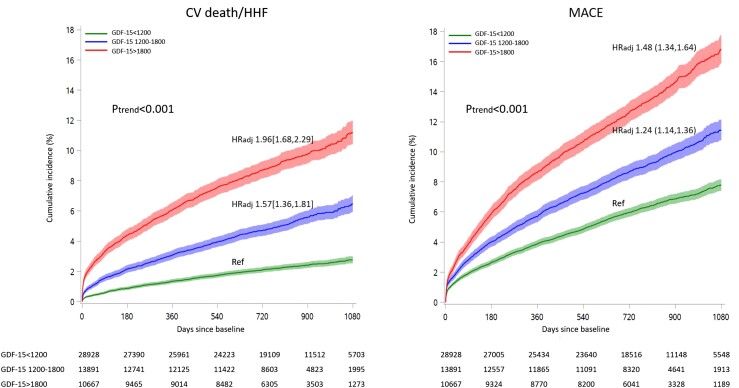
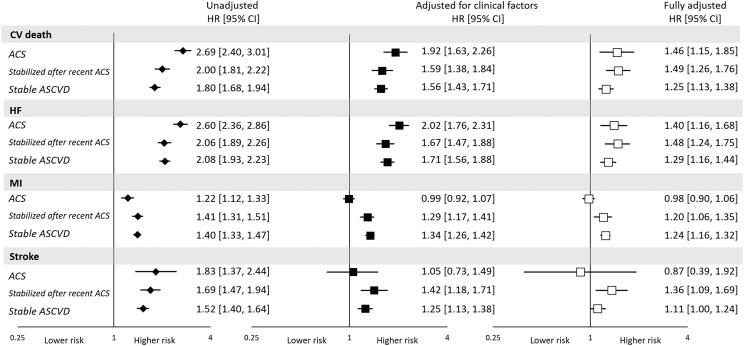
Methods and results: An individual patient meta-analysis was performed using data pooled from eight trials including 53 486 patients. Baseline GDF-15 concentration was analyzed as a continuous variable and using established cutpoints (<1200 ng/L, 1200-1800 ng/L, > 1800 ng/L) to evaluate its prognostic performance for CV death/hospitalization for heart failure (HHF), major adverse cardiovascular events (MACE), and their components using Cox models adjusted for clinical variables and established CV biomarkers. Analyses were further stratified on ASCVD status: acute coronary syndrome (ACS), stabilized after recent ACS, and stable ASCVD. Overall, higher GDF-15 concentration was significantly and independently associated with an increased rate of CV death/HHF and MACE (P < 0.001 for each). However, while GDF-15 showed a robust and consistent independent association with CV death and HHF across all presentations of ASCVD, its prognostic association with future myocardial infarction (MI) and stroke only remained significant in patients stabilized after recent ACS or with stable ASCVD [hazard ratio (HR): 1.24, 95% confidence interval (CI): 1.17-1.31 and HR: 1.16, 95% CI: 1.05-1.28 for MI and stroke, respectively] and not in ACS (HR: 0.98, 95% CI: 0.90-1.06 and HR: 0.87, 95% CI: 0.39-1.92, respectively).
Conclusion: Growth differentiation factor 15 consistently adds prognostic information for CV death and HHF across the spectrum of ASCVD. GDF-15 also adds prognostic information for MI and stroke beyond clinical risk factors and cardiac biomarkers but not in the setting of ACS.
Keywords: ASCVD; Biomarker; GDF-15; MI; Stroke.
© The Author(s) 2022. Published by Oxford University Press on behalf of European Society of Cardiology.
Conflict of interest statement
Conflict of interest: E.T.K. reports receiving lecture fees from Astellas, Abbott, Amgen, AstraZeneca, Boehringer Ingelheim, Bristol-Myers Squibb, Eli-Lilly Japan KK, Daiichi-Sankyo, Menarini, Ono Pharmaceutical, Ootsuka Pharmaceutical, MSD KK, Takeda Pharmaceutical, Tanabe-Mitsubishi, Bayer, Pfizer; consultant fee from Boehringer Ingelheim and Daiichi-Sankyo; research fund from Abbott, Ono Pharmaceutical, and Tanabe-Mitsubishi; D.M. reports grants to the Brigham and Women’s Hospital from Abbott Laboratories, Amgen, Anthos Therapeutics, AstraZeneca, Eisai, Medicines Co., Merck, Novartis, Pfizer, Roche Diagnostics, and Siemens; and consultant fees from InCardia, Inflammatix, Merck & Co, Novartis, and Roche Diagnostics. D.M. is a member of the TIMI Study Group, which has received institutional research grant support through Brigham and Women’s Hospital from Abbott, Amgen, Anthos Therapeutics, ARCA Biopharma, AstraZeneca, Bayer, Daiichi-Sankyo, Eisai, Intarcia, Ionis Pharmaceuticals, MedImmune, Merck, Novartis, Pfizer, Quark Pharmaceuticals, Regeneron Pharmaceuticals, Roche, Siemens Healthcare Diagnostics, The Medicines Company, and Zora Biosciences; J.G. is a member of the TIMI Study Group which has received institutional research grant support through Brigham and Women’s from Abbott Laboratories, Amgen; AstraZeneca; Critical Diagnostics, Daiichi-Sankyo; Eisai; Genzyme; Gilead; GlaxoSmithKline; Intarcia; Janssen Research and Development; Medicines Company; MedImmune; Merck; Novartis; Pfizer; Poxel; Roche Diagnostics; and Takeda; D.D.B. is supported by Harvard Catalyst KL2/CMeRIT (NIH/NCATS grant UL 1TR002541). He has received research grant support to his institution from AstraZeneca and Pfizer; consulting fees from AstraZeneca; and participates on a clinical endpoint committee for a study sponsored by Kowa Pharmaceuticals. M.B. has no conflict of interest; E.A.B. is a member of the TIMI Study Group which has received institutional research grant support through Brigham and Women’s Hospital from Abbott, Amgen, Anthos Therapeutics, AstraZeneca, Bayer HealthCare Pharmaceuticals, Inc., Daiichi-Sankyo, Eisai, Intarcia, MedImmune, Merck, Novartis, Pfizer, Quark Pharmaceuticals, Regeneron Pharmaceuticals, Inc., Roche, Siemens Healthcare Diagnostics, Inc., The Medicines Company, Zora Biosciences. E.A.B. has received personal fees from Servier, Kowa, Medscape, Novo Nordisk, Amgen, PriMed and Merck; M.P.B. is the Executive Director of CPC, a non-profit academic research organization affiliated with the University of Colorado, that receives research grant/consulting funding from: Abbott, Agios, Alexion Pharma, Alnylam, Amgen, Angionetics, ARCA Biopharma, Array, AstraZeneca, Atentiv, Audentes, Bayer, Better Therapeutics, Brigham and Women’s Hospital, Bristol-Myers Squibb, Cardiol Therapeutics, CellResearch, Cook Medical, Cook, CSL Behring, Eidos Therapeutics, EP Trading Co, Esperion Therapeutics, EverlyWell, Faraday, Fortress Biotech, HDL Therapeutics, Heartflow, Hummingbird Bioscience, Insmed, Janssen, Kowa Research, Lexicon, Merck, Medtronic, Moderna, Novate Medical, NovoNordisk, Pfizer, PhaseBio, PPD Development, Prairie Education and Research, Prothena Ciosciences, Regeneron, Regio Biosciences, Sanifit Therapeutics, Sanofi, Smith and Nephew, Stealth BioTherapeutics, University of Colorado, Worldwide Clinical Trials, Wraser, Yale Cardiovascular Research Group. M.P.B. also reports stock in Medtronic and Pfizer and consulting fees from Audent; C.P.C. reports research grants from: Amgen, Better Therapeutics, Boehringer-Ingelheim (BI), Bristol-Myers Squibb (BMS), Daiichi Sankyo, Janssen, Merck, Novo Nordisk, Pfizer, Consulting fees from Aegerion/Amryt, Alnylam, Amarin, Amgen, Applied Therapeutics, Ascendia, BI, BMS, Eli Lilly, Janssen, Lexicon, Merck, Pfizer, Rhoshan, and Sanofi. C.P.C. serve on Data and Safety Monitoring Boards for the Veteran’s Administration, Applied Therapeutics and NovoNordisk; J.A.d.L reports grant support from Roche Diagnostics and Abbott Diagnostics, consulting fees from Ortho Clinical Diagnostics, Siemen’s Health Care Diagnostics, Beckman Coulter, and Quidel; R.P.G. reports clinical trials/research support from Amgen, Anthos Therapeutics, Daiichi Sankyo, honoraria for Lectures/CME Programs for Amgen, Centrix, Daiichi Sankyo, Dr. Reddy’s Laboratories, Medical Education Resources (MER), Medscape, Menarini, Merck, Pfizer, SAJA Pharmaceuticals, Servier, Shanghai Medical Telescope, Voxmedia, Consultant fee from Amarin, Amgen, Boston Scientific, CryoLife, CSL Behring, CVS Caremark, Daiichi Sankyo, Esperion, Gilead, Hengrui, Inari, Janssen, Novartis, Pfizer, PhaseBio Pharmaceuticals, St. Lukes, Samsung; P.J. reports research support from Abbott Laboratories, Amgen, Inc., AstraZeneca, LP, Daiichi-Sankyo, Inc., GlaxoSmithKline, Merck & Co., Inc., Regeneron, Roche Diagnostics Corporation, and Siemens Healthineers; T.K. has been a paid consultant for and/or received honoraria payments from AstraZeneca, Bayer, Boehringer Ingelheim, Bristol Myers Squibb, Edwards, Novartis, Pharmacosmos, and Vifor and has received research support from Vifor; K.N. reports research funding through Duke University from Roche Diagnostics; Consulting honoraria from Beckman-Coulter; M.O’. reports Grants via Brigham and Women’s Hospital from Amgen, Novartis, AstraZeneca, Janssen, Intarcia, Merck, Pfizer. Honararia from Novartis, AstraZeneca, Amgen, Janssen; M.A.P. reports Research Grant Support from Novartis; consultant to AstraZeneca, Boehringer Ingelheim and Eli Lilly Alliance, DalCor, GlaxoSmithKline, Lexicon, NHLBI CONNECTs (Master Protocol Committee), Novartis, Novo Nordisk, Peerbridge and Sanofi; and has equity in DalCor; N.R. has no conflic of interest; S.D.W. reports research grants from Amgen, AstraZeneca, Daiichi Sankyo, Eisai, Janssen, and Merck. He reports consulting fees from AstraZeneca, Boston Clinical Research Institute, ICON Clinical, Novo Nordisk. Spouse, Dr. Caroline Fox is an employee of Merck. S.D.W. is a member of the TIMI Study Group, which has received institutional research grant support through Brigham and Women’s Hospital from: Abbott, Amgen, Aralez, AstraZeneca, Bayer HealthCare Pharmaceuticals, Inc., BRAHMS, Daiichi-Sankyo, Eisai, GlaxoSmithKline, Intarcia, Janssen, MedImmune, Merck, Novartis, Pfizer, Poxel, Quark Pharmaceuticals, Roche, Takeda, The Medicines Company, Zora Biosciences; S.D.W. has been a paid consultant for and has received research support from Boehringer Ingelheim, and has received honoraria payments from Roche Diagnostics. T.K. and S.D.W. hold patents (EP 2047275 B1 and US 8951742) and have a licensing contract with Roche Diagnostics related to GDF-15; E.B. reports research grants through his institution from Astra Zeneca, Daiichi Sankyo, Merck and Novartis, and consultancies with Amgen, Boehringer-Ingelheim/Lilly, Bristol Myers Squibb, Cardurion, Novo Nordisk, and Verve; M.S. report research grant support through Brigham and Women’s Hospital from Amgen; Anthos Therapeutics; AstraZeneca; Bayer; Daiichi-Sankyo; Eisai; Intarcia; Ionis; Medicines Company; MedImmune; Merck; Novartis; Pfizer; Quark Pharmaceuticals. Consulting for: Althera; Amgen; Anthos Therapeutics; AstraZeneca; Beren Therapeutics; Bristol-Myers Squibb; DalCor; Dr. Reddy’s Laboratories; Fibrogen; Intarcia; Merck; Moderna; Novo Nordisk; Silence Therapeutics. Additionally, M.S. is a member of the TIMI Study Group, which has also received institutional research grant support through Brigham and Women’s Hospital from Abbott, ARCA Biopharma, Inc., Janssen Research and Development, LLC, Siemens Healthcare Diagnostics, Inc., Softcell Medical Limited, Regeneron, Roche, and Zora Biosciences.
Figures
Comment in
-
Growth differentiation factor 15: a biomarker searching for an indication.Eur Heart J. 2023 Jan 21;44(4):301-303. doi: 10.1093/eurheartj/ehac681. Eur Heart J. 2023. PMID: 36459111 No abstract available.
References
-
- Wollert KC, Kempf T, Lagerqvist B, Lindahl B, Olofsson S, Allhoff T, et al. . Growth differentiation factor 15 for risk stratification and selection of an invasive treatment strategy in non ST-elevation acute coronary syndrome. Circulation 2007;116:1540–1548. doi: CIRCULATIONAHA.107.697714 [pii] 10.1161/CIRCULATIONAHA.107.697714 - DOI - PubMed
Publication types
MeSH terms
Substances
LinkOut - more resources
Full Text Sources
Medical
Research Materials
Miscellaneous
