


Pathogenic variants of ornithine transcarbamylase deficiency: Nation-wide study in Japan and literature review
- PMID: 36303552
- PMCID: PMC9593096
- DOI: 10.3389/fgene.2022.952467
Pathogenic variants of ornithine transcarbamylase deficiency: Nation-wide study in Japan and literature review
Abstract
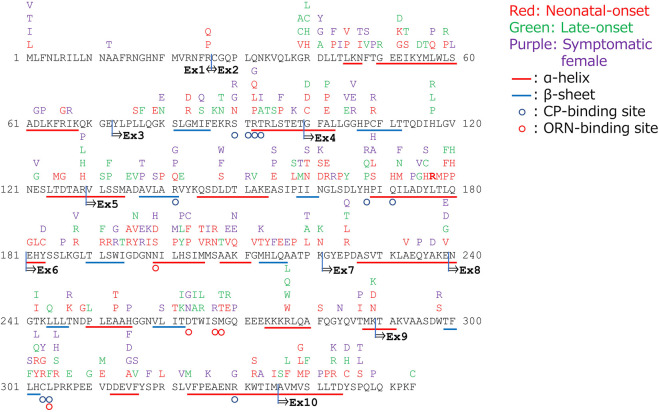
Ornithine transcarbamylase deficiency (OTCD) is an X-linked disorder. Several male patients with OTCD suffer from severe hyperammonemic crisis in the neonatal period, whereas others develop late-onset manifestations, including hyperammonemic coma. Females with heterozygous pathogenic variants in the OTC gene may develop a variety of clinical manifestations, ranging from asymptomatic conditions to severe hyperammonemic attacks, owing to skewed lyonization. We reported the variants of CPS1, ASS, ASL and OTC detected in the patients with urea cycle disorders through a nation-wide survey in Japan. In this study, we updated the variant data of OTC in Japanese patients and acquired information regarding genetic variants of OTC from patients with OTCD through an extensive literature review. The 523 variants included 386 substitution (330 missense, 53 nonsense, and 3 silent), eight deletion, two duplication, one deletion-insertion, 55 frame shift, two extension, and 69 no category (1 regulatory and 68 splice site error) mutations. We observed a genotype-phenotype relation between the onset time (neonatal onset or late onset), the severity, and genetic mutation in male OTCD patients because the level of deactivation of OTC significantly depends on the pathogenic OTC variants. In conclusion, genetic information about OTC may help to predict long-term outcomes and determine specific treatment strategies, such as liver transplantation, in patients with OTCD.
Keywords: X-linked disorder; hyperammonemia; late onset OTCD; neonatal onset OTCD; ornithine transcarbamylase deficiency.
Copyright © 2022 Kido, Sugawara, Sawada, Matsumoto and Nakamura.
Conflict of interest statement
The authors declare that the research was conducted in the absence of any commercial or financial relationships that could be construed as a potential conflict of interest.
Figures
References
-
- Ali E. Z., Zakaria Y., Mohd Radzi M. A., Ngu L. H., Jusoh S. A. (2018). Mutation study of Malaysian patients with ornithine transcarbamylase deficiency: Clinical, molecular, and bioinformatics analyses of two novel missense mutations of the OTC gene. BioMed Res. Int. 2018, 1–15. 10.1155/2018/4320831 - DOI - PMC - PubMed
-
- Arranz J. A., Riudor E., Marco-Marín C., Rubio V. (2007). Estimation of the total number of disease-causing mutations in ornithine transcarbamylase (OTC) deficiency. Value of the OTC structure in predicting a mutation pathogenic potential. J Inher Metab Disea 30, 217–226. 10.1007/s10545-007-0429-x - DOI - PubMed
LinkOut - more resources
Full Text Sources
Miscellaneous
