


Explaining the Black-White Disparity in Preterm Birth: A Consensus Statement From a Multi-Disciplinary Scientific Work Group Convened by the March of Dimes
- PMID: 36303973
- PMCID: PMC9580804
- DOI: 10.3389/frph.2021.684207
Explaining the Black-White Disparity in Preterm Birth: A Consensus Statement From a Multi-Disciplinary Scientific Work Group Convened by the March of Dimes
Abstract
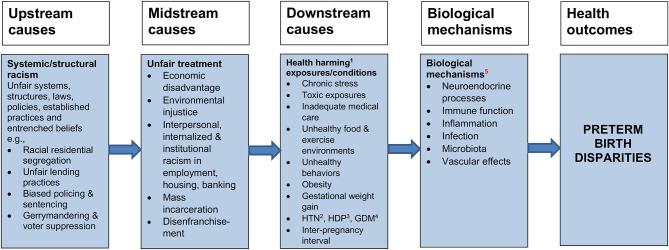
In 2017-2019, the March of Dimes convened a workgroup with biomedical, clinical, and epidemiologic expertise to review knowledge of the causes of the persistent Black-White disparity in preterm birth (PTB). Multiple databases were searched to identify hypothesized causes examined in peer-reviewed literature, 33 hypothesized causes were reviewed for whether they plausibly affect PTB and either occur more/less frequently and/or have a larger/smaller effect size among Black women vs. White women. While definitive proof is lacking for most potential causes, most are biologically plausible. No single downstream or midstream factor explains the disparity or its social patterning, however, many likely play limited roles, e.g., while genetic factors likely contribute to PTB, they explain at most a small fraction of the disparity. Research links most hypothesized midstream causes, including socioeconomic factors and stress, with the disparity through their influence on the hypothesized downstream factors. Socioeconomic factors alone cannot explain the disparity's social patterning. Chronic stress could affect PTB through neuroendocrine and immune mechanisms leading to inflammation and immune dysfunction, stress could alter a woman's microbiota, immune response to infection, chronic disease risks, and behaviors, and trigger epigenetic changes influencing PTB risk. As an upstream factor, racism in multiple forms has repeatedly been linked with the plausible midstream/downstream factors, including socioeconomic disadvantage, stress, and toxic exposures. Racism is the only factor identified that directly or indirectly could explain the racial disparities in the plausible midstream/downstream causes and the observed social patterning. Historical and contemporary systemic racism can explain the racial disparities in socioeconomic opportunities that differentially expose African Americans to lifelong financial stress and associated health-harming conditions. Segregation places Black women in stressful surroundings and exposes them to environmental hazards. Race-based discriminatory treatment is a pervasive stressor for Black women of all socioeconomic levels, considering both incidents and the constant vigilance needed to prepare oneself for potential incidents. Racism is a highly plausible, major upstream contributor to the Black-White disparity in PTB through multiple pathways and biological mechanisms. While much is unknown, existing knowledge and core values (equity, justice) support addressing racism in efforts to eliminate the racial disparity in PTB.
Keywords: birth outcomes; health disparities; maternal/infant health; preterm birth; racial health disparities; racism; social determinants of health; stress.
Copyright © 2021 Braveman, Dominguez, Burke, Dolan, Stevenson, Jackson, Collins, Driscoll, Haley, Acker, Shaw, McCabe, Hay, Thornburg, Acevedo-Garcia, Cordero, Wise, Legaz, Rashied-Henry, Frost, Verbiest and Waddell.
Conflict of interest statement
FJ is President of Majaica, LLC. CDC funds supported March of Dime's (MOD's) Prematurity Campaign, which included convening a scientific workgroup. CDC funds were not used to directly support development of this manuscript. MOD funded a small stipend for TD to conduct a comprehensive scientific edit of the initial consensus statement to prepare it as a manuscript of publishable length. MOD funded a small stipend for TH for additional assistance with references. The remaining authors declare that the research was conducted in the absence of any commercial or financial relationships that could be construed as a potential conflict of interest.
Figures

References
-
- Heron M. Deaths: Leading Causes for 2017. Washington, DC: (2019). - PubMed
-
- Ely D, Driscoll A. Infant Mortality in the United States, 2017: Data from the Period Linked Birth/Infant Death File. (2019). Retrieved from: https://www.cdc.gov/nchs/data/nvsr/nvsr68/nvsr68_10-508.pdf - PubMed
Publication types
LinkOut - more resources
Full Text Sources
Research Materials
