


A Landscape Analysis of Offering HIV Testing Services Within Family Planning Service Delivery
- PMID: 36304029
- PMCID: PMC9580748
- DOI: 10.3389/frph.2021.657728
A Landscape Analysis of Offering HIV Testing Services Within Family Planning Service Delivery
Abstract
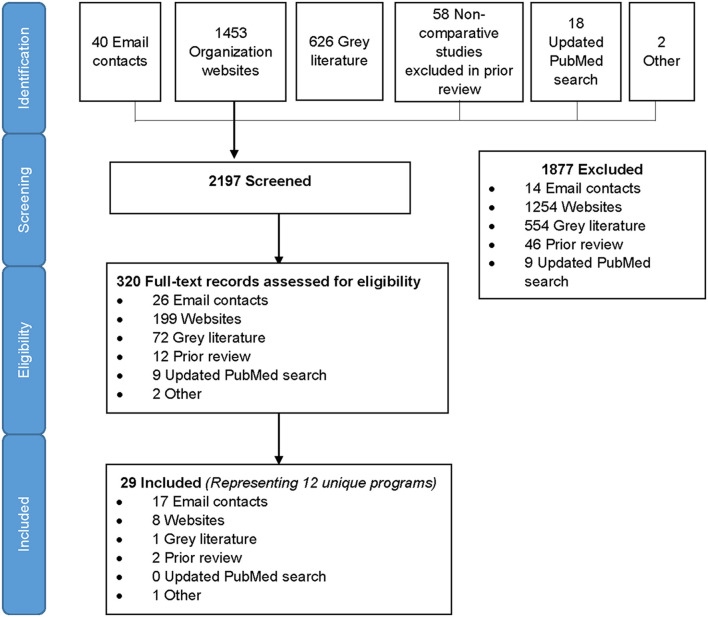
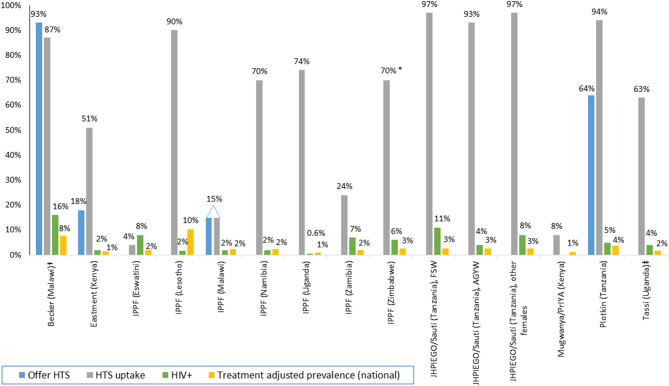
Introduction: Offering HIV testing services (HTS) within sexual and reproductive health (SRH) services is a priority, especially for women who have a substantial risk. To reach women with HIV who do not know their status and prevent mother-to-child HIV transmission, the World Health Organization (WHO) recommends routinely offering HTS as part of family planning (FP) service delivery in high HIV burden settings. We conducted a landscape analysis to assess HTS uptake and HIV positivity in the context of FP/SRH services. Assessment of Research and Programs: We searched records from PubMed, four gray literature databases, and 13 organization websites, and emailed 24 organizations for data on HTS in FP/SRH services. We also obtained data from International Planned Parenthood Federation (IPPF) affiliates in Eswatini, Kenya, Lesotho, Malawi, Namibia, Uganda, Zambia, and Zimbabwe. Unique programs/studies from records were included if they provided data on, or barriers/facilitators to, offering HTS in FP/SRH. Overall, 2,197 records were screened and 12 unique programs/studies were eligible, including 10 from sub-Saharan Africa. Four reported on co-delivery of SRH services (including FP), with reported HTS uptake between 17 and 94%. Six reported data on HTS in FP services: four among general FP clients; one among couples; and one among female sex workers, adolescent girls, and young women. Two of the six reported HTS uptake >50% (51%, 419/814 Kenya; 63%, 5,930/9,439 Uganda), with positivity rates of 2% and 4.1%, respectively. Uptake was low (8%, 74/969 Kenya) in the one FP program offering pre-exposure prophylaxis. In the IPPF program, seven countries reported HTS uptake in FP services and ranged from 4% in Eswatini to 90% in Lesotho; between 0.6% (Uganda) and 8% (Eswatini) of those tested were HIV positive. Implications: Data on providing HTS in FP/SRH service delivery were sparse and HTS uptake varied widely across programs. Actionable Recommendations: As countries expand HTS in FP/SRH appropriate to epidemiology, they should ensure data are reported and monitored for progress and impact.
Keywords: HIV testing services; family planning; service delivery; service integration; sexual and reproctive health.
Copyright © 2021 Drake, Quinn, Kidula, Sibanda, Steyn, Barr-DiChiara, Jamil, Rodolph, Gaffield, Kiarie, Baggaley and Johnson.
Conflict of interest statement
The authors declare that the research was conducted in the absence of any commercial or financial relationships that could be construed as a potential conflict of interest.
Figures
References
-
- The Prevention Gap Report . Geneva: Joint United Nations Programme on HIV/AIDS2016; (2016).
-
- Fast-Track - Ending the AIDS Epidemic by 2030 . Geneva: Joint United Nations Programme on HIV/AIDS (UNAIDS) (2014).
-
- Evidence for Contraceptive Options and HIV Outcomes (ECHO) Trial Consortium . HIV incidence among women using intramuscular depot medroxyprogesterone acetate, a copper intrauterine device, or a levonorgestrel implant for contraception: a randomised, multicentre, open-label trial. Lancet. (2019) 394:303–13. 10.1016/S0140-6736(19)31288-7 - DOI - PMC - PubMed
Grants and funding
LinkOut - more resources
Full Text Sources
Research Materials
