. 2023 Feb;237(3):999-1013.
doi: 10.1111/nph.18581. Epub 2022 Dec 3.

Recruitment of distinct UDP-glycosyltransferase families demonstrates dynamic evolution of chemical defense within Eucalyptus L'Hér

Affiliations

Recruitment of distinct UDP-glycosyltransferase families demonstrates dynamic evolution of chemical defense within Eucalyptus L'Hér

Cecilie Cetti Hansen et al. New Phytol. 2023 Feb.

Abstract

The economic and ecologically important genus Eucalyptus is rich in structurally diverse specialized metabolites. While some specialized metabolite classes are highly prevalent across the genus, the cyanogenic glucoside prunasin is only produced by c. 3% of species. To investigate the evolutionary mechanisms behind prunasin biosynthesis in Eucalyptus, we compared de novo assembled transcriptomes, together with online resources between cyanogenic and acyanogenic species. Identified genes were characterized in vivo and in vitro. Pathway characterization of cyanogenic Eucalyptus camphora and Eucalyptus yarraensis showed for the first time that the final glucosylation step from mandelonitrile to prunasin is catalyzed by a novel UDP-glucosyltransferase UGT87. This step is typically catalyzed by a member of the UGT85 family, including in Eucalyptus cladocalyx. The upstream conversion of phenylalanine to mandelonitrile is catalyzed by three cytochrome P450 (CYP) enzymes from the CYP79, CYP706, and CYP71 families, as previously shown. Analysis of acyanogenic Eucalyptus species revealed the loss of different ortholog prunasin biosynthetic genes. The recruitment of UGTs from different families for prunasin biosynthesis in Eucalyptus demonstrates important pathway heterogeneities and unprecedented dynamic pathway evolution of chemical defense within a single genus. Overall, this study provides relevant insights into the tremendous adaptability of these long-lived trees.

Keywords: Eucalyptus; UDP-glycosyltransferase; UGT87; chemical defense; cyanogenic glucoside; cytochrome P450; evolution; plant-specialized metabolism.


Figures

Fig. 1
Fig. 1
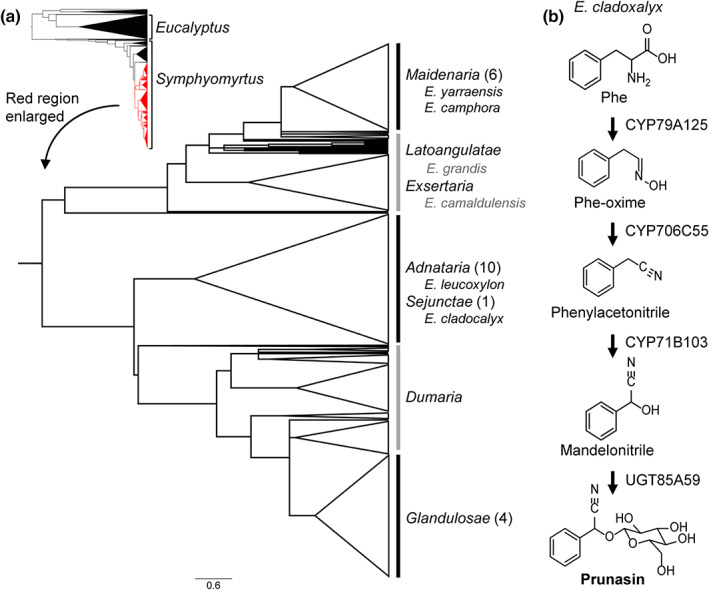
Distribution and biosynthesis of cyanogenic glucosides in Eucalyptus. (a) Species phylogeny of the genus Eucalyptus adapted from Thornhill et al. (2019). The small phylogenetic tree shows the phylogeny of the entire Eucalyptus genus, where the two major subgenera (Eucalyptus and Symphyomyrtus) are labeled. Subgenus Eucalyptus and the section Bisectae are colored black. The subtree marked in red is enlarged and consists of all sections belonging to Symphyomyrtus except the large acyanogenic section Bisectae. Eucalyptus species are highly paraphyletic (Thornhill et al., 2019), and the sections are labeled based on the most number of representative species for a given section. Sections encompassing cyanogenic species (black lines) and mayor sections without cyanogenic species (gray lines) are marked. The number in brackets denotes the number of identified cyanogenic species in a given section (Gleadow et al., 2008). Cyanogenic and acyanogenic species studied in this article are written in black and gray, respectively. (b) Prunasin biosynthetic pathway in Eucalyptus cladocalyx (section Sejunctae) (Hansen et al., 2018). phe, phenylalanine; phe‐oxime, phenylacetaldoxime.
Fig. 2
Fig. 2
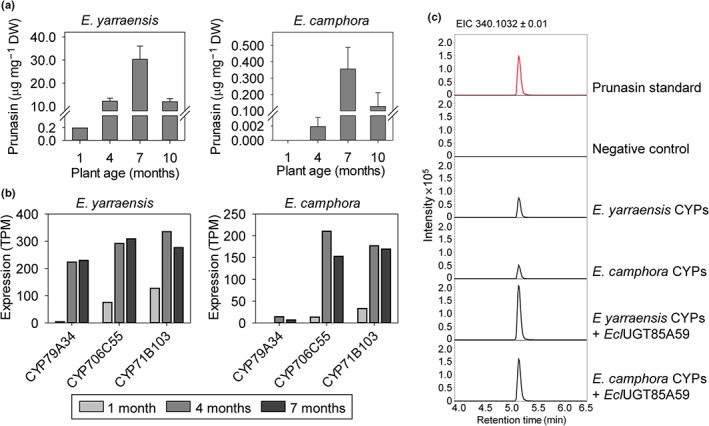
Prunasin accumulation in Eucalyptus yarraensis and Eucalyptus camphora, and CYPs involved in prunasin production. (a) Mean prunasin content (± 1 SE) in E. yarraensis and E. camphora seedlings at 1, 4, 7, and 10 months of age (n = 8). (b) Transcript profiles of prunasin biosynthetic CYP genes in representative E. yarraensis and E. camphora individual tissue at different ontogenetic stages. Prunasin and transcript values at 1 month represent a pooled sample due to small plant size. (c) Extracted ion chromatograms (EIC) corresponding to prunasin (m/z 340.1032 [M + FA]) of leaf extracts from Nicotiana benthamiana plants transiently expressing the three candidate CYP genes from E. yarraensis and E. camphora with the UGT85A59 from Eucalyptus cladocalyx. DW, dry weight; TPM, transcripts per million.
Fig. 3
Fig. 3
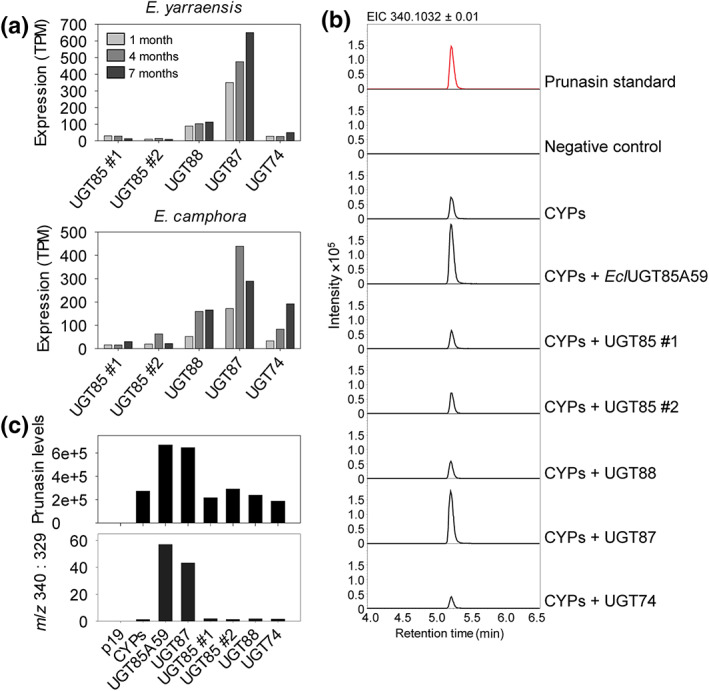
UGT87 is involved in prunasin production in Eucalyptus yarraensis and Eucalyptus camphora. (a) Transcript profiles of UGT candidate genes from E. yarraensis and E. camphora (n = 1 per species, at 1, 4, and 7 months of age). UGT candidates were selected based on expression criteria within and between the two species. (b) Representative extracted ion chromatograms (EIC) corresponding to prunasin (m/z 340.1032 [M + FA]) of leaf extracts from Nicotiana benthamiana plants transiently expressing the E. yarraensis and E. camphora UGT candidate genes together with the prunasin EyCYP79A34, EyCYP706C55, and EyCYP71B103. (c) Corresponding levels of prunasin in N. benthamiana leaf extracts measured by peak area integration of prunasin (m/z 340; upper panel), and prunasin levels normalized to the pathway derivative putatively annotated as benzoic acid glucoside (m/z 329), shown here as a ratio (m/z 340 : 329; lower panel). All tested UGT candidates and the positive control UGT85A59 are co‐expressed with the prunasin CYPs. TPM, transcripts per million.
Fig. 4
Fig. 4
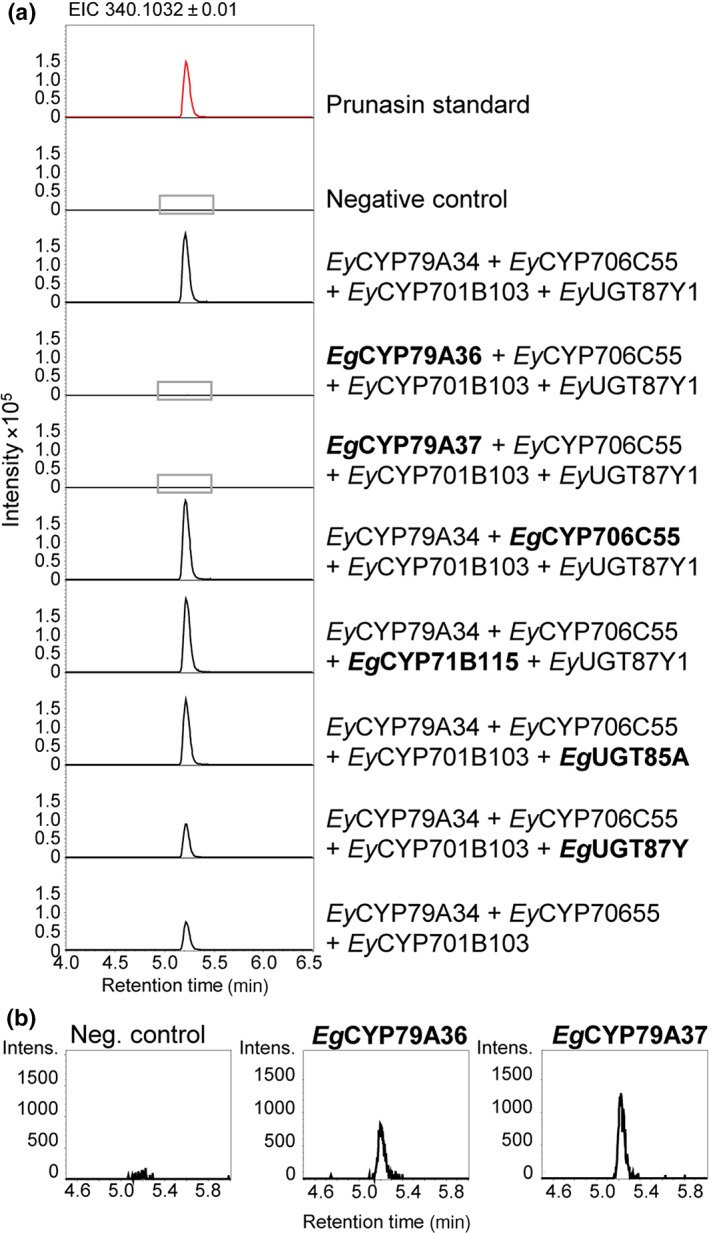
Transient expression of homologous prunasin biosynthetic genes from acyanogenic Eucalyptus grandis. (a) Extracted ion chromatograms (EIC) of Nicotiana benthamiana leaf extracts prepared from plants transiently co‐expressing homologs of prunasin biosynthetic genes from E. grandis (marked in bold) with the prunasin biosynthetic genes from Eucalyptus yarraensis. The chromatograms surrounded by a gray box for the combinations co‐expressing EgCYP79A36 and EgCYP79A37, respectively, are enlarged in panel B. (b) Zoom on two chromatograms from panel A where the CYP79s EgCYP79A36 and EgCYP79A37 are each co‐expressed with downstream prunasin biosynthetic genes.
Fig. 5
Fig. 5
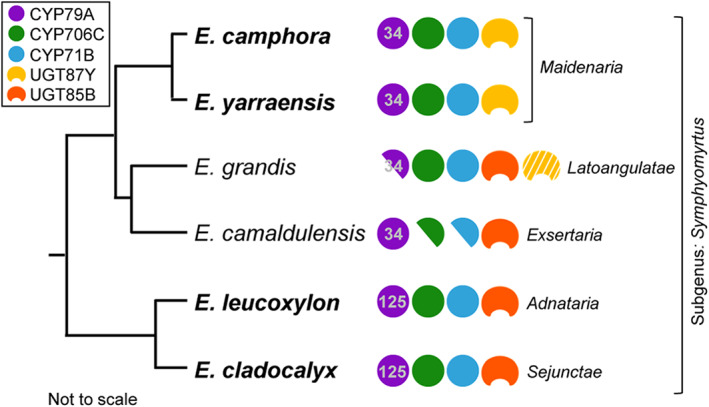
Evolution of prunasin biosynthesis in Eucalyptus showing conservation of the three‐CYP system but functional recruitment of two distinct UGT families. CYP79 subfamily names are denoted, showing divergence across sections. Eucalyptus camphora, Eucalyptus yarraensis, Eucalyptus leucoxylon, and Eucalyptus cladocalyx are cyanogenic (highlighted in bold). Ortholog genes identified in the acyanogenic Eucalyptus grandis and Eucalyptus camaldulensis are shown. The half circles illustrate pseudogenes. The ortholog CYP706C, CYP71B, and UGT85A from E. grandis demonstrated functional activity for prunasin production, while the ortholog UGT87Y showed severely compromised activity (illustrated with white stripes).
Fig. 6
Fig. 6
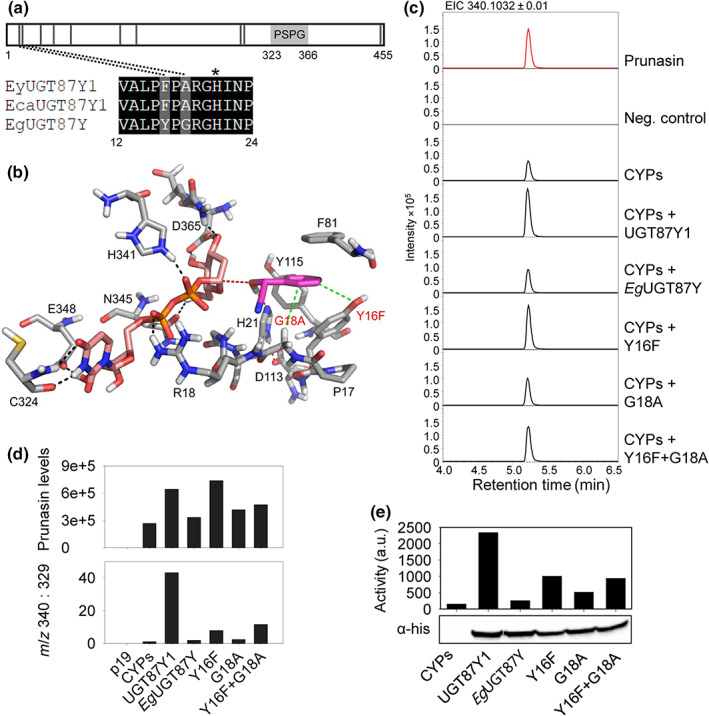
Site‐directed mutagenesis of EgUGT87. (a) Schematic of the UGT87 amino acid sequence indicating the positions of amino acids (black vertical lines) that differ between UGT87Y1 and EgUGT87Y. The PSPG motif is marked with a light gray box. The catalytic His is marked with an asterisk. (b) Active site of EgUGT87 (Eucgr.B03993) (grey carbon atoms) with docked mandelonitrile (magenta carbon atoms) and UDP‐glucose (pink carbon atoms). Nitrogen, oxygen, sulfur and phosphorus atoms are shown in blue, red, yellow and orange, respectively. The benzene moiety of the substrate is mainly recognized by hydrophobic interactions with Y16, F81, and Y115. Mutations of Y16F and G18A (red text) enhance the hydrophobic interactions (green dotted lines) with the benzene ring of mandelonitrile. The catalytic dyad H21 ‐ D113 is shown (red dotted lines) and hydrogen bonds indicated (black dotted lines). (c) Representative extracted ion chromatograms (EIC) corresponding to prunasin (m/z 340.1032 [M + FA]) of leaf extracts from Nicotiana benthamiana plants transiently expressing Eucalyptus UGTs together with the prunasin CYPs from Eucalyptus yarraensis. (d) Prunasin accumulation in N. benthamiana leaf extracts measured by peak area integration of prunasin (m/z 340; upper panel), and prunasin levels normalized to the pathway derivative putatively annotated as benzoic acid glucoside (m/z 329), shown here as a ratio (m/z 340 : 329; lower panel). (e) In vitro assays using protein extracts prepared from N. benthamiana leaves transiently expressing prunasin CYPs and the UGT variants (top) and Western blot of the His‐tagged UGTs in the protein extract that was used for activity assay (bottom). The UGT activity is plotted as the intensity of the prunasin signal on a TLC plate measured by phospho‐imaging.

References

    1. Bak S, Kahn RA, Nielsen HL, Møller BL, Halkier BA. 1998. Cloning of three A‐type cytochromes P450, CYP71E1, CYP98, and CYP99 from Sorghum bicolor (L.) Moench by a PCR approach and identification by expression in Escherichia coli of CYP71E1 as a multifunctional cytochrome P450 in the biosynthesis of the cyanogenic glucoside dhurrin. Plant Molecular Biology 36: 393–405. - PubMed
    1. Bak S, Olsen CE, Halkier BA, Møller BL. 2000. Transgenic tobacco and Arabidopsis plants expressing the two multifunctional sorghum cytochrome P450 enzymes, CYP79A1 and CYP71E1, are cyanogenic and accumulate metabolites derived from intermediates in dhurrin biosynthesis. Plant Physiology 123: 1437–1448. - PMC - PubMed
    1. Bashandy H, Jalkanen S, Teeri TH. 2015. Within leaf variation is the largest source of variation in agroinfiltration of Nicotiana benthamiana . Plant Methods 11: 47. - PMC - PubMed
    1. Bennett AF. 2016. Eucalypts, wildlife and nature conservation: from individual trees to landscape patterns. Proceedings of the Royal Society of Victoria 128: 71–86.
    1. Bjarnholt N, Neilson EHJ, Crocoll C, Jørgensen K, Motawia MS, Olsen CE, Dixon DP, Edwards R, Møller BL. 2018. Glutathione transferases catalyze recycling of auto‐toxic cyanogenic glucosides in sorghum. The Plant Journal 94: 1109–1125. - PubMed

Publication types

MeSH terms

LinkOut - more resources