Age at Onset of Spinal Cord Injury is Associated with Increased Inpatient Care Needs, Reduced Independence at Discharge and a Higher Risk of Institutionalization after Primary Inpatient Rehabilitation
- PMID: 36306176
- PMCID: PMC9855980
- DOI: 10.2340/jrm.v54.4468
Age at Onset of Spinal Cord Injury is Associated with Increased Inpatient Care Needs, Reduced Independence at Discharge and a Higher Risk of Institutionalization after Primary Inpatient Rehabilitation
Abstract
Objective: To investigate the influence of age at onset of spinal cord injury on length of stay, inpatient therapy and nursing hours, independence at discharge and risk of institutionalization.
Design: Retrospective cohort study.
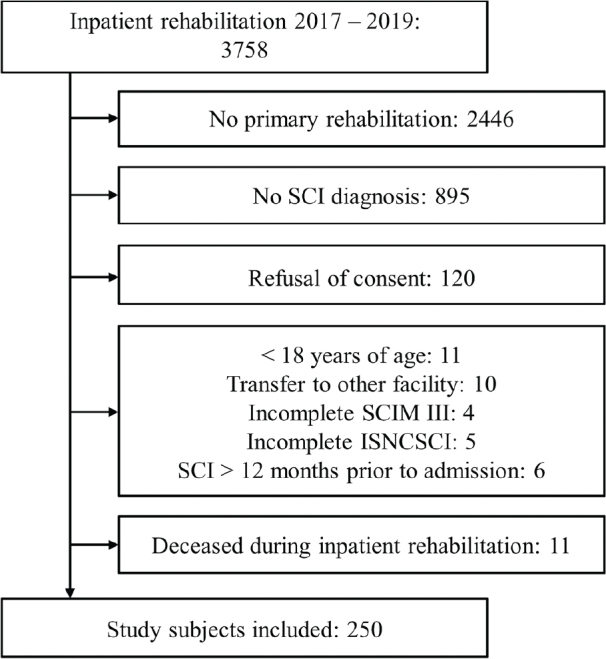
Participants: A total of 250 patients with a newly acquired traumatic or non-traumatic spinal cord injury undergoing primary inpatient rehabilitation in a Swiss spinal cord injury specialized clinic between 2017 and 2019.
Methods: Multiple regression analysis was used to determine if age, in addition to clinical characteristics (co-morbidities, secondary complications and spinal cord injury severity), affects inpatient rehabilitation parameters (length of stay, daily nursing hours and daily therapy hours), independence at discharge (Spinal Cord Independence Measure III) and place of discharge (private residence vs institution).
Results: Chronological age correlated with the number of co-morbidities and secondary complications. Older age was associated with increased daily nursing care and reduced independence at discharge. However, both were also influenced by co-morbidities, secondary complications and severity of spinal cord injury. Length of stay and daily therapy hours were age-independent. Odds for institutionalization after discharge increased significantly, by 1.03-fold per year of age.
Conclusion: Age at onset of spinal cord injury predicted inpatient nursing care, independence at discharge and the risk of institutionalization after primary inpatient rehabilitation. Co-morbidities, secondary complications and severity of spinal cord injury were also important influencing factors.
Conflict of interest statement
Figures
References
-
- World Health Organization (WHO) . International Perspectives on Spinal Cord Injury. 2013. [accessed 2022 Feb 1]. Available from: https://www.who.int/publications/i/item/international-perspectives-on-sp...
-
- Kang Y, Ding H, Zhou H, Wei Z, Liu L, Pan D, et al. Epidemiology of worldwide spinal cord injury: a literature review. J Neurorestoratology 2018; 6: 1–9. DOI: 10.2147/jn.S143236 - DOI
-
- Brinkhof MWG, Al-Khodairy A, Eriks-Hoogland I, Fekete C, Hinrichs T, Hund-Georgiadis M, et al. Health conditions in people with spinal cord injury: Contemporary evidence from a population-based community survey in Switzerland. J Rehabil Med 2016; 48: 197–209. DOI: 10.2340/16501977-2039 - DOI - PubMed
MeSH terms
LinkOut - more resources
Full Text Sources
Medical