. 2022 Oct 28;12(1):18158.
doi: 10.1038/s41598-022-21865-2.

Diminazene aceturate attenuates hepatic ischemia/reperfusion injury in mice

Affiliations

Diminazene aceturate attenuates hepatic ischemia/reperfusion injury in mice

So Hye Yoon et al. Sci Rep. .

Abstract

Hepatic ischemia/reperfusion (I/R) injury is one of the leading causes of mortality following partial hepatectomy, liver transplantation, hypovolemic shock and trauma; however, effective therapeutic targets for the treatment of hepatic I/R injury are lacking. Recent studies have shown that diminazene aceturate (DIZE) has protective effects against inflammation, oxidative stress and cell death, which are the main pathogenetic mechanisms associated with hepatic I/R injury. However, the mechanistic effects DIZE exerts on hepatic I/R remain unknown. C57BL/6 male mice were pretreated with either 15 mg/kg DIZE or vehicle control (saline) and subjected to partial liver ischemia for 60 min. One day after induction of hepatic I/R, liver damage, inflammatory responses, oxidative stress and apoptosis were analyzed. By evaluating plasma alanine aminotransferase levels and histology, we found that DIZE treatment attenuated liver failure and was associated with a reduction in histologically-apparent liver damage. We also found that DIZE-treated mice had milder inflammatory responses, less reactive oxidative damage and less apoptosis following hepatic I/R compared to vehicle-treated mice. Taken together, our study demonstrates that DIZE protects against ischemic liver injury by attenuating inflammation and oxidative damage and may be a potential therapeutic agent for the prevention and treatment of ischemic liver failure.


Conflict of interest statement

The authors declare no competing interests.

Figures

Figure 1
Figure 1
Effect of DIZE on liver injury following hepatic ischemia/reperfusion. C57BL/6 male mice were subjected to partial hepatic ischemia (HIR) induction for 1 h or sham surgery. Mice were randomized to receive treatment with either Diminazene aceturate (DIZE) or vehicle control (saline) before undergoing surgery, as described in “Methods”. (A) Four and twenty-four hours after surgeries, plasma ALT levels were measured. Liver sections were subjected to hematoxylin and eosin (H&E) staining (B, Upper panel: magnification X200; lower panel: magnification X400) and histological damages (C, D, E, and F) were analyzed using Suzuki’s criteria (sinusoidal congestion, parenchymal cell necrosis and cytoplasmic vacuolization). Results are expressed as mean ± SEM (n = 5). For statistical analysis, the one-way ANOVA plus Tukey’s post hoc multiple comparison test was used to detect significant changes in plasma ALT levels and the Mann–Whitney nonparametric test and t test were used to detect significant changes of Suzuki score with Origin 2021 v.9.8.0 200 (OriginLab, https://www.originlab.com) software. *P < 0.05 vs. Vehicle Sham, †P < 0.05 vs. Vehicle HIR.
Figure 2
Figure 2
Effect of DIZE on apoptosis following hepatic ischemia/reperfusion. C57BL/6 male mice were subjected to partial hepatic ischemia (HIR) induction for 1 h or sham surgery. Mice were treated with either Diminazene aceturate (DIZE) or vehicle control (saline) before undergoing surgery, as described in “Methods”. Twenty-four hours after surgery, liver sections were subjected to TUNEL staining (A; magnification X200) and the TUNEL-positive cells were counted (B). (C) Whole liver lysates were subjected to western blotting using B-cell lymphoma 2 (Bcl-2) and cleaved caspase-3 antibodies. GAPDH was used as a loading control. (D, E) Band intensities were measured using the ImageJ v.1.53e software. Results are expressed as mean ± SEM (n = 5). For statistical analysis, one-way ANOVA with plus Tukey’s post hoc multiple comparison test were used to detect significant changes with Origin 2021 v.9.8.0 200 (OriginLab, https://www.originlab.com) software. *P < 0.05 vs. Vehicle Sham, †P < 0.05 vs. Vehicle HIR.
Figure 3
Figure 3
Effect of DIZE on neutrophil infiltration and Ly6G protein expression following hepatic ischemia/reperfusion. C57BL/6 male mice were subjected to partial hepatic ischemia (HIR) induction for 1 h or sham surgery. Mice were treated with either Diminazene aceturate (DIZE) or vehicle control (saline) before undergoing surgery, as described in “Methods”. Twenty-four hours after surgery, liver sections were subjected to immunohistochemistry (IHC) staining using an antibody against Ly6G, a neutrophil marker (A, Upper panel: magnification X200; lower panel: magnification X400), and Ly6G-positive cells were counted (B). (C) Whole liver lysates were subjected to western blot analysis using an anti-Ly6G antibody. GAPDH was used as a loading control. (D) Band intensities were measured using the ImageJ v.1.53e software. Results are expressed as mean ± SEM (n = 5). For statistical analysis, one-way ANOVA with plus Tukey’s post hoc multiple comparison test were used to detect significant changes with Origin 2021 v.9.8.0 200 (OriginLab, https://www.originlab.com) software. *P < 0.05 vs. Vehicle Sham, †P < 0.05 vs. Vehicle HIR.
Figure 4
Figure 4
Effect of DIZE on hepatic inflammation following hepatic ischemia/reperfusion. C57BL/6 male mice were subjected to partial hepatic ischemia (HIR) induction for 1 h or sham surgery. Mice were treated with either Diminazene aceturate (DIZE) or vehicle control (saline) before undergoing surgery, as described in “Methods”. Fold-increases in the liver expression of pro-inflammatory mRNAs [tumor necrosis factor α (TNF-α, A), interleukin 1β (IL-1β, B), interleukin 6 (IL-6, C), keratinocyte chemoattractant (KC, D), monocyte chemoattractant protein-1 (MCP-1, E) and macrophage inflammatory protein-2 (MIP-2, F)] were assessed using quantitative RT-PCR 24 h after sham surgery or HIR induction; expression of GAPDH was used as reference control. (G) Liver samples were subjected to western blot analysis using anti-NFκB and -IκBα antibodies. (H, I) Band intensities were measured using the ImageJ v.1.53e software. Results are expressed as mean ± SEM (n = 5). For statistical analysis, one-way ANOVA with plus Tukey’s post hoc multiple comparison test were used to detect significant changes with Origin 2021 v.9.8.0 200 (OriginLab, https://www.originlab.com) software. *P < 0.05 vs. Vehicle Sham. †P < 0.05 vs. Vehicle HIR.
Figure 5
Figure 5
Effect of DIZE on oxidative stress following hepatic ischemia/reperfusion. C57BL/6 male mice were subjected to partial hepatic ischemia (HIR) induction for 1 h or sham surgery. Mice were treated either with Diminazene aceturate (DIZE) or vehicle control (saline) before undergoing surgery, as described in “Methods”. (A) Levels of hydrogen peroxide in the liver were measured. (B) Whole liver lysates were subjected to western blot analysis using an anti-4-Hydroxynonenal (4-HNE) antibody. GAPDH was used as a loading control. (C) Band intensities were measured using the ImageJ software. Liver sections were subjected to immunohistochemistry (IHC) staining using an anti-8-hydroxy-2′-deoxyguanosine (8-OHdG) antibody (D; magnification X200). (E) The intensity of 8-OHdG staining was measured using Fiji imageJ v.1.53c software. (F) Whole liver lysates were subjected to western blot analysis using anti-Heme oxygenase 1 (HO-1) and Superoxide dismutase 1 (SOD1) antibodies. GAPDH was used as a loading control. (G, H) Band intensities were measured using the ImageJ v.1.53e software. Results are expressed as mean ± SEM (n = 5). For statistical analysis, one-way ANOVA with plus Tukey’s post hoc multiple comparison test were used to detect significant changes with Origin 2021 v.9.8.0 200 (OriginLab, https://www.originlab.com) software. *P < 0.05 vs. Vehicle Sham, †P < 0.05 vs. Vehicle HIR.
Figure 6
Figure 6
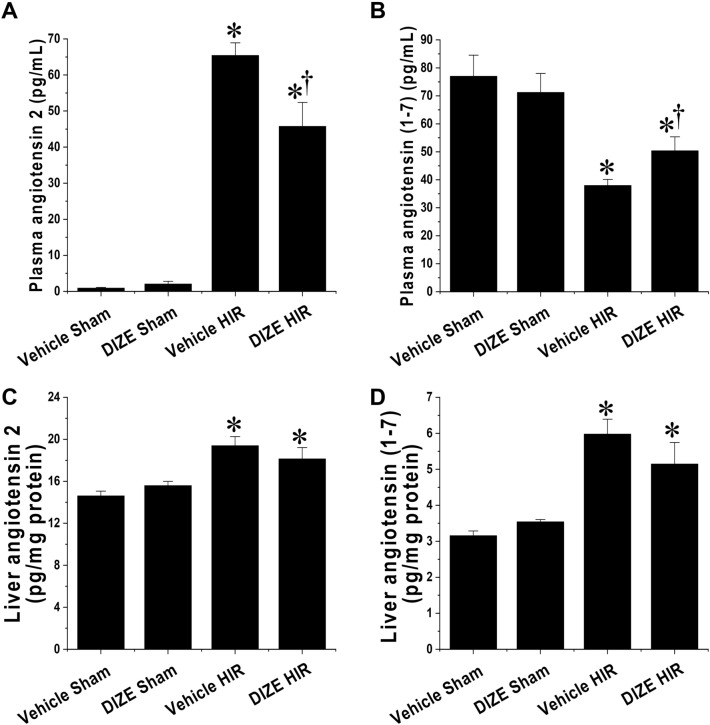
Effect of DIZE on angiotensin 2 and angiotensin (1–7) levels in plasma and liver, following hepatic ischemia/reperfusion. C57BL/6 male mice were subjected to partial hepatic ischemia (HIR) induction for 1 h or sham surgery. Mice were treated either with Diminazene aceturate (DIZE) or vehicle control (saline) before undergoing surgery, as described in “Methods”. Twenty-four hours after surgery, angiotensin 2 and angiotensin (1–7) levels were measured in plasma and liver. Results are expressed as mean ± SEM (n = 5). For statistical analysis, one-way ANOVA with plus Tukey’s post hoc multiple comparison test were used to detect significant changes with Origin 2021 v.9.8.0 200 (OriginLab, https://www.originlab.com) software. *P < 0.05 vs. Vehicle Sham, †P < 0.05 vs. Vehicle HIR.

References

    1. Ju C, Colgan SP, Eltzschig HK. Hypoxia-inducible factors as molecular targets for liver diseases. J. Mol. Med. 2016;94:613–627. doi: 10.1007/s00109-016-1408-1. - DOI - PMC - PubMed
    1. Guan LY, et al. Mechanisms of hepatic ischemia-reperfusion injury and protective effects of nitric oxide. World J. Gastrointest. Surg. 2014;6:122–128. doi: 10.4240/wjgs.v6.i7.122. - DOI - PMC - PubMed
    1. Elias-Miro M, Jimenez-Castro MB, Rodes J, Peralta C. Current knowledge on oxidative stress in hepatic ischemia/reperfusion. Free Radic. Res. 2013;47:555–568. doi: 10.3109/10715762.2013.811721. - DOI - PubMed
    1. Atsriku C, Watson DG, Tettey JN, Grant MH, Skellern GG. Determination of diminazene aceturate in pharmaceutical formulations by HPLC and identification of related substances by LC/MS. J. Pharm. Biomed. Anal. 2002;30:979–986. doi: 10.1016/s0731-7085(02)00450-8. - DOI - PubMed
    1. Shenoy V, et al. Diminazene attenuates pulmonary hypertension and improves angiogenic progenitor cell functions in experimental models. Am. J. Respir. Crit. Care Med. 2013;187:648–657. doi: 10.1164/rccm.201205-0880OC. - DOI - PMC - PubMed

Publication types

Substances