Review
. 2023 Mar;78(3):356-370.
doi: 10.1111/anae.15896. Epub 2022 Oct 29.

Postoperative systemic inflammatory dysregulation and corticosteroids: a narrative review

Affiliations
Review

Postoperative systemic inflammatory dysregulation and corticosteroids: a narrative review

C R Bain et al. Anaesthesia. 2023 Mar.

Abstract

In some patients, the inflammatory-immune response to surgical injury progresses to a harmful, dysregulated state. We posit that postoperative systemic inflammatory dysregulation forms part of a pathophysiological response to surgical injury that places patients at increased risk of complications and subsequently prolongs hospital stay. In this narrative review, we have outlined the evolution, measurement and prediction of postoperative systemic inflammatory dysregulation, distinguishing it from a healthy and self-limiting host response. We reviewed the actions of glucocorticoids and the potential for heterogeneous responses to peri-operative corticosteroid supplementation. We have then appraised the evidence highlighting the safety of corticosteroid supplementation, and the potential benefits of high/repeated doses to reduce the risks of major complications and death. Finally, we addressed how clinical trials in the future should target patients at higher risk of peri-operative inflammatory complications, whereby corticosteroid regimes should be tailored to modify not only the a priori risk, but also further adjusted in response to markers of an evolving pathophysiological response.

Keywords: corticosteroids; dysregulation; inflammation; postoperative complications; surgical injury.


Figures

Figure 1
Figure 1
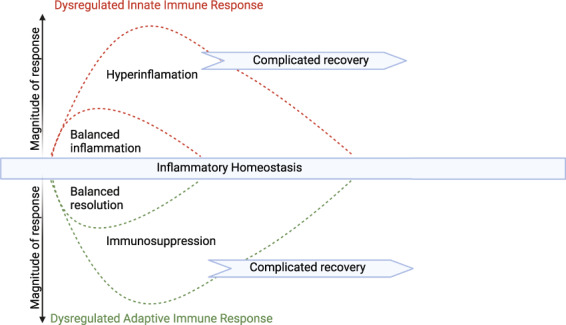
Post‐traumatic dysregulated inflammatory‐immune state. Paradigm shift in the nature of the systemic inflammatory‐immune response to trauma based on analysis of differential gene expression. Initial rapid upregulation of proinflammatory genes involved in the innate immune response is accompanied by simultaneous downregulation of genes involved in adaptive immunity. Dysregulation of the host response is reflected by excessively altered gene expression for a prolonged period associated with complicated outcomes. Adapted with permission from reference [13] Creativecommons license by‐nc‐sa/3.0/.
Figure 2
Figure 2
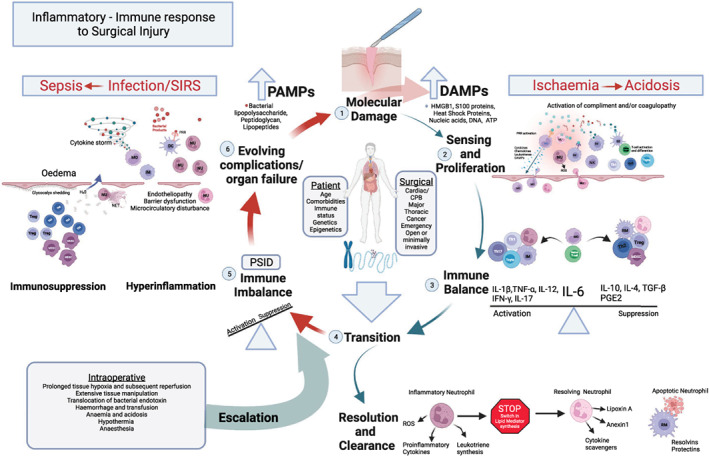
The inflammatory‐immune response to surgical injury. (1) The host response is primarily driven by damage that is apparent at a molecular level; (2) danger‐associated molecular patterns (DAMPs), sensed by cells of the innate immune system, proliferate the response and activate the adaptive immune system further bolstering cell‐mediated immunity; (3) the response is balanced with the actions of interleukin 6 (IL‐6) driving the initial host response and simultaneously contributing to immune regulation and suppression; (4) Transition towards resolution and clearance is marked by a switch within inflammatory neutrophil lipid mediator (LM) biosynthesis pathways away from strongly chemoattractant and proinflammatory leukotrienes to lipoxins (Lipoxin A), proresolving LMs (resolvins and protectins) and resolving proteins (annexin 1). Monocyte‐derived macrophages reprogramme to a resolving macrophage (RM) promoting neutrophil apoptosis and tissue repair; (5) patient and surgical factors combine with intra‐operative events to escalate the response resulting in a pathophysiological state of immune imbalance and postoperative systemic inflammatory dysregulation (PSID); (6) this response may become a cycle of increasing tissue injury, with endotheliopathy, barrier dysfunction, further DAMP production and the release pathogen‐associated molecular patterns (PAMPs). Uncontrolled hyperinflammation simultaneously triggers significant immunosuppression, the net effect being increased risk of organ dysfunction, infection and complications. CPB, cardiopulmonary bypass; DC, dendritic cells; ROS, reactive oxygen species; HMGB1, high‐mobility group box protein B; IFN‐γ, interferon gamma; IL‐1β, interleukin 1 beta; IL‐6, interleukin 6; IL‐10, interleukin 10; IL‐12, interleukin 12; IM, inflammatory macrophage; MDSC, myeloid‐derived suppressor cells; MO, monocytes; NET, neutrophil extracellular traps; NK, natural killer; NU, neutrophil; PGE2, prostaglandin E2; PRR, pattern recognition receptor; SIRS, systemic inflammatory response syndrome; TGF‐β, transforming growth factor β; TNF‐ɑ, tumour necrosis factor alpha; T reg, regulatory T cell; T cyto, cytotoxic T cell; Th1, T helper type 1; Th2, T helper type 2; Th17, T helper type 17. Adapted with permission from reference [20].
Figure 3
Figure 3
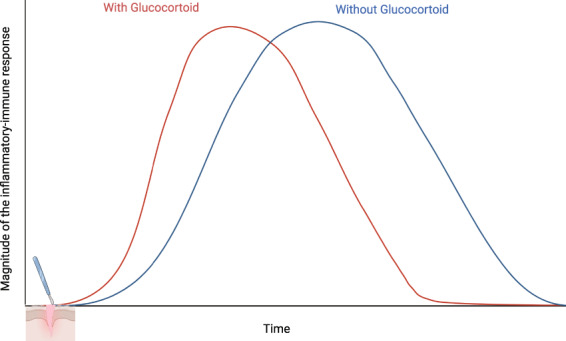
Unified model of glucocorticoid mediation of the immune response. Hypothetical timeline of the immune response to surgery in the presence (red) and absence (blue) of glucocorticoids as proposed by Cain and Cidowoski, based on the biphasic action of glucocorticoids. At low levels, glucocorticoids promote expression of innate immune genes and a rapid initial response to surgical injury. Postoperatively, the stress response and/or corticosteroid supplementation suppresses signalling and inflammation promoting resolution and restoration of homeostasis. When there is an absence or relative lack of glucocorticoid (adrenalectomy or antagonism), the initial response is delayed and the duration of the response is prolonged. Adapted with permission from reference [80].

References

    1. Weiser TG, Haynes AB, Molina G, et al. Estimate of the global volume of surgery in 2012: an assessment supporting improved health outcomes. Lancet 2015; 385: S11. - PubMed
    1. Dobson GP. Trauma of major surgery: a global problem that is not going away. International Journal of Surgery 2020; 81: 47–54. - PMC - PubMed
    1. Hearps AC, Martin GE, Angelovich TA, et al. Aging is associated with chronic innate immune activation and dysregulation of monocyte phenotype and function. Aging Cell 2012; 11: 867–75. - PubMed
    1. Dieleman JM, Peelen LM, Coulson TG, et al. Age and other perioperative risk factors for postoperative systemic inflammatory response syndrome after cardiac surgery. British Journal of Anaesthesia 2017; 119: 637–44. - PubMed
    1. Vester H, Huber‐Lang MS, Kida Q, et al. The immune response after fracture trauma is different in old compared to young patients. Immunity and Ageing 2014; 11: 20. - PMC - PubMed

MeSH terms