


Evidencing the role of carbonic anhydrase in the formation of carbonate minerals by bacterial strains isolated from extreme environments in Qatar
- PMID: 36311368
- PMCID: PMC9614864
- DOI: 10.1016/j.heliyon.2022.e11151
Evidencing the role of carbonic anhydrase in the formation of carbonate minerals by bacterial strains isolated from extreme environments in Qatar
Abstract
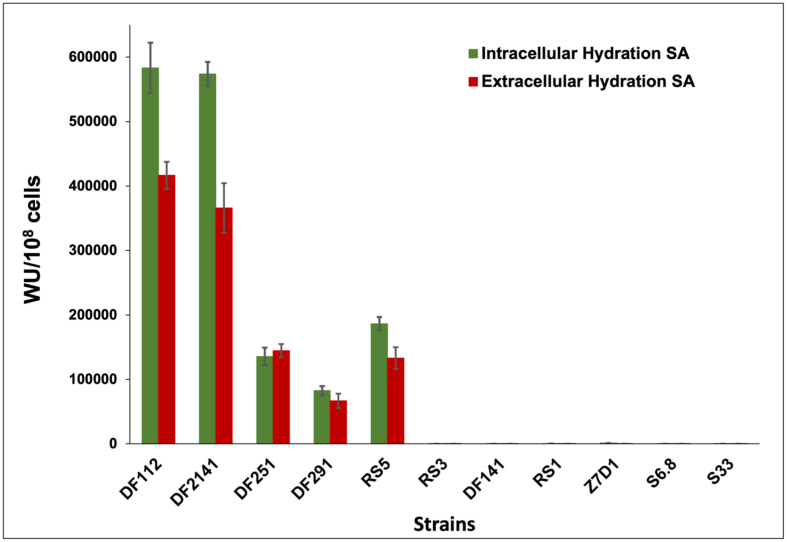
Calcium carbonate, one of the most abundant minerals in the geological records is considered as primary source of the carbon reservoir. The role of microorganisms in the biotic precipitation of calcium carbonate has been extensively investigated, especially at extreme life conditions. In Qatar, Sabkhas which are microbial ecosystems housing biomineralizing bacteria, have been carefully studied as unique sites of microbial dolomite formation. Dolomite (CaMg(CO3)2 is an important carbonate mineral forming oil reservoir rocks; however, dolomite is rarely formed in modern environments. The enzyme carbonic anhydrase is present in many living organisms, performs interconversion between CO2 and the bicarbonate ion. Thus, carbonic anhydrase is expected to accelerate both carbonate rock dissolution and CO2 uptake at the same time, serving as carbonite source to carbonites-forming bacteria. This study gathered cross-linked data on the potential role of the carbonic anhydrase excreted by mineral-forming bacteria, isolated from two different extreme environments in Qatar. Dohat Faishakh Sabkha, is a hypersaline coastal Sabkha, from where various strains of the bacterium Virgibacillus were isolated. Virgibacillus can -not only-mediate carbonate mineral formation, but also contributes to magnesium incorporation into the carbonate minerals, leading to the formation of high magnesium calcite. The latter is considered as precursor for dolomite formation. In addition, bacterial strains isolated from marine sediments, surrounding coral reef in Qatar sea, would provide additional knowledge on the role of carbonic anhydrase in mineral formation. Here, the quantification of the two mostly described activities of carbonic anhydrase; esterase and hydration reactions were performed. Mineral-forming strains were shown to exhibit high activities as opposed to the non-forming minerals, which confirms the relation between the presence of active carbonic anhydrase combined with elevated metabolic activity and the biomineralizing potential of the bacterial strains. The highest specific intracellular carbonic anhydrase activity; as both esterase and hydration (i.e., 66 ± 3 and 583000 ± 39000 WAU/108 cells respectively), was evidenced in mineral-forming strains as opposed to non-mineral forming strains (i.e., 6 ±. 0.5 and 1223 ± 61 WAU/108cells) respectively. These findings would contribute to the understanding of the mechanism of microbially mediated carbonate precipitation. This role may be both in capturing CO2 as source of carbonate, and partial solubilization of the formed minerals allowing incorporation of Mg instead of calcium, before catalyzing again the formation of more deposition of carbonates.
Keywords: Carbonate formation; Carbonic anhydrase; Extreme environments; Marine sediments; Sabkha; Virgibacillus.
© 2022 The Authors.
Conflict of interest statement
The authors declare no conflict of interest.
Figures


References
-
- Achal V., Pan X. Characterization of urease and carbonic anhydrase producing bacteria and their role in calcite precipitation. Curr. Microbiol. 2011;62:894–902. - PubMed
-
- Al Disi Z.A., Jaoua S., Bontognali T.R., Attia E.S., Al-Kuwari H.A., Zouari N. Evidence of a role for aerobic bacteria in high magnesium Carbonate formation in the evaporitic environment of Dohat Faishakh sabkha in Qatar. Front. Environ. Sci. 2017;5
-
- Al Disi Z.A., Zouari N., Dittrich M., Jaoua S., l-Kuwari H.A., Bontognali T.R. Characterization of the extracellular polymeric substances (EPS) of Virgibacillus strains capable of mediating the formation of high Mg-calcite and protodolomite. Mar. Chem. 2019;216
LinkOut - more resources
Full Text Sources
