


The effects of mindfulness upbringing perception on social entrepreneurship orientation: A moderated mediation model of prosocial motivation and perceived pressure from external stakeholders
- PMID: 36312148
- PMCID: PMC9606459
- DOI: 10.3389/fpsyg.2022.968484
The effects of mindfulness upbringing perception on social entrepreneurship orientation: A moderated mediation model of prosocial motivation and perceived pressure from external stakeholders
Abstract
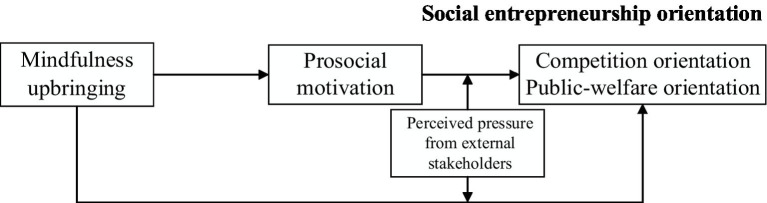
Driven by economic and social benefits, social enterprises create new development models that combine wealth creation, social welfare provision, and environmental improvement through innovative approaches. The social entrepreneurship orientation reflects the behavioral tendency to transplant entrepreneurship orientation into the field of social value creation. It is a strategy to balance and integrate economic interests and social interests, which has a significant impact on social entrepreneurship performance. The purpose of this study is to explore the internal mechanism of the impact of social entrepreneurs' mindfulness upbringing perception on social entrepreneur orientation. To reveal the internal mechanism, we propose a moderated and mediation model of prosocial motivation and perceived pressure from external stakeholders. In this study, random sampling was conducted among social start-ups in China. In order to improve the accuracy of the scale, a pre-survey was conducted before the formal survey. The data analysis results of the pre-survey showed that the scale in this study was suitable for the Chinese context and had good external validity. Through using survey data from social entrepreneurs in China, hierarchical regression analysis and bootstrapping model are adapted to test and verify mediation and moderation effects. The results show that mindfulness upbringing perception indeed positively influences social entrepreneurship orientation directly and partly through the mediating effect of prosocial motivation. Moreover, findings suggest the perceived pressure from external stakeholders negatively moderates not only the relationship between prosocial motivation and social entrepreneurship orientation but also the overall mediation model. This indicates that social entrepreneurs with low perceived pressure from external stakeholders will improve their social entrepreneurship orientation rapidly when their prosocial level is high. Based on these findings, we conclude that social entrepreneurship orientation may be achieved more effectively through the complex process of mindfulness upbringing perception, prosocial motivation, and perceived pressure from external stakeholders. Finally, the study proposes the theoretical and practical implications and suggestions for follow-up research.
Keywords: a moderated mediation model; mindfulness upbringing; perceived pressure from external stakeholders; prosocial motivation; social entrepreneurship orientation.
Copyright © 2022 Shan and Tian.
Conflict of interest statement
The authors declare that the research was conducted in the absence of any commercial or financial relationships that could be construed as a potential conflict of interest.
Figures


References
-
- Abatemarco D. J. (2014). “Mindfulness based parenting for mothers in substance use treatment,” in 2014 AAP National Conference and Exhibition. American Academy of Pediatrics.
-
- Adcock S. J., Nelson-Gray R. O., Richter S. (2021). A prosocial manipulation produces increases in positive affect and prosocial behavior, including those high in borderline traits. J. Persona. Individ. Differ. 181:111019. doi: 10.1016/j.paid.2021.111019 - DOI
-
- Ahmad Y.-F. (2016). The effect of social capital on rural women's entrepreneurial orientation. J. Intern. j. entrepre. small business. 27, 289–307. doi: 10.1504/IJESB.2016.073989 - DOI
-
- Alex I. (2014). Working for the ‘warm glow’: on the benefits and limits of prosocial incentives. J. J. Public Econ. 3445. doi: 10.2139/ssrn.2343445 - DOI
LinkOut - more resources
Full Text Sources
