


A randomized controlled trial of a coping-focused family resilience intervention program for breast cancer patients: Study protocol
- PMID: 36312162
- PMCID: PMC9614429
- DOI: 10.3389/fpsyg.2022.968154
A randomized controlled trial of a coping-focused family resilience intervention program for breast cancer patients: Study protocol
Erratum in
-
Corrigendum: A randomized controlled trial of a coping-focused family resilience intervention program for breast cancer patients: study protocol.Front Psychol. 2023 Jun 26;14:1240505. doi: 10.3389/fpsyg.2023.1240505. eCollection 2023. Front Psychol. 2023. PMID: 37434883 Free PMC article.
Abstract
Background: Breast cancer patients and their families are under various pressures in the process of disease diagnosis and treatment, which seriously threaten their physical and mental health. Findings from existing research suggest that good family resilience can help breast cancer families better adapt and cope with adversity and challenges. However, there are only a few intervention studies on family resilience and no intervention studies on resilience among the families of breast cancer patients. Therefore, this study aims to explore appropriate measures to improve the resilience level of breast cancer families and help them better cope with the disease.
Objective: The purpose of this study protocol is to demonstrate a coping-focused family resilience intervention to increase the level of resilience in the families of breast cancer patients and help them better cope with adversity.
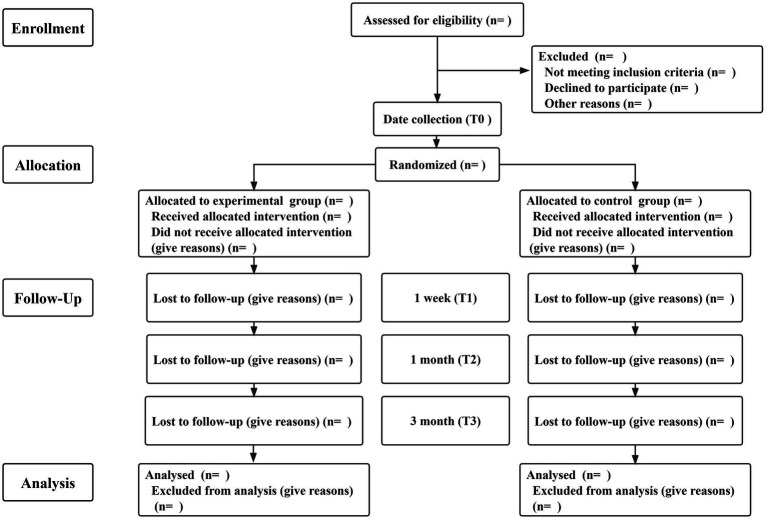
Methods: The trial will recruit 80 breast cancer families and randomly assign them to experimental and control groups in a 1:1 ratio. The control group will receive routine care, and the intervention group will receive a 6-week one-on-one online family resilience intervention based on the control group. Two groups of subjects will be assessed at baseline and at 1 week, 1 month, and 3 months after the intervention. The primary outcome is family resilience, and the secondary outcomes are coping style, social support, family disease burden, and levels of anxiety and depression.
Expected results: We hypothesized that after the intervention, the intervention group would have significantly higher levels of family resilience than the preintervention and control groups. In the intervention group, other aspects related to family resilience, such as family disease burden and anxiety and depression levels of patients and their families, were significantly alleviated, and disease coping and social support levels were improved accordingly.
Discussion: If the program works, it can help breast cancer families identify family strengths and resources to proactively address challenges so that families can successfully navigate the crisis and patient and family recovery can be facilitated. It can also provide a practical path for clinical workers to help breast cancer families adjust rationally.
Clinical trial registration: This study has been registered in the Chinese Clinical Trials Registry (Registration Number: http://www.chictr.org.cn/ChiCTR2100052108).
Keywords: breast cancer; family resilience; intervention; protocol; randomized control trail.
Copyright © 2022 Gao, Li, Chen, Song, Zhou, Zhang and Li.
Conflict of interest statement
The authors declare that the research was conducted in the absence of any commercial or financial relationships that could be construed as a potential conflict of interest.
Figures
References
-
- Allemani C., Matsuda T., Di Carlo V., Harewood R., Matz M., Niksic M., et al. (2018). Global surveillance of trends in cancer survival 2000-14 (CONCORD-3): analysis of individual records for 37 513 025 patients diagnosed with one of 18 cancers from 322 population-based registries in 71 countries. Lancet 391, 1023–1075. doi: 10.1016/S0140-6736(17)33326-3, PMID: - DOI - PMC - PubMed
-
- Boamah M. A., Adamu B., Mensah K. B., Dzomeku V. M., Agbadi P., Kusi G., et al. (2021). Exploring the social stressors and resources of husbands of women diagnosed with advanced breast cancer in their role as primary caregivers in Kumasi, Ghana. Suppor. Care Cancer 29, 2335–2345. doi: 10.1007/s00520-020-05716-2, PMID: - DOI - PubMed
-
- Chen C. M. (2015). The study of family cohesion, adaptability and potential factors of post OperativeBreast cancer patients during chemotherapy (Master’s thesis). Hangzhou: Zhejiang Chinese Medical University.
LinkOut - more resources
Full Text Sources
