Review
. 2022 Oct 12:10:968342.
doi: 10.3389/fbioe.2022.968342. eCollection 2022.

Microfluidics for long-term single-cell time-lapse microscopy: Advances and applications

Affiliations
Review

Microfluidics for long-term single-cell time-lapse microscopy: Advances and applications

Paige Allard et al. Front Bioeng Biotechnol. .

Abstract

Cells are inherently dynamic, whether they are responding to environmental conditions or simply at equilibrium, with biomolecules constantly being made and destroyed. Due to their small volumes, the chemical reactions inside cells are stochastic, such that genetically identical cells display heterogeneous behaviors and gene expression profiles. Studying these dynamic processes is challenging, but the development of microfluidic methods enabling the tracking of individual prokaryotic cells with microscopy over long time periods under controlled growth conditions has led to many discoveries. This review focuses on the recent developments of one such microfluidic device nicknamed the mother machine. We overview the original device design, experimental setup, and challenges associated with this platform. We then describe recent methods for analyzing experiments using automated image segmentation and tracking. We further discuss modifications to the experimental setup that allow for time-varying environmental control, replicating batch culture conditions, cell screening based on their dynamic behaviors, and to accommodate a variety of microbial species. Finally, this review highlights the discoveries enabled by this technology in diverse fields, such as cell-size control, genetic mutations, cellular aging, and synthetic biology.

Keywords: cell screening; cellular dynamics; microfluidics; phenotypic heterogeneity; single-cell analysis; time-lapse microscopy.


Conflict of interest statement

The authors declare that the research was conducted in the absence of any commercial or financial relationships that could be construed as a potential conflict of interest.

Figures
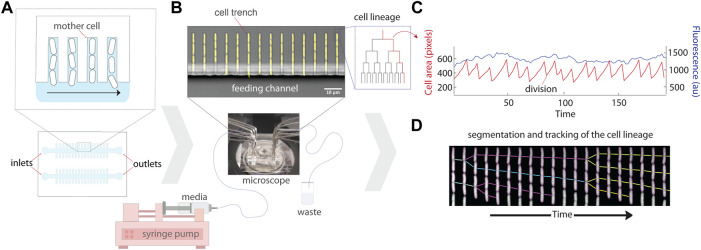
FIGURE 1
FIGURE 1
Schematic of the experimental setup for the mother machine microfluidic device and data analysis. (A) Schematic representation of the platform which traps single bacterial cells in trenches that are perpendicular to a larger feeding channel. Daughter cells are flushed out of the trenches with flowing media, while mothers remain trapped at the end of the cell trench. (B) A micrograph of the mother machine, with YFP fluorescence showing the cells superimposed on a brightfield image of the device. Media is pumped through the inlet into the main feeding channel by a syringe pump, and then exits through the outlet into a waste beaker. (C) The lineages of growing cells in the trenches can then be followed under precisely controlled environmental conditions using time-lapse microscopy. (D) An example kymograph of a growing cell imaged in fluorescence, illustrating the segmentation and tracking of the lineage.
FIGURE 2
FIGURE 2
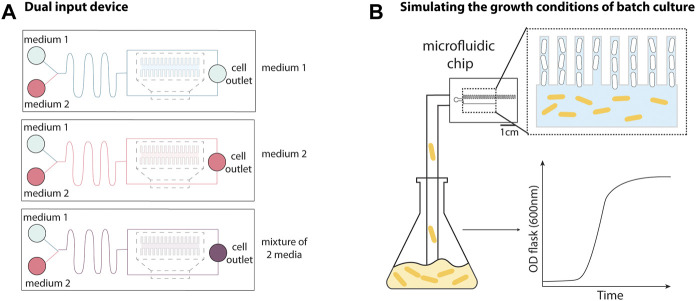
Adaptations to the mother machine architecture for improved fluidic and environmental control. (A) The dual input mother machine (DIMM) has two media inlets followed by a serpentine channel that fluid passes through prior to reaching cell trenches to facilitate mixing and/or rapid switching between different environmental conditions. Schematic representation inspired from Kaiser et al. (2018). (B) The growth curve platform allows batch culture to be fed into the device to recapitulate batch culture conditions. This allows for observation of cells entering and exiting the stationary phase by switching between nutrient depleted culture and fresh media. Schematic representation inspired from Bakshi et al. (2021).
FIGURE 3
FIGURE 3
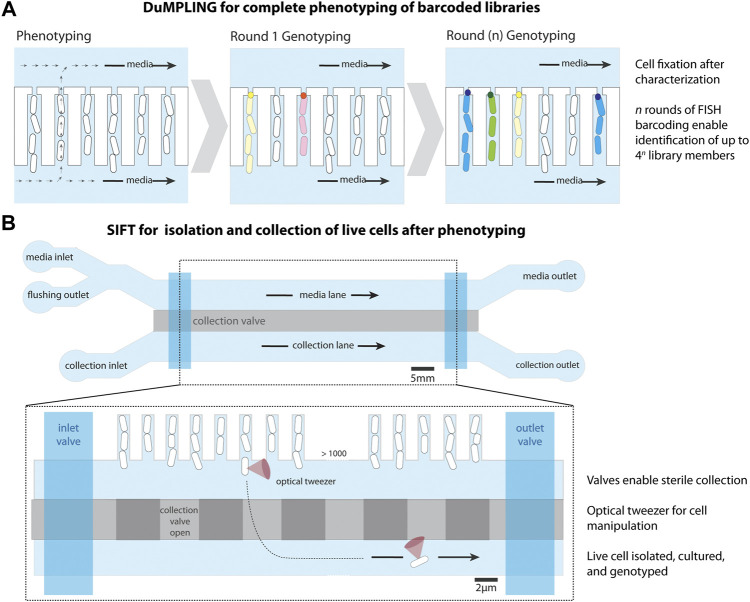
Modifications to the mother machine to enable cell screening. (A) Dynamic u-fluidic microscopy-based phenotyping of a library before in situ genotyping” (DuMPLING), has a 300 nm gap at the end of the cell trench, allowing media to flow through the cell channels. Rounds of barcoding through FISH enable genotyping of the pooled library. Schematic representation inspired from Lawson et al. (2017). (B) Single-cell isolation following time-lapse microscopy (SIFT) uses a modified microfluidic chip containing an additional lane for cell isolation below the cell trenches, separated by a pressurized valve system (collection valve). A second set of valves (inlet and outlet) allows for the lane to be sealed for inlet cleaning and restricting media flow after cell loading. An optical tweezer moves cells of interest from their trench to a collection trap, where they are isolated and removed from the device to be cultured and sequenced. Schematic representation inspired from Luro et al. (2020).
FIGURE 4
FIGURE 4
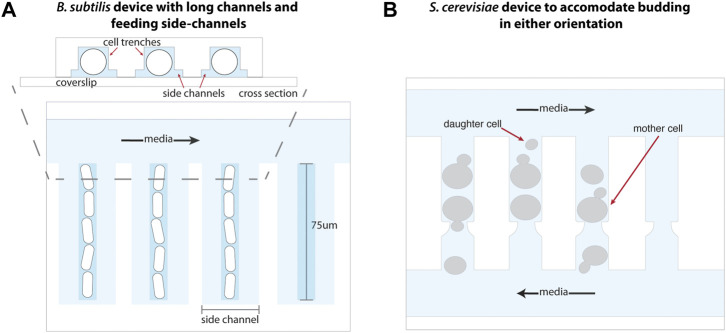
Adaptations to the mother machine architecture to optimize growth of other organisms. (A) The mother machine design adapted for B. subtilis growth includes elongated trenches 75 μm in length to accommodate its multicellular, chained state, as well as side channels that enable uniform nutrient availability throughout the trenches. Schematic representation inspired from Norman et al. (2013). (B) Maintaining an opening at either end of each cell trench in a modified MM device enables removal of S. cerevisiae daughter cells produced from budding in either orientation into perpendicular media channels. Schematic representation inspired from Li et al. (2017).

References

    1. Amir A. (2014). Cell size regulation in bacteria. Phys. Rev. Lett. 112, 208102. 10.1103/physrevlett.112.208102 - DOI
    1. Angert E. R. (2005). Alternatives to binary fission in bacteria. Nat. Rev. Microbiol. 3, 214–224. 10.1038/nrmicro1096 - DOI - PubMed
    1. Arnaouteli S., Bamford N. C., Stanley-Wall N. R., Kovács Á. T. (2021). Bacillus subtilis biofilm formation and social interactions. Nat. Rev. Microbiol. 19, 600–614. 10.1038/s41579-021-00540-9 - DOI - PubMed
    1. Aslam B., Wang W., Arshad M. I., Khurshid M., Muzammil S., Rasool M. H., et al. (2018). Antibiotic resistance: A rundown of a global crisis. Infect. Drug Resist. 11, 1645–1658. 10.2147/idr.s173867 - DOI - PMC - PubMed
    1. Bakshi S., Leoncini E., Baker C., Cañas-Duarte S. J., Okumus B., Paulsson J. (2021). Tracking bacterial lineages in complex and dynamic environments with applications for growth control and persistence. Nat. Microbiol. 6, 783–791. 10.1038/s41564-021-00900-4 - DOI - PMC - PubMed

LinkOut - more resources