


Clinical pharmacology and pharmacogenetics of prostaglandin analogues in glaucoma
- PMID: 36313286
- PMCID: PMC9596770
- DOI: 10.3389/fphar.2022.1015338
Clinical pharmacology and pharmacogenetics of prostaglandin analogues in glaucoma
Abstract
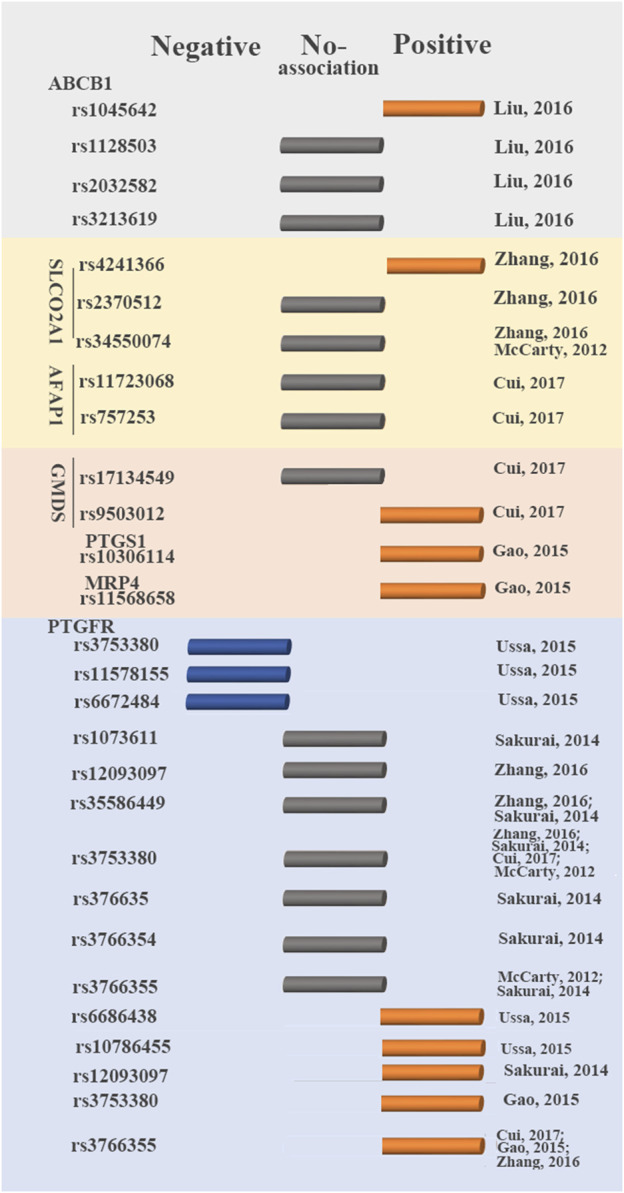
Glaucoma is the main cause of irreversible visual loss worldwide, and comprises a group of progressive, age-related, and chronic optic neuropathies. Prostaglandin analogs are considered a first-line treatment in the management of glaucoma and have the best efficacy in reducing intraocular pressure. When comparing these therapeutic agents between them, long-term therapy with 0.03% bimatoprost is the most effective followed by treatment with 0.005% latanoprost and 0.004% travoprost. The prevalence of adverse events is lower for latanoprost than for other prostaglandin analogs. However, some patients do not respond to the treatment with prostaglandin analogs (non-responders). Intraocular pressure-lowering efficacy differs significantly between individuals partly owing to genetic factors. Rs1045642 in ABCB1, rs4241366 in SLCO2A1, rs9503012 in GMDS, rs10306114 in PTGS1, rs11568658 in MRP4, rs10786455 and rs6686438 in PTGFR were reported to be positive with the response to prostaglandin analogs in patients with glaucoma. A negative association was found between single nucleotide polymorphisms of PTGFR (rs11578155 and rs6672484) and the response to prostaglandin analogs in patients with glaucoma. The current review is an analysis of the information relevant to prostaglandin analog treatments based on previous literatures. It describes in detail the clinical pharmacology and pharmacogenetics of drugs belonging to this therapeutical class to provide a sound pharmacological basis for their proper use in ophthalmological clinical practice.
Keywords: efficiency; glaucoma; neuropathy; pharmacogenetics; prostaglandin analogues; safety; visual loss.
Copyright © 2022 Zhou, Zhan and Wei.
Conflict of interest statement
The authors declare that the research was conducted in the absence of any commercial or financial relationships that could be construed as a potential conflict of interest.
Figures
References
-
- Aihara M., Lu F., Kawata H., Iwata A., Odani-Kawabata N., Shams N. K. (2020). Omidenepag isopropyl versus latanoprost in primary open-angle glaucoma and ocular hypertension: The phase 3 AYAME study. Am. J. Ophthalmol. 220, 53–63. 10.1016/j.ajo.2020.06.003 PubMed Abstract | 10.1016/j.ajo.2020.06.003 | Google Scholar - DOI - DOI - PubMed
-
- Aihara M. (2021). Prostanoid receptor agonists for glaucoma treatment. Jpn. J. Ophthalmol. 65 (5), 581–590. 10.1007/s10384-021-00844-6 PubMed Abstract | 10.1007/s10384-021-00844-6 | Google Scholar - DOI - DOI - PubMed
-
- Alm A., Grierson I., Shields M. B. (2008). Side effects associated with prostaglandin analog therapy. Surv. Ophthalmol. 53 (1), S93–S105. 10.1016/j.survophthal.2008.08.004 PubMed Abstract | 10.1016/j.survophthal.2008.08.004 | Google Scholar - DOI - DOI - PubMed
-
- Angeli A., Supuran C. T. (2019). Prostaglandin receptor agonists as antiglaucoma agents (a patent review 2013 - 2018). Expert Opin. Ther. Pat. 29 (10), 793–803. 10.1080/13543776.2019.1661992 PubMed Abstract | 10.1080/13543776.2019.1661992 | Google Scholar - DOI - DOI - PubMed
-
- Antonova M., Wienecke T., Olesen J., Ashina M. (2013). Prostaglandins in migraine: Update. Curr. Opin. Neurol. 26 (3), 269–275. 10.1097/WCO.0b013e328360864b PubMed Abstract | 10.1097/WCO.0b013e328360864b | Google Scholar - DOI - DOI - PubMed
Publication types
LinkOut - more resources
Full Text Sources
