Review
. 2022 Oct 12:12:999643.
doi: 10.3389/fonc.2022.999643. eCollection 2022.

Recent progress of the tumor microenvironmental metabolism in cervical cancer radioresistance

Affiliations
Review

Recent progress of the tumor microenvironmental metabolism in cervical cancer radioresistance

Junying Zhou et al. Front Oncol. .

Abstract

Radiotherapy is widely used as an indispensable treatment option for cervical cancer patients. However, radioresistance always occurs and has become a big obstacle to treatment efficacy. The reason for radioresistance is mainly attributed to the high repair ability of tumor cells that overcome the DNA damage caused by radiotherapy, and the increased self-healing ability of cancer stem cells (CSCs). Accumulating findings have demonstrated that the tumor microenvironment (TME) is closely related to cervical cancer radioresistance in many aspects, especially in the metabolic processes. In this review, we discuss radiotherapy in cervical cancer radioresistance, and focus on recent research progress of the TME metabolism that affects radioresistance in cervical cancer. Understanding the mechanism of metabolism in cervical cancer radioresistance may help identify useful therapeutic targets for developing novel therapy, overcome radioresistance and improve the efficacy of radiotherapy in clinics and quality of life of patients.

Keywords: cervical cancer; metabolism; radioresistance; radiotherapy; tumor microenvironment.


Conflict of interest statement

The authors declare that the research was conducted in the absence of any commercial or financial relationships that could be construed as a potential conflict of interest.

Figures
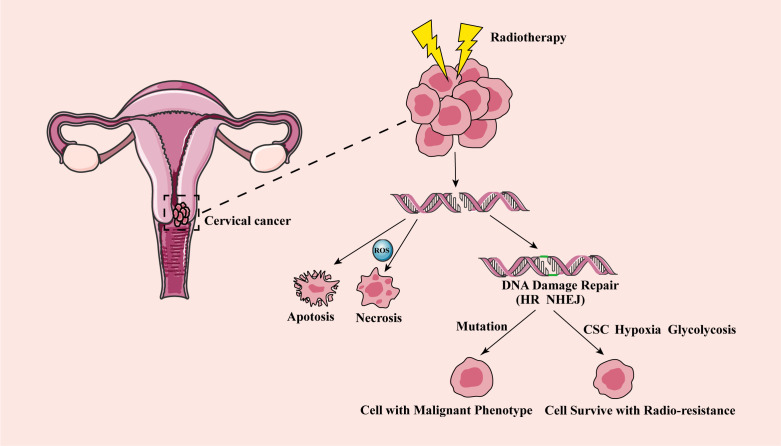
Figure 1
Figure 1
The mechanism of cervical cancer radioresistance after radiotherapy. After RT, DNA double strand breaks in cervical cancer cells, and some cancer cells show apoptosis and necrosis, reaching the effect of RT. Other fraction of cancer cells has DNA damage repair (including HR and NHEJ). The wrong repair path leads to the accumulation of acquired mutations, and tumor aggressivity and recurrence, while the correct repair leads to cell survival and radioresistance. CSC, cancer stem cell; HR, homologous recombination; NHEJ, non-homologous end joining; RT, radiotherapy.
Figure 2
Figure 2
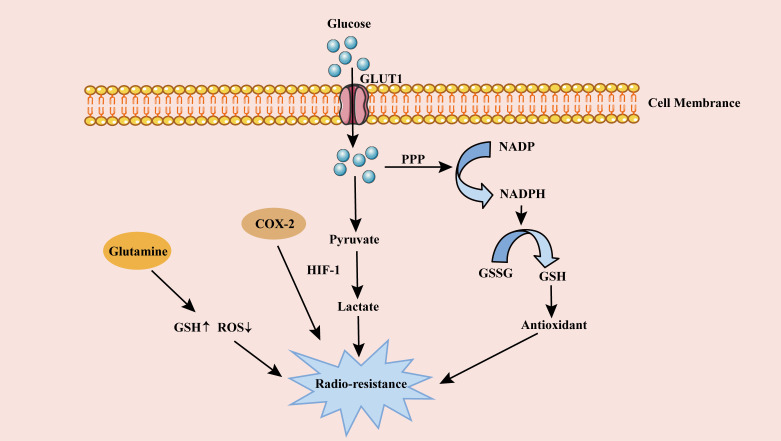
The role of metabolism on cervical cancer radioresistance. Glucose is transported into cells through GLUT1 for glycolysis and produces a large amount of lactic acid, enhancing cervical cancer radioresistance. Glucose in cells also produces GSH through PPP pathway. The antioxidant GSH weakens DSB after RT, resulting in radioresistance of cervical cancer cells. High expression of COX-2 in lipid metabolism and Glutamine in amino acid metabolism also contribute to cervical cancer radioresistance. GLUT1, glucose transporter 1; PPP, pentose phosphate pathway; ROS, reactive oxygen species; HIF-1, hypoxia-inducible factor 1; GSSG, oxidized glutathione; GSH, glutathione; RT, radiotherapy.

References

    1. Arbyn M, Weiderpass E, Bruni L, de Sanjosé S, Saraiya M, Ferlay J, et al. Estimates of incidence and mortality of cervical cancer in 2018: A worldwide analysis. Lancet Glob Health (2020) 8(2):e191–203. doi: 10.1016/S2214-109X(19)30482-6 - DOI - PMC - PubMed
    1. Mezei AK, Armstrong HL, Pedersen HN, Campos NG, Mitchell SM, Sekikubo M, et al. Cost-effectiveness of cervical cancer screening methods in low- and middle-income countries: A systematic review. Int J Cancer (2017) 141(3):437–46. doi: 10.1002/ijc.30695 - DOI - PubMed
    1. Gupta SM, Mania-Pramanik J. Molecular mechanisms in progression of HPV-associated cervical carcinogenesis. J BioMed Sci (2019) 26(1):28. doi: 10.1186/s12929-019-0520-2 - DOI - PMC - PubMed
    1. Ngune I, Kalembo F, Loessl B, Kivuti-Bitok. LW. Biopsychosocial risk factors and knowledge of cervical cancer among young women: A case study from Kenya to inform HPV prevention in Sub-Saharan Africa. PloS One (2020) 15(8):e0237745. doi: 10.1371/journal.pone.0237745 - DOI - PMC - PubMed
    1. Hu K, Wang W, Liu X, Meng Q, Zhang. F. Comparison of treatment outcomes between squamous cell carcinoma and adenocarcinoma of cervix after definitive radiotherapy or concurrent chemoradiotherapy. Radiat Oncol (2018) 13(1):249. doi: 10.1186/s13014-018-1197-5 - DOI - PMC - PubMed

LinkOut - more resources