


Hypothalamic Functional Connectivity and Apathy in People with Alzheimer's Disease and Cognitively Normal Healthy Controls
- PMID: 36314209
- PMCID: PMC10064487
- DOI: 10.3233/JAD-220708
Hypothalamic Functional Connectivity and Apathy in People with Alzheimer's Disease and Cognitively Normal Healthy Controls
Abstract
Background: Earlier studies have described the neural markers of apathy in Alzheimer's disease (AD) and mild cognitive impairment (MCI), but few focused on the motivation circuits. Here, we targeted hypothalamus, a hub of the motivation circuit.
Objective: To examine hypothalamic resting state functional connectivity (rsFC) in relation to apathy.
Methods: We performed whole-brain regression of hypothalamic rsFC against Apathy Evaluation Scale (AES) total score and behavioral, cognitive, and emotional subscores in 29 patients with AD/MCI and 28 healthy controls (HC), controlling for age, sex, education, cognitive status, and depression. We evaluated the results at a corrected threshold and employed path analyses to assess possible interaction between hypothalamic rsFCs, apathy and depression/memory. Finally, we re-examined the findings in a subsample of amyloid-β-verified AD.
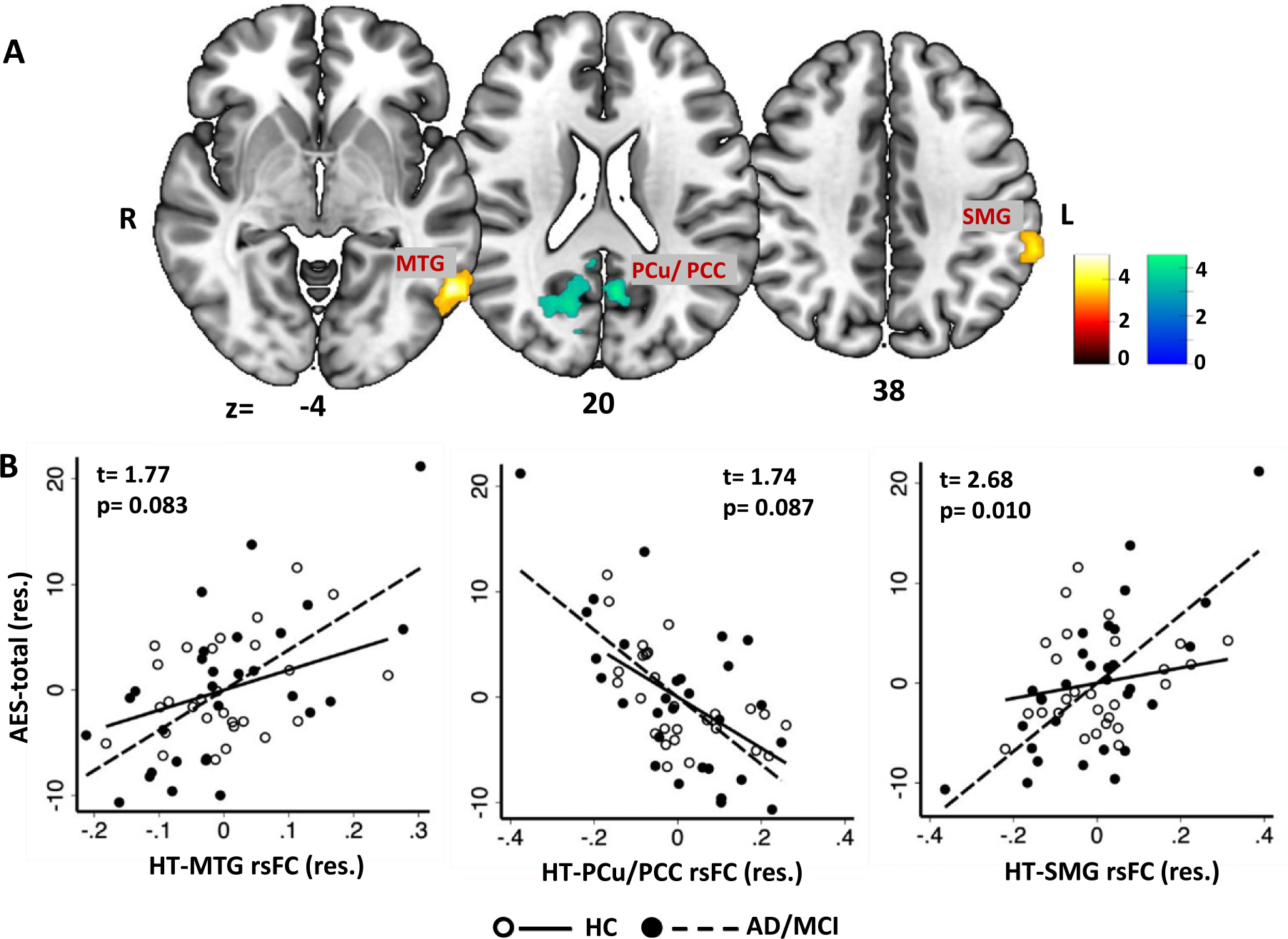
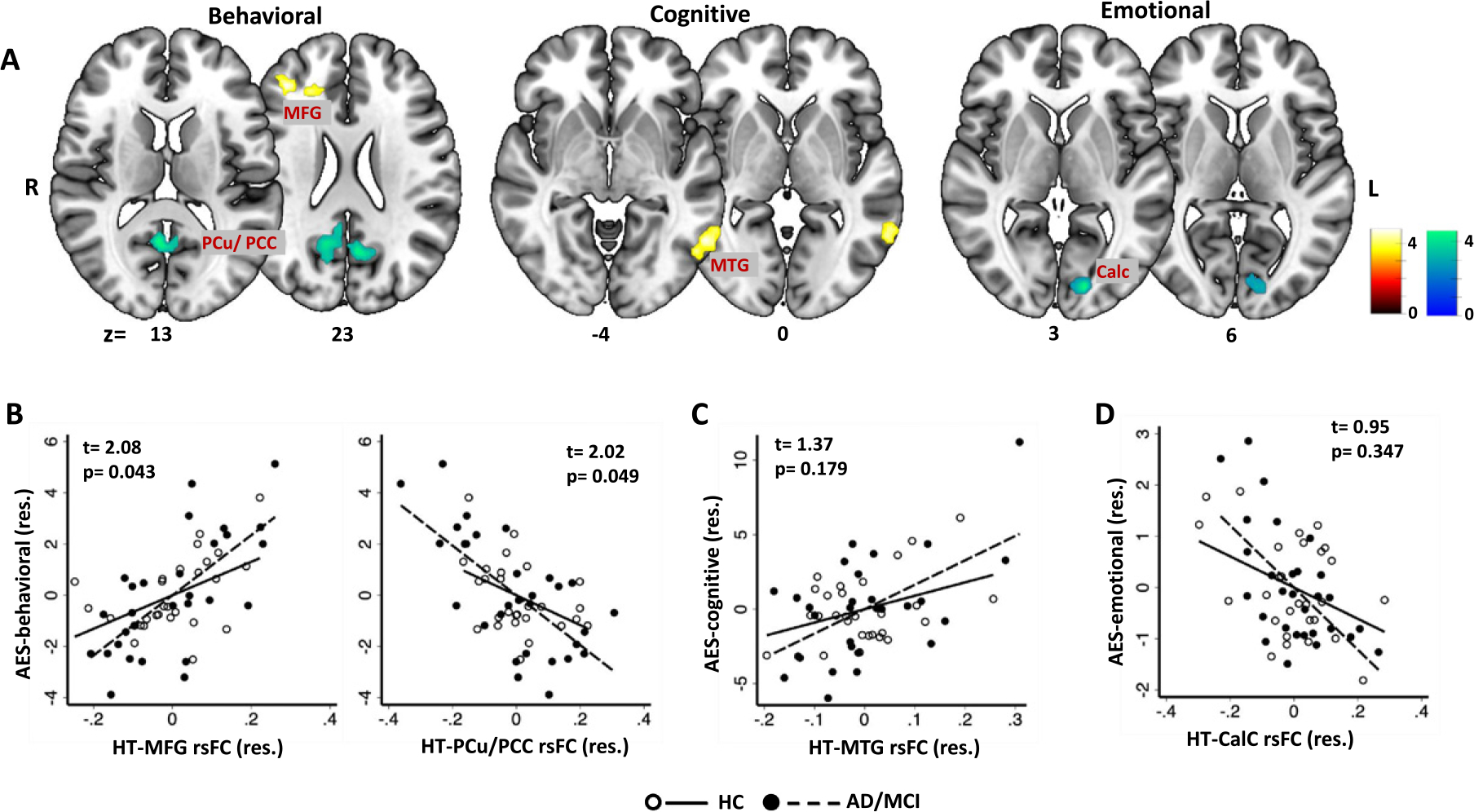
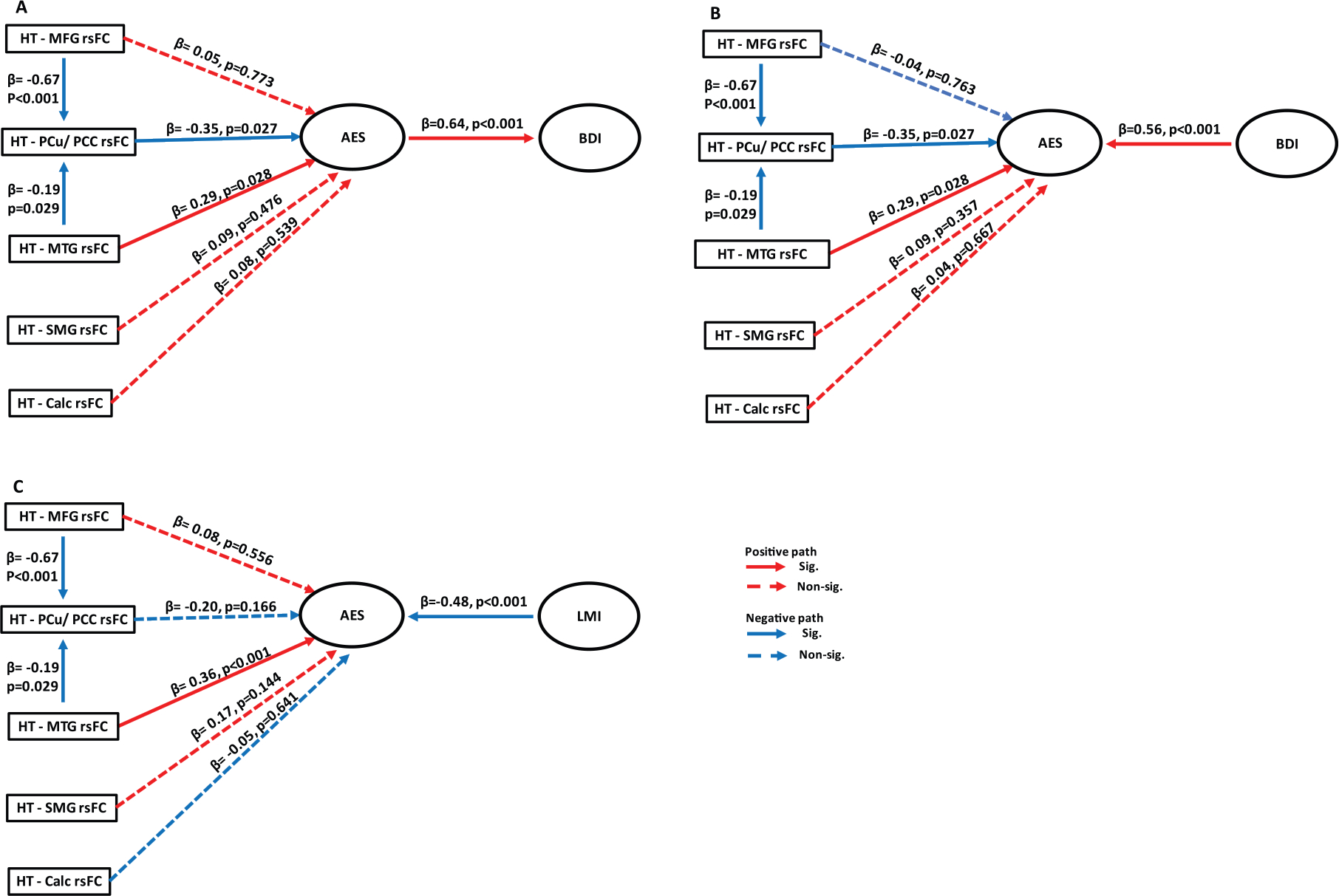
Results: AES total score correlated negatively with hypothalamic precuneus (PCu)/posterior cingulate cortex (PCC) and positively with left middle temporal gyrus (MTG) and supramarginal gyrus rsFCs. Behavioral subscore correlated negatively with hypothalamic PCu/PCC and positively with middle frontal gyrus rsFC. Cognitive subscore correlated positively with hypothalamic MTG rsFC. Emotional subscore correlated negatively with hypothalamic calcarine cortex rsFC. In path analyses, hypothalamic-PCu/PCC rsFC negatively modulated apathy and, in turn, depression. The model where hypothalamic MTG rsFC and memory independently modulated apathy also showed a good fit. The findings of diminished hypothalamic-PCu/PCC rsFC in relation to apathy and, in turn, depression were confirmed in amyloid-verified AD.
Conclusion: The findings together support a role of altered hypothalamic connectivity in relation to apathy and depression, and modulation of apathy by memory dysfunction.
Keywords: Alzheimer’s disease; apathy; depression; hypothalamus; memory; resting state functional connectivity.
Figures
References
-
- Mortby ME, Adler L, Agüera-Ortiz L, Bateman DR, Brodaty H, Cantillon M, Geda YE, Ismail Z, Lanctôt KL, Marshall GA, Padala PR, Politis A, Rosenberg PB, Siarkos K, Sultzer DL, Theleritis C, ISTAART NPS PIA (2022) Apathy as a treatment target in Alzheimer’s disease: Implications for clinical trials. Am J Geriatr Psychiatry 30, 119–147. - PubMed
-
- Levy R, Dubois B (2006) Apathy and the functional anatomy of the prefrontal cortex-basal ganglia circuits. Cereb Cortex 16, 916–28. - PubMed
-
- David R, Koulibaly M, Benoit M, Garcia R, Caci H, Darcourt J, Robert P (2008) Striatal dopamine transporter levels correlate with apathy in neurodegenerative diseases A SPECT study with partial volume effect correction. Clin Neurol Neurosurg 110, 19–24. - PubMed
Publication types
MeSH terms
Substances
Grants and funding
LinkOut - more resources
Full Text Sources
Medical
