


Somatic inactivation of breast cancer predisposition genes in tumors associated with pathogenic germline variants
- PMID: 36315097
- PMCID: PMC9905963
- DOI: 10.1093/jnci/djac196
Somatic inactivation of breast cancer predisposition genes in tumors associated with pathogenic germline variants
Abstract
Background: Breast cancers (BCs) that arise in individuals heterozygous for a germline pathogenic variant in a susceptibility gene, such as BRCA1 and BRCA2, PALB2, and RAD51C, have been shown to exhibit biallelic loss in the respective genes and be associated with triple-negative breast cancer (TNBC) and distinctive somatic mutational signatures. Tumor sequencing thus presents an orthogonal approach to assess the role of candidate genes in BC development.
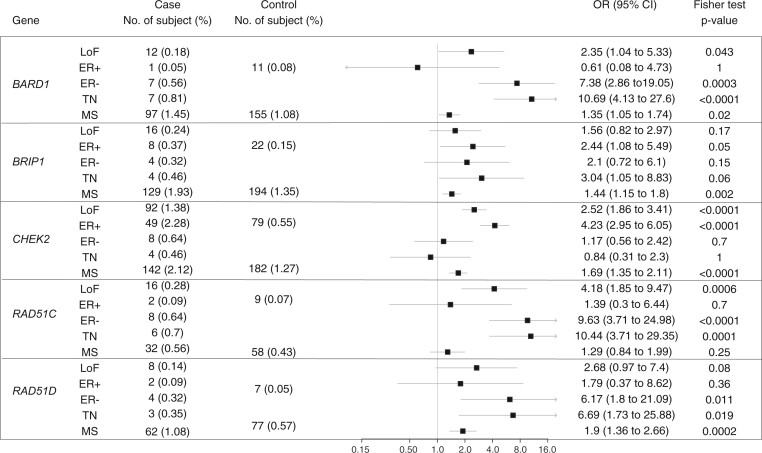
Methods: Exome sequencing was performed on paired normal-breast tumor DNA from 124 carriers of germline loss-of-function (LoF) or missense variant carriers in 15 known and candidate BC predisposition genes identified in the BEACCON case-control study. Biallelic inactivation and association with tumor genome features including mutational signatures and homologous recombination deficiency (HRD) score were investigated.
Results: BARD1-carrying TNBC (4 of 5) displayed biallelic loss and associated high HRD scores and mutational signature 3, as did a RAD51D-carrying TNBC and ovarian cancer. Biallelic loss was less frequent in BRIP1 BCs (4 of 13) and had low HRD scores. In contrast to other established BC genes, BCs from carriers of CHEK2 LoF (6 of 17) or missense (2 of 20) variant had low rates of biallelic loss. Exploratory analysis of BC from carriers of LoF variants in candidate genes such as BLM, FANCM, PARP2, and RAD50 found little evidence of biallelic inactivation.
Conclusions: BARD1 and RAD51D behave as classic BRCA-like predisposition genes with biallelic inactivation, but this was not observed for any of the candidate genes. However, as demonstrated for CHEK2, the absence of biallelic inactivation does not provide definitive evidence against the gene's involvement in BC predisposition.
© The Author(s) 2022. Published by Oxford University Press.
Figures
References
-
- Narod SA, Foulkes WD.. BRCA1 and BRCA2: 1994 and beyond. Nat Rev Cancer. 2004;4(9):665-676. - PubMed
Publication types
MeSH terms
Substances
LinkOut - more resources
Full Text Sources
Medical
Research Materials
Miscellaneous
