. 2022 Oct 31;12(1):18282.
doi: 10.1038/s41598-022-22426-3.

Hypothermia and heart rate variability in a healthy newborn piglet model

Affiliations

Hypothermia and heart rate variability in a healthy newborn piglet model

Mette Vestergård Pedersen et al. Sci Rep. .

Abstract

Decreased heart rate variability (HRV) may be a biomarker of brain injury severity in neonatal hypoxic-ischemic encephalopathy for which therapeutic hypothermia is standard treatment. While therapeutic hypothermia may influence the degree of brain injury; hypothermia may also affect HRV per se and obscure a potential association between HRV and hypoxic-ischemic encephalopathy. Previous results are conflicting. This study aimed to investigate the effect of hypothermia on HRV in healthy, anaesthetised, newborn piglets. Six healthy newborn piglets were anaesthetised. Three piglets were first kept normothermic (38.5-39.0 °C) for 3 h, then exposed to hypothermia (33.5-34.5 °C) for 3 h. Three piglets were first exposed to hypothermia for 3 h, then rewarmed to normothermia for 3 h. Temperature and ECG were recorded continuously. HRV was calculated from the ECG in 5 min epochs and included time domain and frequency domain variables. The HRV variables were compared between hypothermia and normothermia. All assessed HRV variables were higher during hypothermia compared to normothermia. Heart rate was lower during hypothermia compared to normothermia and all HRV variables correlated with heart rate. Hypothermia was associated with an increase in HRV; this could be mediated by bradycardia during hypothermia.


Conflict of interest statement

The authors declare no competing interests.

Figures

Figure 1
Figure 1
HRV time domain variables and heart rate in six healthy, anaesthetised, newborn piglets exposed to 3 h of normothermia (38.5–39.5 °C) and 3 h of hypothermia (33.5–34.0 °C). Data are presented as mean with SD of 3 h of normothermia (NT) and mean with SD of 3 h of hypothermia (HT). P-value comparing NT with HT with paired t-test. NT: Normothermia; HT: Hypothermia; SDNN: Standard deviation of normal-to-normal interval; RMSSD: Root mean square of successive differences; logVLF: log-transformed power in the very low frequencies; logLF: log-transformed power in the low frequencies; logHF: log-transformed power in the high frequencies; HR: heart rate.
Figure 2
Figure 2
HRV frequency domain variables in six healthy, anaesthetised, newborn piglets exposed to 3 h of normothermia (38.5–39.5 °C) and 3 h of hypothermia (33.5–34.0 °C). Data are presented as mean with SD of 3 h of normothermia (NT) and mean with SD of 3 h of hypothermia (HT). P-value comparing NT with HT with paired t-test. NT: Normothermia; HT: Hypothermia; SDNN: Standard deviation of normal-to-normal interval; RMSSD: Root mean square of successive differences; logVLF: log-transformed power in the very low frequencies; logLF: log-transformed power in the low frequencies; logHF: log-transformed power in the high frequencies; HR: heart rate.
Figure 3
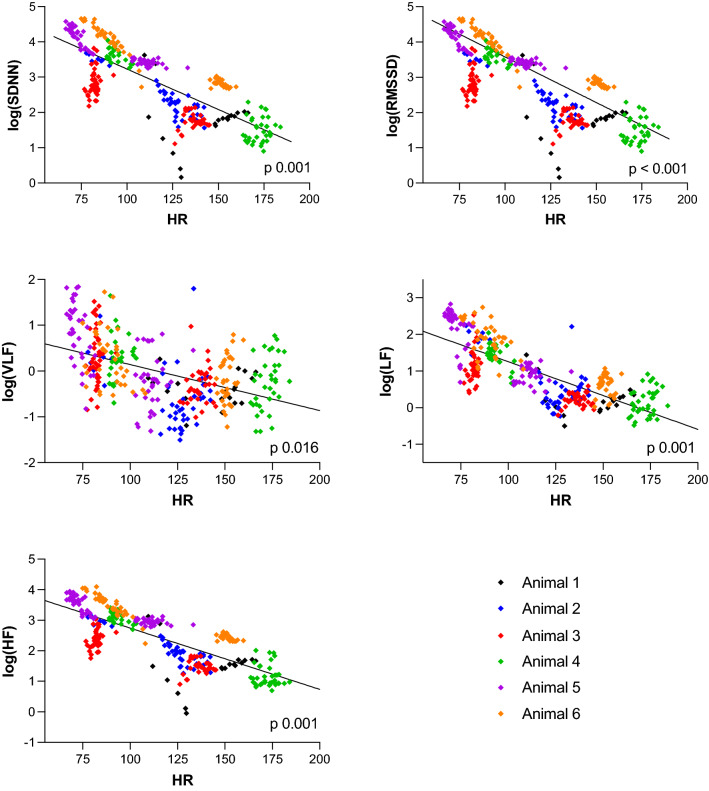
Figure 3
Clustered linear regression of heart rate and HRV measures in six healthy, anaesthetised, newborn piglets exposed to 3 h of normothermia (38.5–39.5 °C) and 3 h of hypothermia (33.5–34.0 °C). SDNN: Standard deviation of normal-to-normal interval; RMSSD: Root mean square of successive differences; log(VLF): log-transformed power in the very low frequencies; log(LF): log-transformed power in the low frequencies; log(HF): log-transformed power in the high frequencies; HR: heart rate.

References

    1. Lee AC, et al. Intrapartum-related neonatal encephalopathy incidence and impairment at regional and global levels for 2010 with trends from 1990. Pediatr. Res. 2013;74(Suppl 1):50–72. doi: 10.1038/pr.2013.206. - DOI - PMC - PubMed
    1. Bennet L, Booth L, Gunn AJ. Potential biomarkers for hypoxic-ischemic encephalopathy. Semin. Fetal Neonatal. Med. 2010;15:253–260. doi: 10.1016/j.siny.2010.05.007. - DOI - PMC - PubMed
    1. Camm AJ, et al. Heart rate variability: Standards of measurement, physiological interpretation and clinical use. Task force of the European society of cardiology and the North American society of pacing and electrophysiology. Circulation. 1996;93:1043–1065. doi: 10.1161/01.CIR.93.5.1043. - DOI - PubMed
    1. Andersen M, Andelius TCK, Pedersen MV, Kyng KJ, Henriksen TB. Severity of hypoxic ischemic encephalopathy and heart rate variability in neonates: A systematic review. BMC Pediatr. 2019;19:242. doi: 10.1186/s12887-019-1603-7. - DOI - PMC - PubMed
    1. Oliveira V, et al. Prognostic accuracy of heart rate variability analysis in neonatal encephalopathy: A systematic review. Neonatology. 2019;115:59–67. doi: 10.1159/000493002. - DOI - PubMed