


The COVID-19 pandemic's intersectional impact on work life, home life and wellbeing: an exploratory mixed-methods analysis of Georgia women's experiences during the pandemic
- PMID: 36316668
- PMCID: PMC9619013
- DOI: 10.1186/s12889-022-14285-4
The COVID-19 pandemic's intersectional impact on work life, home life and wellbeing: an exploratory mixed-methods analysis of Georgia women's experiences during the pandemic
Abstract
Background: Women have been especially impacted by the COVID-19 pandemic. This exploratory study aimed to characterize women's adverse experiences related to their work, home lives, and wellbeing during the height of the COVID-19 pandemic and to describe demographic differences of those lived experiences.
Methods: Using the validated Epidemic-Pandemic Impacts Inventory, we collected data from reproductive-aged women in the state of Georgia about their exposure to adverse events during the pandemic. A latent class analysis (LCA) was performed to identify subgroups of women reporting similar adverse experiences and describe their sociodemographic characteristics. An optional open-ended question yielded qualitative data that were analyzed thematically and merged with subgroup findings. Data were collected from September 2020 to January 2021.
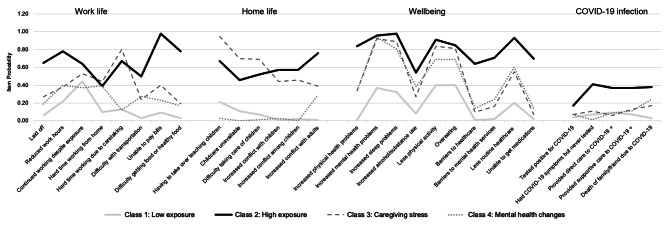
Results: 423 individuals aged 18-49 completed the survey with 314 (74.2%) providing qualitative responses. The LCA yielded 4 subgroups: (1) a "low exposure" subgroup (n = 123, 29.1%) with relatively low probability of adverse experiences across domains (e.g. financial insecurity, health challenges, barriers to access to healthcare, intimate partner violence (IPV)); (2) a "high exposure" subgroup (n = 46, 10.9%) with high probability of experiencing multiple adversities across domains including the loss of loved ones to COVID-19; (3) a "caregiving stress" subgroup (n = 104, 24.6%) with high probability of experiencing challenges with home and work life including increased partner conflict; and (4) a "mental health changes" subgroup (n = 150, 35.5%) characterized by relatively low probability of adverse experiences but high probability of negative changes in mental health and lifestyle. Individuals in subgroups 1 and 4, which had low probabilities of adverse experiences, were significantly more likely to be non-Hispanic white. Individuals in subgroup 2 were more likely to identify with a sexual or racial/ethnic minority population. Inductive coding of qualitative data yielded themes such as stress, mental health, financial impact, and adaptation/resilience, providing context for pandemic-related adversity.
Conclusion: Though many individuals in our sample experienced hardship, minority populations were unequally impacted by pandemic-related adversity in work life, home life, and wellbeing. Recovery and future emergency preparedness efforts in Georgia must incorporate support mechanisms for mental health and IPV, focusing especially on the intersectional needs of racial, ethnic, and sexual minorities.
Keywords: Adverse experience; COVID-19; Exposure; Female; Intimate partner violence; Latent class analysis; Mental health; Mixed methods; Stress.
© 2022. The Author(s).
Conflict of interest statement
The authors declare that they have no competing interests.
Figures

References
-
- Johns Hopkins University & Medicine. Coronavirus Resource Center 2021 [Available from: https://coronavirus.jhu.edu/map.html.
-
- Bean M. States ranked by COVID-19 death rates: Oct. 29: Becker’s Healthcare; 2021 [Available from: https://www.beckershospitalreview.com/public-health/us-coronavirus-death....
-
- National Public Radio. Harvard TH. Chan School of Public Health, Robert Wood Johnson Foundation. The Impact of Coronavirus on Households in Major US Cities 2020 [updated September. Available from: https://www.rwjf.org/en/library/research/2020/09/the-impact-of-coronavir....
-
- Madgavkar A, White O, Krishnan M, Mahajan D, Azcue X. COVID-19 and gender equality: Countering the regressive effects. 2020 Jul 15.
Publication types
MeSH terms
LinkOut - more resources
Full Text Sources
Medical
Research Materials
