


Efficacy of domperidone plus renal diet in slowing the progression of chronic kidney disease in dogs with leishmaniosis
- PMID: 36316751
- PMCID: PMC9620618
- DOI: 10.1186/s13071-022-05537-8
Efficacy of domperidone plus renal diet in slowing the progression of chronic kidney disease in dogs with leishmaniosis
Abstract
Background: Chronic kidney disease (CKD) represents the main cause of mortality in dogs with leishmaniosis. Domperidone has recently been reported to improve kidney function in leishmaniotic dogs affected by CKD. Serum symmetric dimethylarginine (sSDMA) has also been shown to be a useful biomarker for earlier detection of decreased kidney function when compared to serum creatinine (sCr). This study aimed to assess the efficacy of domperidone plus renal diet in slowing the progression of nephropathy in leishmaniotic dogs with CKD, evaluating sSDMA and sCr as markers of kidney function.
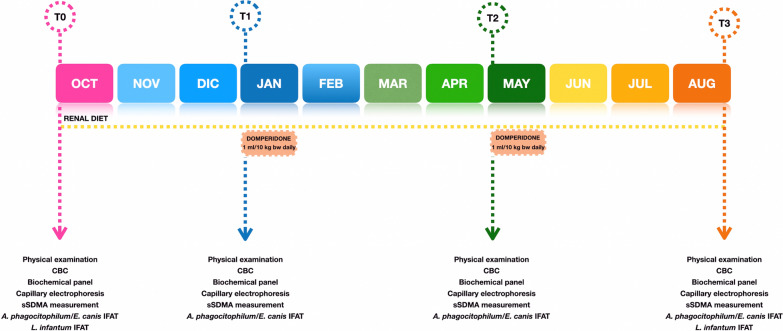
Methods: This study was a therapeutic, prospective, randomized, controlled, 11-month-long field trial. Dogs were recruited if classified as "exposed" to or "infected" with Leishmania infantum and affected by CKD at early stages. After enrolment (T0), dogs were randomized into groups T (treatment) and C (control). All dogs were fed a renal diet and then followed up at 90 (T1), 210 (T2), and 330 (T3) days after inclusion in the study. At T1 and T2, dogs in group T received an oral suspension of domperidone (1 ml/10 kg once a day for up to 28 days).
Results: Twenty-two dogs (i.e., n = 12 in group T and n = 10 in group C) completed the study. At T0, the entire population of enrolled dogs presented a mean sSDMA value of 16.5 ± 3.4 μg/dl. At T1 (i.e., after 3 months of renal diet), sSDMA was significantly decreased in both groups, with an sSDMA of 13.1 ± 4.4 μg/dl for the entire population involved. From T1 to T3, sSDMA gradually increased in group C, while remaining stable in group T, which continued to show a significantly lower value of sSDMA at T3 than at T0. Regarding sCr, at T0 and T1, the mean values of the entire population of dogs were 1.1 ± 0.3 and 1.0 ± 0.4 mg/dl, respectively, with no statistical differences between groups T and C. In group T, sCr decreased significantly from T0 to T1, while returning at T3 to values similar to T0.
Conclusions: In this study, domperidone plus renal diet reduced the progression of kidney disease in leishmaniotic dogs affected by CKD.
Keywords: Canine; Chronic kidney disease; Leishmania infantum; Serum creatinine; sSDMA.
© 2022. The Author(s).
Conflict of interest statement
The authors declare that they have no competing interests.
Figures
References
Publication types
MeSH terms
Substances
LinkOut - more resources
Full Text Sources
Medical
