


SulfAtlas, the sulfatase database: state of the art and new developments
- PMID: 36318251
- PMCID: PMC9825549
- DOI: 10.1093/nar/gkac977
SulfAtlas, the sulfatase database: state of the art and new developments
Abstract
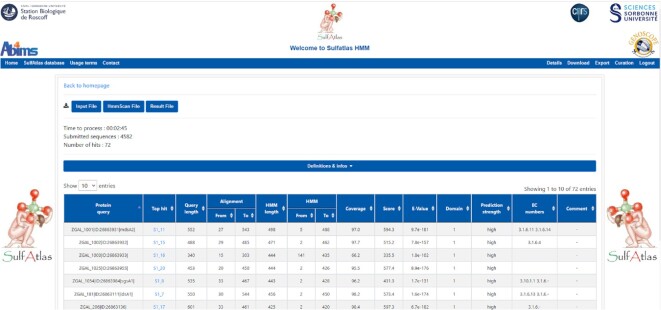
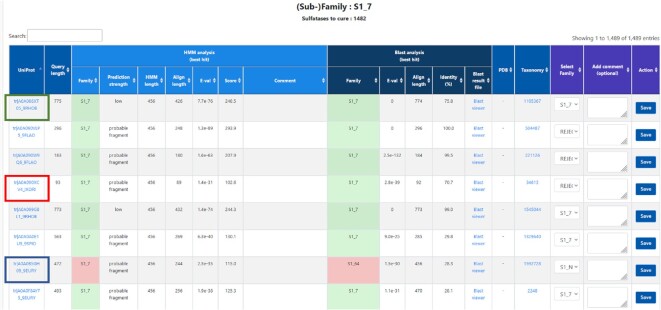
SulfAtlas (https://sulfatlas.sb-roscoff.fr/) is a knowledge-based resource dedicated to a sequence-based classification of sulfatases. Currently four sulfatase families exist (S1-S4) and the largest family (S1, formylglycine-dependent sulfatases) is divided into subfamilies by a phylogenetic approach, each subfamily corresponding to either a single characterized specificity (or few specificities in some cases) or to unknown substrates. Sequences are linked to their biochemical and structural information according to an expert scrutiny of the available literature. Database browsing was initially made possible both through a keyword search engine and a specific sequence similarity (BLAST) server. In this article, we will briefly summarize the experimental progresses in the sulfatase field in the last 6 years. To improve and speed up the (sub)family assignment of sulfatases in (meta)genomic data, we have developed a new, freely-accessible search engine using Hidden Markov model (HMM) for each (sub)family. This new tool (SulfAtlas HMM) is also a key part of the internal pipeline used to regularly update the database. SulfAtlas resource has indeed significantly grown since its creation in 2016, from 4550 sequences to 162 430 sequences in August 2022.
© The Author(s) 2022. Published by Oxford University Press on behalf of Nucleic Acids Research.
Figures
References
-
- Hanson S.R., Best M.D., Wong C.H.. Sulfatases: structure, mechanism, biological activity, inhibition, and synthetic utility. Angew. Chem. Int. Ed. Engl. 2004; 43:5736–5763. - PubMed
-
- Kahnert A., Kertesz M.A.. Characterization of a sulfur-regulated oxygenative alkylsulfatase from Pseudomonas putida S-313. J. Biol. Chem. 2000; 275:31661–31667. - PubMed
-
- Davison J., Brunel F., Phanopoulos A., Prozzi D., Terpstra P.. Cloning and sequencing of pseudomonas genes determining sodium dodecyl sulfate biodegradation. Gene. 1992; 114:19–24. - PubMed
Publication types
MeSH terms
Substances
LinkOut - more resources
Full Text Sources
Research Materials
