


Facial palsy as a manifestation of COVID-19: A systematic review of cases
- PMID: 36320650
- PMCID: PMC9616168
- DOI: 10.1002/hsr2.887
Facial palsy as a manifestation of COVID-19: A systematic review of cases
Abstract
Background and aims: Facial palsy is a rare complication of the COVID-19 infection. Herein, we conducted a systematic review of all published cases of facial palsy post-COVID-19 infection in an attempt to educate the general population and medical practitioners regarding the likely occurrence of facial palsy in COVID-19 patients, its detection, effective treatment plan, and prognosis of the condition.
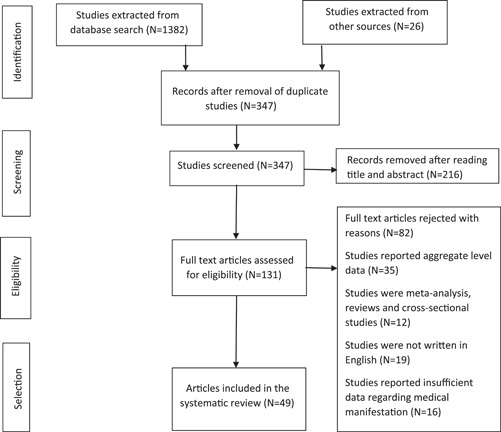
Methods: We searched PubMed, Google Scholar, and Directory of Open Access Journals (DOAJ) from December 1, 2019 to September 21, 2021.
Results: We included 49 studies bearing accounts of 75 cases who had facial palsy. The mean age of patients was 42.9 ± 19.59 years, with a male-to-female ratio of 8:7. The majority of the cases were reported from Brazil (n = 14), USA (n = 9), Turkey (n = 9), and Spain (n = 9). Noticeably, 30.14% of COVID-19 patients were diagnosed with Guillain-Barré syndrome. In total, 22.97% of patients complained of bilateral facial paralysis (n = 17), whereas ipsilateral paralysis was observed in 77.03% (n = 57). These were common complaints of Lagophthalmos, otalgia, facial drooping, dysarthria, and compromised forehead wrinkling. The treatment regimen mainly included the use of corticosteroids (n = 51) (69.86%), antivirals (n = 23) (31.51%), IVIG (n = 18) (24.66%), antibiotics (n = 13) (17.81%), antiretroviral (n = 9) (12.33%), and antimalarial (n = 8) (10.96%) medications. In all, 35.62% of patients (n = 26) adhered to a combination of antiviral and corticosteroid-based therapy. Positive treatment outcomes were observed in 83.58% (n = 56) of cases. In contrast, 10 patients (14.93%) showed nonsignificant recovery, out of which 3 (4.48%) died from the disease.
Conclusion: The association of facial palsy with COVID-19 is controversial and therefore requires further investigation and published work to confirm a causal relationship. However, physicians should not overlook the likelihood of facial palsy post-COVID-19 infection and treat it accordingly.
Keywords: COVID‐19; SARS‐CoV‐2; facial palsy; neurological symptoms; systematic review.
© 2022 The Authors. Health Science Reports published by Wiley Periodicals LLC.
Conflict of interest statement
Abdulqadir J. Nashwan is an Editorial Board member of Health Science Reports and co‐author of this article. He is excluded from editorial decision‐making related to the acceptance of this article for publication in the journal. The remaining authors declare no conflict of interest.
Figures
References
-
- World Health Organization . Archived: WHO Timeline – COVID‐19. 2020. https://www.who.int/news/item/27-04-2020-who-timeline---covid-19
-
- WHO Coronavirus (COVID‐19) Dashboard. WHO coronavirus (COVID‐19) Dashboard with Vaccination Data. World Health Organization; 2022. https://covid19.who.int/
-
- Tsang HF, Chan LWC, Cho WCS, et al. An update on COVID‐19 pandemic: the epidemiology, pathogenesis, prevention and treatment strategies. Expert Rev Anti Infect Ther. 2021;19(7):877‐888. https://www.tandfonline.com/action/journalInformation?journalCode=ierz20 - PubMed
-
- Respiratory management of COVID 19 – physiopedia. Physiopedia. Accessed March 1, 2022. https://www.physio-pedia.com/Respiratory_Management_of_COVID_19
-
- Soy M, Atagündüz P, Atagündüz I, Sucak GT. Hemophagocytic lymphohistiocytosis: a review inspired by the COVID‐19 pandemic. Rheumatol Int. 2020;41(1):7‐18. https://pubmed.ncbi.nlm.nih.gov/32588191/ - PMC - PubMed
LinkOut - more resources
Full Text Sources
Miscellaneous
